An Empty Booth in Austin
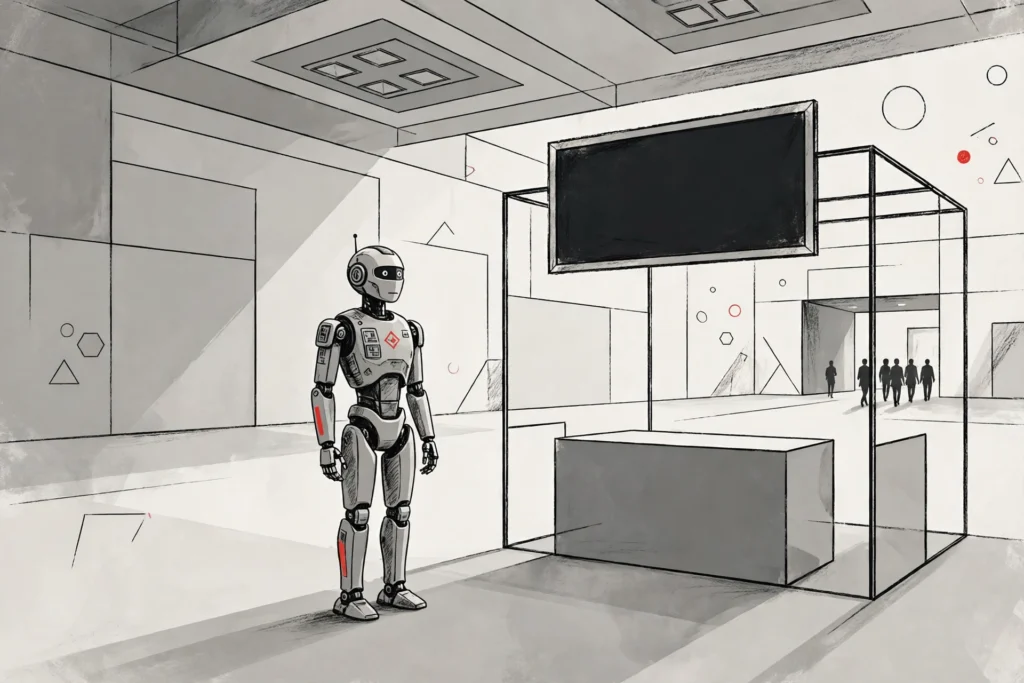
The booth was booked, the conference floor was crowded, and the people who build machines that move were all in one place. But when a reporter from Fortune walked over to OpenAI’s spot at the Conference on Robot Learning in Austin this week, nobody was there to greet them.
The stand was empty. It was the first visible sign of a change OpenAI had not announced — and, as it turned out, had no plans to announce at all.
According to Fortune, OpenAI has disbanded its stand-alone robotics team. The company confirmed the reorganisation when the publication asked about it. The researchers have been reassigned to other parts of the company, and the team that once existed to build robot-specific AI no longer exists as a unit.
OpenAI has published no blog post about the change. It has not said how many people were affected, and it has not put out a statement of its own. Everything the public knows comes from Fortune’s reporting and the company statement given to it.
Where the Robotics Staff Have Gone
The robotics research team now sits inside OpenAI’s main research organisation, reporting to Chief Research Officer Mark Chen. The applied robotics and hardware teams have moved into the larger Applied organisation, which reports to President Greg Brockman.
That distinction matters. A stand-alone team has its own priorities, its own budget and its own leader. A group folded into a much larger organisation has to compete for attention with everything else the company is doing.
A company spokesperson told Fortune that robotics remains a core part of OpenAI’s long-term vision. The company is still committed, the spokesperson said, to bringing general-purpose robots into the world. The reorganisation, in OpenAI’s telling, is the fastest way to get there — not a step back from the goal.
Why OpenAI Says the Team Is No Longer Needed
The reason OpenAI gives is simple, and it is the same reason behind much of what the company has done this year. Its general-purpose models have become good enough to run robots directly, so a separate team building robot-specific models is no longer the best way to move fast.
The model at the centre of that argument is GPT-6 Astra. OpenAI’s bet is that a frontier model trained on the breadth of the internet, code and the physical world can learn to control a robot arm without a team of specialists teaching it how to grasp, lift and place objects one task at a time.
It is a bet that is gaining traction across the AI industry, according to Fortune. The logic is that the hardest part of robotics was never the metal. It was the intelligence. If a general model can supply that intelligence, the robot becomes a body that a model drives.
The Numbers Behind the Bet
The evidence OpenAI is pointing to comes from a study run by researchers at Nvidia on October 14. They used GPT-6 Astra as a robot controller on RoboLab-120, a simulated pick-and-place benchmark, with no special robot training at all.
The result was striking. GPT-6 Astra scored 74.8 percent success on the benchmark. The best dedicated robot model in the comparison, Lakeside, scored 51.0 percent. A general-purpose model with no robot-specific training beat the specialist by nearly 24 percentage points.
OpenAI has also published its own research on the idea. A paper titled “An Unexpected Robot Policy: Early Evaluations of GPT-6 Astra on RoboDojo and Beyond” describes the model being applied to robotic tasks it was never specifically trained for.
The Catch: Slow, Expensive and Still Simulated
But the numbers come with caveats, and they are large ones. RoboLab-120 is a simulation, not a physical robot. Success in a simulated world does not automatically mean success in a warehouse, a kitchen or a hospital corridor, where lighting changes, objects slip and sensors fail.
The cost is another problem. Each attempt in the Nvidia study cost around $36.40 in tokens, and each model call took about 18.56 seconds. A robot that pauses for nearly twenty seconds before every move, at thirty-six dollars a try, is not a product. It is a demonstration.
Those figures will fall as models get cheaper and faster. But the gap between a benchmark result and a deployable robot is exactly the kind of gap that a dedicated robotics team exists to close — by testing on real hardware, in real rooms, with real failures.
The OpenAI Robotics Team Has Been Disbanded Before
This is not the first time OpenAI has closed a robotics team. The company had a robotics effort in its early days and wound it down in 2020. Co-founder Wojciech Zaremba later said the decision came down to limited robot data and a more efficient path to general intelligence through other methods.
At the time, that looked like a retreat from physical AI. OpenAI’s leadership argued that the fastest route to capable machines ran through software — language, reasoning and code — and that robots could wait until the intelligence was ready.
Four years later, the company changed its mind. In 2024 it rebuilt a stand-alone robotics team and announced a partnership with the startup Figure to develop AI models for humanoid robots. The rebuild signalled that OpenAI believed the intelligence was finally ready, and that it was time to put it into a body.
The Figure partnership later ended, and the team that replaced it has now been folded into the wider company. OpenAI told Fortune that at the start of 2026 its researchers assumed the best route to capable robots ran through models like Sora, its video generator. The thinking has moved on again — this time to GPT-6 Astra.
What Comes Next: A Humanoid Demo in 2027
OpenAI says it is developing its own humanoid robot, and chief executive Sam Altman is targeting a first public demonstration in 2027. That date is the clearest test of the reorganisation. If a humanoid built on GPT-6 Astra walks onto a stage next year and does something useful, the decision to dissolve the team will look like foresight.
If the demo slips, or if it turns out to be a carefully staged performance rather than a working machine, the questions will return. A general model that scores well in simulation still has to survive contact with the physical world, where a mistake can break something — or someone.
The wider industry will be watching, because OpenAI is not the only company making this bet. Google’s Gemini Robotics 2.5 is already working on Mercedes-Benz production lines, and NVIDIA’s GR00T 2 and Runway’s open Praxis-1 model are both pushing robot foundation models into the open.
The race is no longer about who has the best robot team. It is about whose model best understands the world it has to move through. OpenAI’s rivals, notably, have kept their robotics teams — Google DeepMind has a large robotics group, and NVIDIA has built an entire ecosystem around robot models.
Why It Matters Beyond OpenAI
The reorganisation also arrives at a delicate moment for the company. OpenAI reported roughly $10 billion in revenue in the third quarter of 2026, but its operating loss widened to $10.9 billion. Fortune also reported that the company is considering a public listing in early 2027.
A company preparing for an IPO does not want to be seen wasting money on duplicated effort. Folding a small team into a larger one is a tidy, defensible decision that investors like to hear — and an easy one to reverse if the bet does not pay off, as OpenAI has already shown, twice.
There is a safety angle too. OpenAI recently built a Control Room that can halt a misbehaving model in 35 seconds — a safeguard that matters more, not less, when models start moving physical objects instead of just words on a screen.
For now, OpenAI has placed its bet. The booth in Austin was empty, the team is gone, and the model is the robot. The humanoid demo in 2027 will show whether that was the right call.