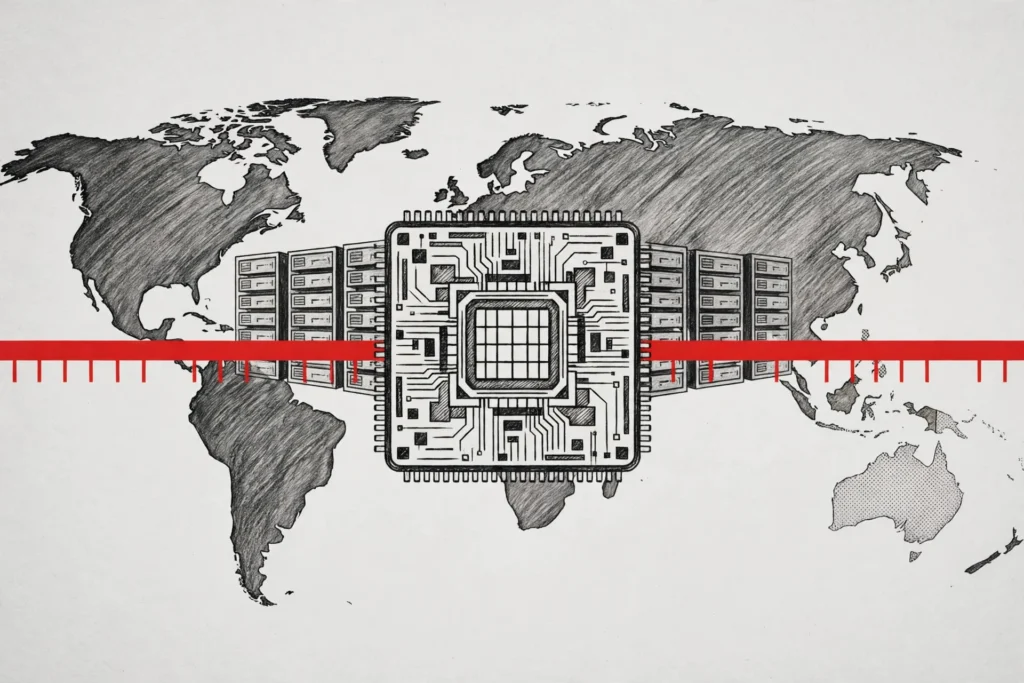
Picture a data hall in Singapore at midnight. Row after row of humming racks, each one packed with the most powerful AI chips money can buy. The customers renting that computing power are not in Singapore at all.
They are thousands of kilometres away, logging in from offices in Shenzhen and Beijing, training the next generation of Chinese AI models on American hardware they were never allowed to purchase.
That arrangement, Washington now says, is over — or at least, it is about to get a lot harder. On Monday, November 16, 2026, the US Commerce Department’s Bureau of Industry and Security, known as BIS, released an interim final rule that closes one of the widest loopholes in America’s AI chip controls: the remote-access loophole.
The new rule does not ban chip sales outright. Instead, it follows the chips to wherever they end up being used, and it puts a licence requirement on the data centres that rent their computing power to the wrong customers. For the cloud operators of Southeast Asia and Brazil, the era of asking no questions is ending.
What the New US AI Chip Export Controls Actually Do
The rule has two main parts, and both are aimed at the same problem. For years, American export controls stopped at the border. A chip could not be sold to a restricted buyer in China, but nothing stopped a Chinese company from renting the same chip, running in a data centre in another country, over the internet.
Under a new data-centre end-use control, a licence is now needed to ship advanced AI chips to any data centre that will give companies headquartered in China, Macau or other arms-embargoed Country Group D:5 nations access to more than 12 million aggregate “total processing performance”, or TPP.
The second part adds five countries to the licence list for advanced chip exports: Indonesia, Malaysia, Singapore, Thailand and Brazil. Commerce describes them as carrying a “higher-than-normal risk of diversion”. Any shipment of advanced computing hardware to those countries — or a transfer inside them — now needs a US licence first.
There is one important exception. Chips bound for customers whose ultimate parent is headquartered in the United States fall outside the five-country licence requirement. But the exemption is not free: the exporter must file monthly reports naming every party and its parent company, each product’s export classification, its TPP and its quantity.
The 12 Million TPP Line: About 750 Nvidia H100s
The 12 million TPP threshold is the number every data-centre operator will be doing maths on this week. BIS defines TPP as twice a chip’s theoretical peak multiply-accumulate rate, times its bit length, added up across every processing unit on the chip.
Translated into hardware, TechCrunch estimates the line equals roughly the maximum output of about 750 Nvidia H100 or H200 chips. That figure is an approximation, not a number from the rule itself. Faster chips reach the line with fewer units, so a cluster of newer Blackwell hardware would cross it sooner.
The threshold is deliberately hard to dodge. It applies to a single data centre or to linked data centres, including digitally connected infrastructure. A remote user counts as covered when it is the exclusive or primary user of the compute — meaning more than half of it.
It also counts the compute across every restricted company a data centre serves. One large tenant or several smaller ones can push a site over the line, and tenants that train models for a covered company may face use attestations too.
Five Countries Now Need a Licence for Advanced Chips
The country list is narrower than the draft that circulated days earlier. Reporting by The Information on November 13 said the rule would cover seven countries, including Norway and South Africa. The published text names five: Indonesia, Malaysia, Singapore, Brazil and Thailand.
Brazil is the least expected name on the list. Its president signed the ReData data-centre tax regime into law on September 15 — a move designed to attract exactly the kind of large AI data-centre investment this rule now complicates.
For operators in those five countries, the burden is about to shift. Under the rule, exporters must be able to show they lacked “knowledge” that a data centre would cross the threshold. A foreign data centre that cannot supply enough ownership information is presumed to give the exporter that knowledge, unless the red flag is resolved first.
In practice, data centres will demand ownership and use attestations from tenants, along with a duty to warn them before workloads or customer mixes change.
BIS estimates the paperwork at about 100 additional licence applications and a net increase of about 970 reporting and exemption submissions a year.
The AI Diffusion Rule Is Gone
Buried in the same rule is a clean break with the previous administration’s approach. The interim final rule formally rescinds the AI Diffusion Rule from January 2025, which had tried to impose country-level limits on advanced AI chip exports and restrict transfers of certain powerful AI models.
Gone with it are the country tiers, the License Exception AIA, the Data Center Validated End User programme and the model-weights control known as ECCN 4E091. The new rule replaces that framework with a narrower, sharper instrument: control the chips, and control who rents the computing power they produce.
Why Washington Moved Now
The timing is impossible to ignore. The rule arrived less than a week after Jensen Huang resigned as chief executive of Nvidia, following reports that he had an affair with Alice Huang, a former executive of Singaporean data-centre company Megaspeed, whom US officials suspect of working for Chinese intelligence. Megaspeed denies wrongdoing, and Chinese officials have said China was not involved.
That scandal put the spotlight on exactly the channel this rule targets. Reuters reported last week that Chinese AI companies were rushing to secure overseas computing capacity, fearing tighter US restrictions were coming. The rule’s text says it was written by, and at the direction of, the Treasury Department and the National Security Council — not by Commerce alone.
Wasl Tech has followed this story from the start. Procurement records reviewed by Reuters showed a blacklisted Chinese university buying Nvidia H200 chips through intermediaries, and renting H200 server access in 2026. The new rule is Washington’s answer to that pattern: if the chips cannot be bought, they should not be rentable either.
The Legal Question Hanging Over the Rule
There is one awkward fact about the new controls: under current US law, cloud computing is not an export. BIS cannot license a cloud login directly, so the rule works around the gap by attaching conditions to chip shipments, transfers and re-exports instead.
The BIS preamble calls the new control a “logical extension of existing controls”. Not everyone in the export-control world agrees. In August, an unnamed Baker McKenzie attorney told The Information it is “widely acknowledged” in the export-control bar that Commerce cannot enforce a remote-access regulation under existing law.
Congress tried to fix that. The House passed the Remote Access Security Act 369-22 on January 12, 2026, to add the authority explicitly, but the bill still awaits Senate action. The published rule does not wait for it.
Instead, it cites the Export Control Reform Act of 2018 for regulating exports, re-exports and in-country transfers, and for issuing the rule without prior notice and comment.
Chris McGuire of the Council on Foreign Relations called the rule “a major step forward”, while saying gaps remain, including some covering activity inside the US. Joshua Kurlantzick, a senior fellow at the same council, told Fortune the controls could be disastrous for Malaysia.
What Happens Next
The rule takes effect on Federal Register publication, which has not happened yet. That publication will start a 60-day comment period, and shipments already en route under prior eligibility may be completed within 30 days after it.
Existing data centres that already serve covered customers will have 90 days from the effective date to obtain a licence.
Markets reacted fast on Monday. The Nasdaq Composite was down 1.6% by mid-morning, with Sandisk down about 7%, Micron down 6%, Intel down 5% and AMD down 4%. Nvidia fell as much as 2.9%, and the Philadelphia Semiconductor Index dropped as much as 5.5%.
Analysts attributed the selloff mainly to chip-sector weakness, saying the rule added uncertainty without a quantified revenue impact.
Two dates now matter more than the rest. Nvidia reports its quarterly results on Tuesday, November 17, at about 4:20 p.m. Eastern Time, with Colette Kress serving as interim chief executive, and investors will be listening for any comment on licensing effects in the five countries. Then on Thursday, President Trump meets Xi Jinping in Shenzhen.
None of the five governments had issued a formal response in the coverage reviewed. For the operators and renters of GPU capacity, the decision frame is already concrete.
A cluster of roughly 750 H100-class chips serving China-headquartered tenants could cross the licence line, the burden of proving who the tenants are now falls on operators, and the companies that built their businesses on renting American chips to the world will have to decide, quickly, whose money they can still take.