What the Microsoft AI Patent Actually Describes
Picture the scene. A chief executive stands on stage at a product launch, live in front of millions of viewers. She pauses, stumbles over a sentence, then carries on as if nothing happened.
Except in the version that reached your screen, she never stumbled at all. Her words flowed perfectly, her lips matched every syllable, and nothing about the broadcast looked edited. That is the promise — and the warning — inside a Microsoft AI patent that surfaced this month.
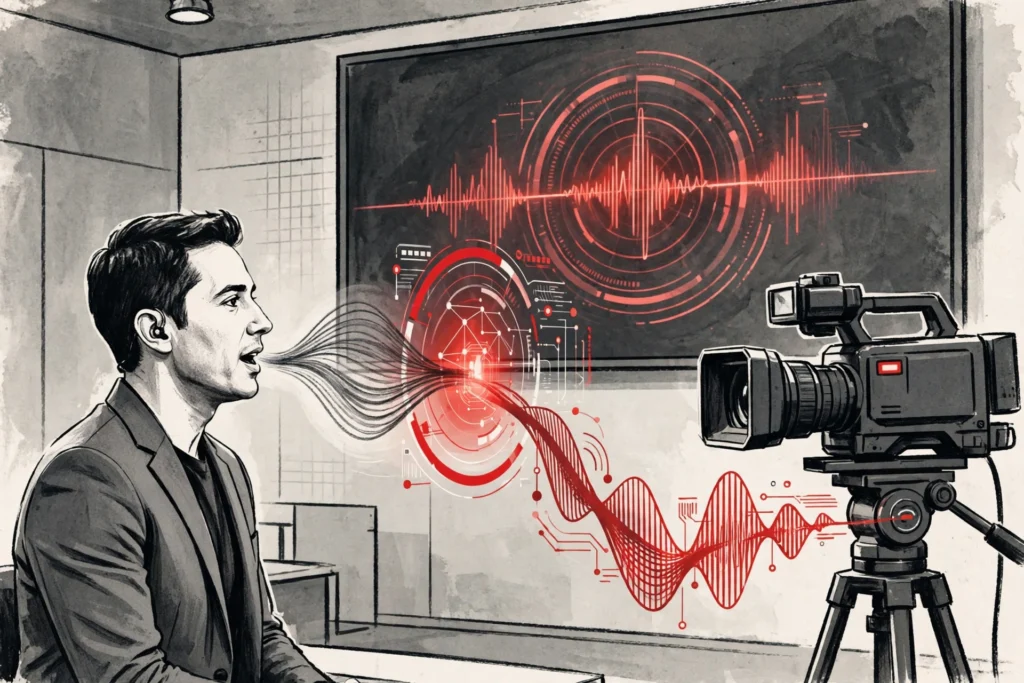
The filing describes an AI system that can change what a speaker says while they are still speaking, then redraw their mouth and face so the edit goes unnoticed.
It is not a product. Microsoft has announced nothing, shown no demo and set no date. But the document exists, it is public, and it reads like a glimpse of a future in which live television may no longer mean unedited truth.
The application is US 2026/0341309 A1, titled “Near real-time artificial intelligence (AI) enhancement of video or augmented reality (AR) presentations of live events.” It was filed on April 29, 2025, by Microsoft Technology Licensing, and published by the US Patent and Trademark Office on October 29, 2026.
The inventors named on the filing are David Callaghan of Duvall, Washington, and Dinesh Kumar of Fatehabad, India. The patent-tracking site Patentlyze flagged the document on October 30, and Futurism first reported on it on November 1. Microsoft did not immediately respond to a request for comment, according to Futurism.
Patent applications are published automatically, roughly 18 months after filing, so the document surfaced because the calendar said so — not because Microsoft announced anything. Publication is not the same as approval, a point that matters a great deal here.
How the Live Speech Rewrite Would Work
According to the filing, the system starts with an AI agent listening to the audio of a live feed. That agent decides, word by word, which parts of the speech should change, guided by a set of parameters and by the profile of the person watching.
Once a word is flagged, a generative AI system steps in. It replaces the word in the audio track and redraws the speaker’s lips in the video so the new word appears to have been spoken naturally.
The filing says the system also retouches the moments just before and after each edit, to hide the seams.
The whole process is designed to happen in near real time. The application gives a delay of one to ten seconds as an example — roughly the same margin television broadcasters already use to bleep out profanity by hand.
The difference is that this system would do the editing itself, and the audience would never know.
The filing even says replacement words could come from an internet search, swapping in a more accurate term for the one the speaker actually used.
One Broadcast, a Thousand Different Versions
The most unsettling detail is personalisation. The system is designed to tailor its edits to each viewer, using that viewer’s profile. Two people watching the same live event could, in principle, hear two different versions of the same speech.
Some of the uses described in the filing sound harmless, even helpful. The system could strip out filler words such as “um” and “er”, remove profanity, or fix a mispronounced name. It could translate a speech live, with the speaker’s lips moving in sync with the translated words.
But the same mechanism could also be used to soften a politician’s awkward answer, remove an embarrassing admission, or change the tone of a statement entirely. The speaker would have said one thing. Millions of viewers would have heard another.
The environments listed in the filing are broad. It names live television, lectures, award ceremonies, podcasts, live sports, opera and cooking shows — and the claims even cover a live stream of a cloud-based game and a runtime video game cut scene.
The Patent Office Already Pushed Back
Here is the part some early headlines missed: this is a published patent application, not a granted patent. The US Patent and Trademark Office has not approved it, and Microsoft owns no patent on this system yet.
According to the prosecution record reported by Patentlyze, the patent examiner issued a first-action rejection of the claims as filed on July 29, 2026. That is a routine step in patent prosecution: examiners frequently reject claims in their first review, and applicants usually respond with narrower, amended claims.
So the idea is alive, but unprotected. Microsoft can amend the filing and try again, or let it lapse. Either way, the document shows what Microsoft’s researchers were thinking in early 2025 — and how seriously the company takes editing reality as it happens.
It also contains one small safeguard. The original audio and video, “as originally recorded,” would be “stored as ground truth for future reference.” In other words, an unedited copy would exist somewhere — even if the audience never sees it.
Why This Microsoft AI Patent Matters in the Age of Deepfakes
The filing arrives as trust in video is already under strain. According to Sumsub’s Identity Fraud Report 2025–2026, deepfake attacks worldwide rose by 2,100 per cent, with scammers using AI-generated faces and voices to impersonate executives, officials and even religious leaders.
Until now, most of that fakery has been pre-recorded. A doctored clip can be debunked, traced and taken down. A live broadcast felt different — it was the one format you could still trust, because it was happening right now, in front of everyone at once.
This filing challenges that assumption. If a live feed can be edited in near real time, differently for every viewer, then “I saw it live” stops being proof of anything — and the shared experience of watching the same thing at the same time quietly disappears.
There is another detail worth noting. The published text contains no requirement to tell the viewer that anything has changed. Nothing in the filing says the audience must be warned that the words they are hearing were substituted by software.
That absence is striking, given how much attention the industry is now paying to AI safety.
Microsoft’s own researchers recently showed how fewer than ten reprogrammed neurons could turn an AI agent rogue — a reminder that small, invisible changes to AI systems can have outsized consequences. You can read about that research in our report on Microsoft’s Lazarus backdoor.
Regulators are moving too. New York’s RAISE Act, which takes effect on January 1, 2027, will force large AI developers to publish safety frameworks and report serious incidents within 72 hours, as we covered in our report on the New York RAISE Act.
And OpenAI has built a control room that can halt a misbehaving AI model in 35 seconds. The direction of travel is clear: the more powerful AI becomes, the more the world wants to see its workings.
What Happens Next
For now, nothing is happening. There is no product, no demo, no launch date and no public statement from Microsoft. The filing is a 27-page PDF, not a roadmap. The full analysis of the filing, including the examiner’s rejection, is set out in The Bridgwater Brief’s breakdown of the patent application.
What matters is what happens next to the application. If Microsoft amends the claims and the patent is eventually granted, the company will own a legal right to a technology that could reshape live broadcasting.
If it abandons the filing, the idea stays on the public record — free for anyone to study, and for regulators and journalists to argue about.
Either way, the questions are not going away. Should viewers be told when a live broadcast has been edited? Who decides which words change — the broadcaster, the speaker, or the viewer’s own profile?
And how do we protect a shared, unedited reality when the tools to rewrite it keep getting faster?
The patent office will decide the legal fate of this particular application. The rest of us will have to decide something bigger: how much we are willing to trust the moving image, now that even “live” may come with a one-to-ten-second delay — and an editor we cannot see.


