Intel Desktop CPU Market Share Jumps Five Points in One Quarter
Picture a PC builder in late summer, hovering over a shopping cart full of parts. The processor is picked out and the motherboard is ready. Then the memory price stops the whole build cold.
A 32GB DDR5 kit now costs about what a mid-range graphics card used to. So the builder closes the tab and waits. Multiply that decision by millions of people, and you get the strangest quarter the desktop CPU market has seen in years.
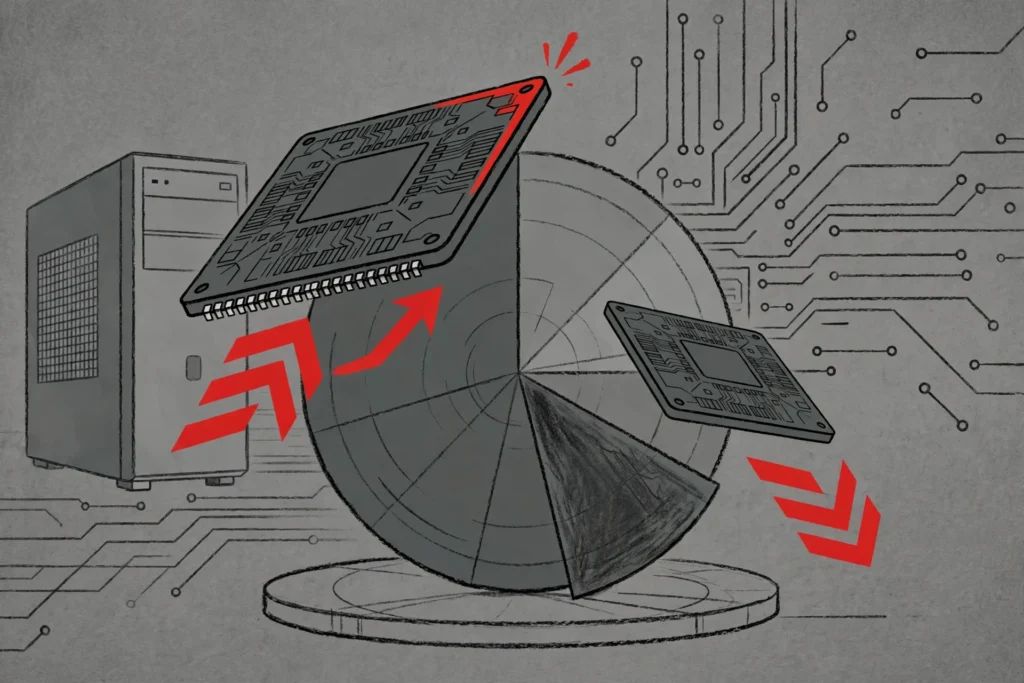
According to Mercury Research, Intel shipped 70.1% of all desktop x86 processors in the third quarter of 2026, while AMD’s share fell to 29.9%. That is a swing of 5.1 percentage points in a single quarter.
The figures were first reported by PC Gamer and quickly picked up across the hardware press, including Hardware Busters. Desktop CPU share does not usually move that fast. This summer, it did.
The reversal undoes a climb AMD had been building all year. AMD sat at 32.2% a year before the second quarter, then 33.2% in the first quarter of 2026, then a peak of 34.9% in the second quarter.
One quarter later, all of that progress is gone, and then some. AMD is back below 30% on the desktop for the first time since early 2025.
Before anyone calls this an Intel comeback, the fine print matters. These figures count processors shipped to PC makers, system builders and retailers, not the chips customers actually bought. Shipments are the industry’s standard measure, but they describe what went into the channel, not what came out of it.
A Bigger Slice of a Much Smaller Pie
The headline number hides an uncomfortable truth: the pie itself shrank. Mercury Research says desktop x86 shipments fell by more than 20%, both compared with a year earlier and compared with the previous quarter.
The firm itself described the quarter as ugly, and it was not exaggerating. Mobile shipments dropped by more than 10% for both vendors as well.
Put plainly, Intel did not suddenly sell a lot more desktop chips. It lost fewer than AMD did. Mercury’s working theory is that Intel moved spare supply from laptops, where demand was soft, into desktops.
That shift covered the usual third-quarter seasonal bump, after Intel undersupplied the desktop channel earlier in the year. AMD, as Mercury put it, did not appear to have a seasonal increase at all.
A separate market update from Jon Peddie Research tells the same gloomy story from a different angle. Worldwide client CPU shipments reached 60.8 million units in the third quarter, down 3.4% from the previous quarter and 6.5% year over year.
Desktop CPU shipments were down 13% year over year, while notebook shipments declined 4%. Both firms point in the same direction: fewer PCs, fewer chips, and a market in retreat.
Why AMD Lost Ground: Gamers, GPUs and Expensive Memory
The likeliest reason for AMD’s slide sits in the kind of customer it depends on most. Its desktop share leans heavily on gamers and do-it-yourself builders, and that crowd had a rough quarter.
Mercury Research points to constrained gaming GPU supply weighing on demand for gaming PCs. When the graphics card is hard to find, the whole build gets postponed, processor included.
Memory prices made things worse. Intel’s own third-quarter filing blamed higher component costs, memory above all, for softer demand from PC buyers.
When the RAM in a build costs as much as the graphics card, plenty of people simply wait. The enthusiast segment, which buys first and upgrades most often, feels that squeeze before anyone else does.
Mercury Research is honest that none of this is settled fact. The firm admits it cannot pin down the causes of the swing with certainty, so every explanation on offer is informed reading rather than proof.
What is certain is the shape of the quarter: a shrinking market, a memory shortage, tight graphics card supply, and AMD’s core audience sitting on its wallet.
Servers Tell the Opposite Story
Step away from the desktop and the picture flips completely. AMD’s server share, excluding the Internet of Things, rose from 34.5% to 35.5% in the same quarter, while Intel lost about a point there.
The data centre is where AMD is winning, and it is winning by design rather than by accident. The money explains the priority. AMD’s data centre segment brought in $8.5 billion last quarter, close to double the year before.
That record result was driven by demand for AI hardware. Chief executive Lisa Su has been blunt about the pecking order, saying the company is a data centre first company.
With wafer supply and memory both tight, the volume that matters most to AMD right now is EPYC, not Ryzen. That choice showed up when AMD launched its 256-core EPYC 6 Venice server chips earlier this month, aimed squarely at the AI agent era.
The server momentum fits a bigger pattern. AMD’s total revenue has been closing in on Intel’s for several quarters, and the company expects to pass Intel in annual total revenue for the first time by the end of 2026.
Losing five points of desktop share in the same year it overtakes its old rival in overall sales sounds contradictory, but it is not. AMD is simply choosing where its limited chips go, and the desktop is no longer first in line.
Look at the whole x86 market, including Internet of Things and semi-custom chips, and the overall trend has not reversed at all. Intel sits at 66.1%, essentially flat on the quarter and about three points lower than a year ago.
AMD stands at 33.9% against 34.1% in the previous quarter. What changed is the desktop, and the desktop shrank. The wider war is still being fought in the data centre, where AMD keeps gaining ground.
What the Numbers Mean for PC Buyers
For anyone shopping for a desktop right now, the market share figures matter less than the forces behind them. Intel-based systems are likely to be easier to find this season, because Intel kept its channel supplied while AMD’s chips went elsewhere.
AMD Ryzen processors are not disappearing, but supply is tighter. The models gamers want most are the ones most likely to be scarce or overpriced.
The memory shortage is the bigger problem for buyers than either brand’s share. A build that made sense six months ago can be several hundred dollars more expensive today, and no processor choice fixes that.
Anyone planning a new PC should price the memory first and the processor second, because the RAM is where the budget is being eaten. Waiting for prices to ease is a reasonable strategy, and the market data suggests plenty of people are already doing exactly that.
Intel’s own product moves hint at how tight supply really is. The company has confirmed the Core Ultra 7 260K, a limited-availability Arrow Lake processor, but buyers should not expect to find it as a boxed retail CPU for now. It is turning up only inside a small number of prebuilt gaming desktops.
What Happens Next in the Desktop CPU Market
One quarter is not a trend, and this one came with an unusual set of distortions: a memory shortage, tight GPU supply and a collapsing unit total. The fourth quarter will be far more telling, because it carries the holiday season, when PC sales normally get their biggest lift of the year.
If AMD is still below 30% after that quarter, then it is fair to call this a real shift. Until then, it reads more like Intel holding up better in a bad market than winning one.
Both companies have new hardware on the way that could change the picture. Intel’s Nova Lake desktop parts, built on its 18A process, have not launched yet, and they are the company’s next big swing at the enthusiast market.
AMD has an enthusiast base that could return quickly if memory and graphics card prices ease, and its server strength gives it room to be patient. The AI infrastructure boom that lifted CoreWeave’s revenue 168% last quarter is the same boom filling AMD’s data centre order book, and that demand is not going away.
The deeper story here is not really about Intel or AMD at all. It is about a desktop PC market that is shrinking while the AI chip business explodes, and two companies making very different bets about where the future sits.
Intel is defending the desktop it has dominated for decades. AMD is trading desktop share for data centre growth. For now, both strategies are working, just not in the same market.
The next quarter will show whether AMD’s gamble keeps paying off, or whether giving up the desktop was a price too high to pay.