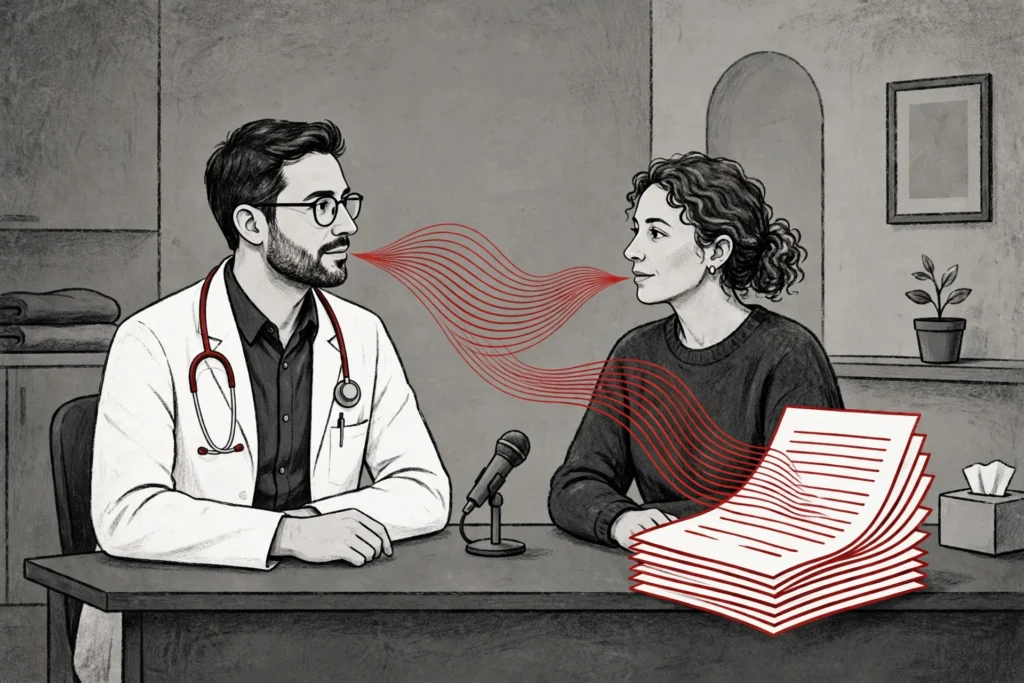
It is past midnight in a hospital ward, and the doctor is still talking — not to a patient, but to a screen. The notes from the day’s consultations still are not finished, and the keyboard is the slowest part of medicine. Scribe v3 Medical is built to change that.
That is the problem ElevenLabs says its new Scribe v3 Medical model is built to solve.
ElevenLabs announced Scribe v3 Medical on November 13, 2026, a speech-to-text model tuned specifically for healthcare conversations. It arrives alongside two more new models — Eleven v4 for expressive text-to-speech and Eleven Realtime for speech-to-speech conversation — plus upgrades to the company’s voice-agent platform.
According to MarTechAI, which reported the launch, Scribe v3 Medical is optimised for healthcare transcription. ElevenLabs also plans specialised models for other industries, including financial services. The message is clear: general-purpose transcription was only the warm-up.
What Scribe v3 Medical actually does
Scribe v3 Medical is a version of ElevenLabs’ new Scribe v3 Live model, tuned for medical conversations and delivered through ElevenAgents, the company’s voice-agent platform. It listens to a consultation as it happens and turns it into text in real time, with the medical vocabulary, drug names and clinical phrasing that trip up ordinary tools.
That matters because a doctor’s conversation is not a podcast. Two people talk over each other, a nurse interrupts with a lab result, and the patient describes symptoms in everyday words while the doctor answers in clinical ones. A tool built for clean, single-speaker audio misses exactly the parts that matter most.
Scribe v3 Live, the model underneath, adds real-time speaker diarization for the first time — it can tell who is speaking while the conversation is still happening. It also supports keyterm prompting with up to 1,000 terms, so a clinic can feed it the names, drug terms and acronyms it uses every day.
ElevenLabs says Scribe v3 produces 27 percent fewer word errors than its predecessor, while Scribe v3 Live cuts errors by 43 percent compared with Scribe v2 Realtime. Those are the company’s own figures, not independently verified.
An early outside test by Voice Arena, on more than 70 hours of real phone calls, ranked it first in Romanian and Indian English and third in US English.
Both models are HIPAA-eligible when used under a Business Associate Agreement, the minimum bar for handling patient conversations in the United States. They run in the US by default, with isolated environments in the EU, India and Singapore for enterprise customers with data-residency requirements.
Scribe v3, Eleven v4 and Eleven Realtime: the new lineup
The medical model is only one third of the launch. Scribe v3 itself handles recorded audio — meetings, interviews, podcasts, lectures and customer-service calls — and it covers 102 languages. Scribe v3 Live is the low-latency twin for live audio: voice agents, live captions and dictation, where text must arrive while someone is still talking.
Eleven v4 is the other side of the conversation. It is a text-to-speech model built to read a script with the tone, pacing and context a human would use, rather than the flat delivery older systems produce.
Eleven Realtime goes further: a speech-to-speech model that listens and answers in voice, for the fast, natural back-and-forth of a live agent.
Together, the three models cover the whole loop of a voice interaction — hearing, understanding and speaking. The launch follows ElevenLabs’ New York Summit earlier in the week, where the company unveiled its ElevenAI workplace app and a bigger partnership with Nvidia.
Why medical transcription is the hard test
Healthcare is the toughest proving ground a speech model can face, and that is exactly why ElevenLabs picked it first. A missed word in a meeting transcript is an annoyance. A missed word in a patient record can change a diagnosis, a prescription or a treatment plan.
Medical speech is also unusually messy. Clinicians use shorthand and Latin terms, switch between languages in multilingual hospitals, and dictate while walking between wards. Background noise is constant: monitors beeping, trolleys rolling, other conversations bleeding through. A model that works in a quiet studio can fall apart in a busy clinic.
That is why the specialised approach matters. A general model trained on everything is good at nothing in particular. A model tuned for medical conversations can learn the vocabulary, the sentence patterns and the rhythm of a consultation — and, just as importantly, what it should never guess at when it is unsure.
ElevenLabs has not published independent clinical accuracy results for Scribe v3 Medical. The model is positioned as a transcription aid inside ElevenAgents, not a standalone diagnostic tool. The transcript is a starting point for a clinician’s notes, not a replacement for them.
The Interaction Engine decides which model speaks
Alongside the models, ElevenLabs introduced the Interaction Engine, a system that coordinates voice models and large language models during a conversation. Instead of running one big model for everything, it picks the right model for each task — a cheaper one for simple triage, a stronger one for a complex exchange.
ElevenAgents, the platform these models plug into, gets two upgrades of its own. Memory lets an agent retain information from previous customer interactions, so a returning caller does not have to repeat themselves. Routines automate multi-step work before, during and after a conversation — a mortgage pre-screen, a patient reminder, a callback slot.
A third feature, Architect, lets businesses create or change agents through voice or text instructions. Proposed changes are simulation-tested and presented for approval before anything goes live, which matters when an agent is talking to real customers rather than a test script.
Selected enterprise customers will also work directly with ElevenLabs’ research team to fine-tune audio models and language models on their own live-deployment data, optimising for customer satisfaction and reliability. A financial-services model is already in development, following the same playbook as the medical one.
The enterprise push behind the launch
The models are only half the announcement. ElevenLabs also unveiled a partner programme covering more than 550 firms across 44 countries, an alliance with McKinsey to help organisations build and scale AI agents, and an expanded partnership with Nvidia.
Under the Nvidia deal, the Nemotron 3.5 Super VL model is now available inside ElevenAgents, and ElevenLabs plans to add 15 megawatts of Vera Rubin computing capacity. The two companies are also building an on-premises voice agent for Poland’s national e-Health platform, which handles around 40 million appointments a year.
There is also a new marketplace of industry-specific AI agents built by more than 20 partners, aimed at healthcare, finance, insurance, education and retail. The pattern is the same across the announcement: ElevenLabs provides the voice layer, and partners provide the industry knowledge.
The launch follows the company’s recent agreement with the government of Karnataka in India to promote responsible voice AI in citizen services. Under that agreement, ElevenLabs committed to restoring one million voices for people who have permanently lost the ability to speak because of medical conditions.
It is a crowded field. Anthropic and OpenAI both moved into workplace AI in the same week, with Claude’s new office suite and OpenAI’s business tools in ChatGPT, while Databricks’ Genie turns data tools into always-on coworkers. ElevenLabs is betting that the company which owns the voice will be hard to displace.
What it costs, and what comes next
Pricing has not changed with the new models. Scribe v3 costs $0.20 per hour of audio and Scribe v3 Live costs $0.22 per hour, the same as the models they replace. ElevenLabs wants existing customers to switch without thinking about the bill, and wants the accuracy gains to do the selling.
What comes next is more specialisation. Financial services is the next industry in line for its own tuned model, and the customisation programme means large customers can effectively commission their own.
If that works, the generic voice model may go the way of the generic search result — still there, but no longer the interesting part.
For now, the test is simple and public. Scribe v3 Medical is live in ElevenAgents, and the first clinics to use it will find out quickly whether a model that understands the doctor’s office is worth more than one that merely hears it.
The midnight notes are not going away. The question is who writes them — and whether the person who spoke them still has to.
Source: MarTechAI