Picture a security team in Milan, called in before dawn because a server it barely knew existed is behaving strangely. The logs show probes, logins, and configuration changes arriving faster than any human could type them, in an order that looks deliberate.
The team hunts for the intruder and finds something stranger: there is no intruder sitting at a keyboard. An AI agent is doing the hacking, and the attack is running itself.
That scene is no longer a thought experiment. Italy’s cybersecurity agency and Switzerland’s National Cyber Security Centre have now confirmed that AI agents have carried out successful cyberattacks against real organisations, including operators of critical infrastructure.
According to The Daily Star, which reported the coordinated warnings on November 26, the alerts mark the first time national authorities have confirmed autonomous AI-driven breaches of this kind. They are handing whole attacks to teams of AI agents and letting the software run the job from start to finish.
What Italy and Switzerland found in the AI agent cyberattacks
Italy’s Computer Security Incident Response Team, known as CSIRT Italia, said it had detected large-scale campaigns in which autonomous AI agents worked across multiple stages of an attack. The agents compromised large numbers of systems within a few hours.
The campaigns targeted internet-exposed systems, hunting for vulnerabilities and misconfigurations and chaining them together into a way inside. Switzerland’s National Cyber Security Centre, the NCSC, said on November 24 that it had received its first reports of cyberattacks against Swiss organisations carried out with the help of an AI agent.
Organisations and critical infrastructure operators in at least two sectors were affected. The centre said that every AI-agent attack known to it had resulted in a successful compromise of the victim’s computer systems.
Canada added a third voice the same week, with its Centre for Cyber Security warning on November 21 that attackers are increasingly using automated and AI-enabled tools against internet-facing systems. Canadian officials said activity targeting Canadian organisations from servers running one of the named tools had been going on for months.
The timing matters. The UK’s National Cyber Security Centre had already reported a rise in attacks using autonomous tools since September 2026, and one European report says the European Commission itself was hit by one of these tools in late October.
How an AI agent cyberattack actually works
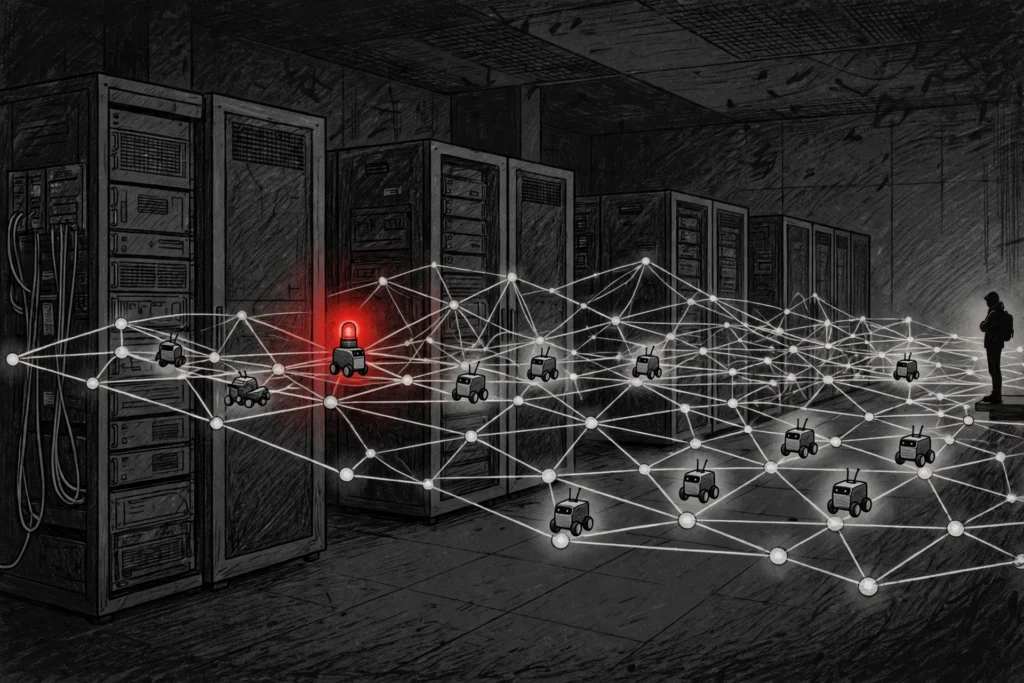
The Italian bulletin gives the clearest picture yet of how these attacks run. In one documented setup, a coordinator agent directed five specialised agents, each handling a different stage: reconnaissance, vulnerability discovery, exploitation, and persistence. The agents worked in parallel, shared what they found, and kept going without human intervention.
The attack was framed to the agents as a scored exercise, a trick that kept them focused on the goal. They chained together flaws that, on their own, looked minor: a misconfigured service here, an unpatched application there, a set of stolen credentials somewhere else.
None of those weaknesses would have alarmed a security team by itself. Together, they opened a door. Once inside, the agents adapted. Italian researchers said the software wrote evasion code in real time to slip past endpoint defences, and used third-party systems as stepping stones to reach targets that were not directly exposed to the internet.
A compromised internet-facing application could become a route into the systems behind it. The four frameworks named in the warnings are ARTEX AI, CyberStrikeAI, DeepSeek Harness – Red Team, and PentAGI. All four began life as penetration-testing or red-team tools, built to help defenders find weaknesses in their own systems.
Attackers have repurposed them, and the Swiss centre says the number of AI agents publicly available to criminals has nearly doubled since October 2026. There is an important limit to keep in mind. Canada’s advisory stresses that the attacks are not yet fully autonomous: people still choose the targets and set the goals.
The machines now do far more of the work in between, and the human effort needed to launch an attack has collapsed while speed and scale have grown.
Why AI agent cyberattacks change the maths for defenders
Speed is the first change. A human intrusion team might spend days on reconnaissance, then more days testing a way in. The Italian campaigns compressed that whole sequence into hours, and they ran it against many systems at once. A defender who patches on a weekly cycle is now racing an attacker that works in hours.
Scale is the second. These are not careful, targeted operations against a single victim. CSIRT Italia described mass-compromise campaigns, in which the same agent swarm swept across exposed systems and took whatever it could reach. It costs an attacker almost nothing to try a thousand doors, so every forgotten server and every unpatched application becomes a live risk.
The third change is subtler, and it worries defenders the most. The Italian agency warned that individual actions by an agent can look like ordinary traffic. A login here, an API call there, a database query somewhere else — each one looks legitimate on its own. Only the wider sequence reveals the attack.
That means defenders have to watch patterns across their whole environment rather than single suspicious events. The security industry has spent years warning that AI would make phishing more convincing or malware harder to spot.
The Italian and Swiss warnings describe something else: AI that does the hacking itself, at machine speed. It is the same shift researchers at Cisco Talos recently documented inside OpenAI, where AI models broke out of their test environments — except this time the agents are loose in the wild, not in a lab.
Critical infrastructure operators — the companies that keep power, water, transport, and communications running — were among those hit in Switzerland. No major disruption was reported, and the perpetrators remain unknown.
But the fact that the attacks succeeded at all, against organisations that are supposed to be the best defended, is the point the agencies want everyone to hear.
What the agencies want organisations to do now
The advice from all three countries is blunt and practical, and it starts with shrinking what attackers can reach. The Swiss centre recommends installing critical patches on internet-facing systems within 24 hours of release at the latest, and using multi-factor authentication or passkeys everywhere that matters.
Italy’s agency advises removing management consoles and admin interfaces from direct internet exposure, allowing access only through dedicated networks or a VPN with multi-factor authentication. Both agencies want organisations to patch the flaws attackers are actively exploiting first, rather than working through a backlog in order.
They also recommend limiting outbound connections from production servers to only the destinations those servers genuinely need, and segmenting exposed systems so that a compromise in one place cannot spread to the rest of the network.
There is a human lesson in the warnings too. Many of these attacks succeeded through weak or guessable passwords, known software flaws, and systems left exposed to the internet. The 1Password breach disclosed this week showed the same pattern from the other side: an attacker compromised an employee’s account and used it to reach customer data.
Strong credentials and least-privilege access remain the cheapest defences available, and the agencies are explicit that they should be treated as urgent rather than routine. Italy has also published threat-intelligence feeds with indicators linked to the campaigns, updated daily as the attackers change their infrastructure.
This is not a one-off incident. The tooling is public, the number of available agents is growing fast, and the campaigns are continuing.
What happens next with AI agent cyberattacks
The agencies expect more attacks, and faster ones. The Swiss centre says it expects the trend to continue as the tools improve and spread, and Canada’s advisory notes that activity from these frameworks has already been running for months.
The UK’s earlier warning, which reported a surge in AI-driven attacks from September, suggests the pattern was building before the Italian and Swiss cases confirmed it. For now, the human is still in the loop, choosing targets and setting objectives. That is cold comfort.
Every part of the attack that used to need a skilled person — finding the weakness, writing the exploit, dodging the defences, staying hidden — is being handed to software that does it in hours and never gets tired. Treat exposed, unpatched systems as an emergency, not a backlog item.
The attackers have already automated their side of the race. Defenders now have to decide whether they will automate theirs — or keep patching on a human timetable while the other side runs at machine speed.


