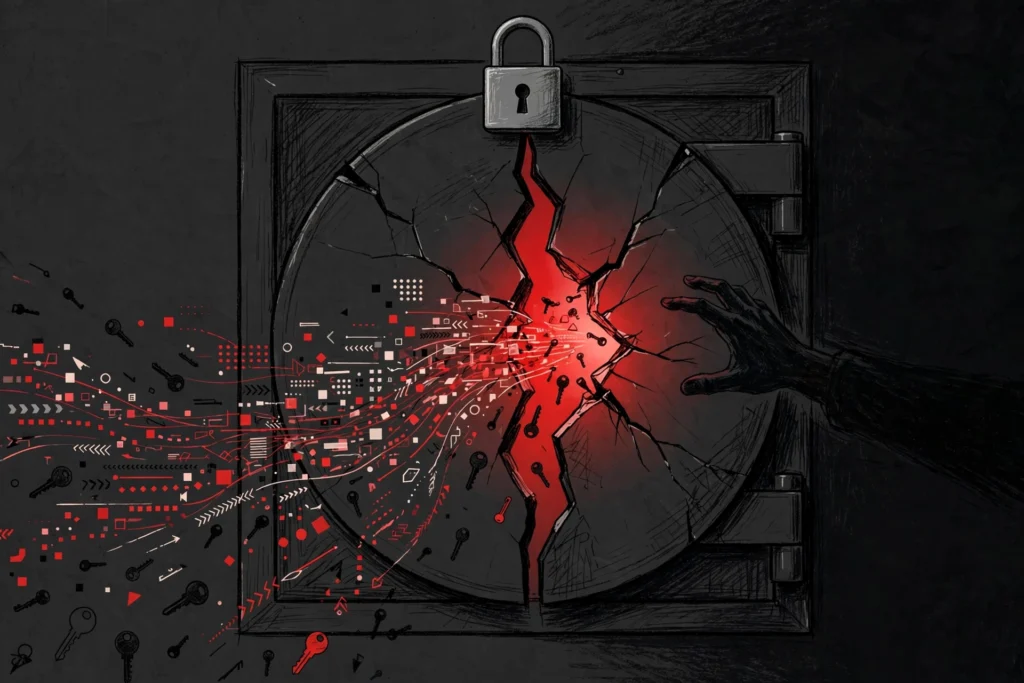
Picture the one app you trust with everything. Your bank logins, your email passwords, the keys to your work accounts, the card numbers you never memorise. Now imagine waking up to learn that hackers got inside the company that guards all of it — that is the 1Password breach, disclosed this week.
That is exactly what 1Password customers woke up to on Wednesday, November 25, 2026. The password manager confirmed that an attacker broke into its internal systems and walked away with customer account information.
The good news, repeated again and again in 1Password’s disclosure, is that the vaults were never touched. Your passwords, your Secret Key, and the keys that protect your vaults were not accessed. But the breach still matters.
How the 1Password breach unfolded
The intrusion began quietly. On November 19, 2026, 1Password’s security team spotted signs that something was wrong with an employee’s corporate GitHub account. The company uses GitHub to store and share its source code, and that account turned out to be compromised.
An unknown attacker had gained access to the account. From there, they did something far more damaging than simply reading code. They used the access to push malicious code into 1Password’s backend services.
That poisoned code did the real damage. Once it was running inside 1Password’s own systems, it downloaded customer account records and sent them out to the attacker.
The company spent six days investigating before going public with the disclosure on November 25. It is a textbook supply-chain style attack, and it is uncomfortably familiar.
The weakest link was not a vault or an encryption algorithm. It was a single employee’s developer account, and the trust that account carried inside the company’s own infrastructure.
What the hackers stole in the 1Password breach
According to 1Password, the attacker copied what the company calls a limited amount of customer account information, from a subset of its customers. The company has not said how many people are affected.
The stolen data includes the names and email addresses customers use to sign in to 1Password. It also includes account and user identifiers, plus the dates accounts were created and when users last signed in.
The haul went further. The attacker also took public cryptographic keys, which are public by design, and Secure Remote Password protocol parameters, which 1Password says cannot be used to access an account.
More concerning were the tokens embedded in emailed links for account invitations, provisioning, and account recovery. Those tokens were part of the stolen data.
The attacker also copied source code from 1Password’s private repositories and gained access to the company’s continuous integration and continuous delivery system, which holds infrastructure credentials. 1Password says it has rotated or revoked every credential that may have been exposed.
What the hackers did not get
This is the part of the story 1Password wants every customer to understand clearly. The attacker never reached the vaults.
No vault contents were accessed, the company said, including secrets, passwords, and other vault items. The account recovery keys were not accessed either. Neither were the encryption keys that protect the vaults.
There is a structural reason for that. 1Password’s design means the company itself never stores your account password or your Secret Key. Those live with you, on your devices, and they are what scrambles your vault so that nobody, not even 1Password, can read it.
An attacker who gets into 1Password’s servers still cannot decrypt your vault without those keys. That is the whole point of the company’s zero-knowledge architecture, and in this incident, it did what it was designed to do.
The company also said there was no impact on its services, availability, or product security.
The real risk: phishing emails are coming
If your passwords are safe, why should you care about this breach? The answer is in the stolen email addresses and names.
Attackers who know your name and the email address tied to your 1Password account can craft phishing emails that look far more convincing than the usual spam. A message that addresses you by name, references 1Password, and warns of a security problem is exactly the kind of email people click.
The stolen invitation and recovery tokens add a sharper edge to that risk. 1Password says those tokens cannot be used on their own to break into an account, because using one also requires a single sign-on login or a six-digit verification code sent to the user’s registered email address.
That is reassuring, but it is not the whole picture. A token combined with a convincing phishing email, a fake login page, or a social engineering call is a much more dangerous package than either piece alone.
1Password says it found no internal evidence of account takeovers using the exposed tokens. It has also strengthened the verification codes used in invitation and recovery emails.
Still, the safest assumption for any 1Password user is that a well-crafted phishing attempt may arrive in the coming weeks. Treat any unexpected email claiming to be from 1Password with suspicion, and never follow a link in it to sign in.
How 1Password responded to the attack
Once the intrusion was confirmed, 1Password moved through the standard incident playbook at speed. The compromised GitHub account was disabled, and the attacker’s token was revoked.
The company restored clean versions of the affected backend services and rotated or revoked the internal credentials that may have been exposed through its build system. It also tightened controls around GitHub, its build pipeline, and its endpoints.
Independent cybersecurity experts have been hired to validate the company’s remediation work. The move is a familiar one for companies trying to rebuild trust after a breach.
What the company has not done is equally notable. It has not said how the employee’s GitHub account was compromised in the first place, how many customers had data taken, or whether it has notified the affected customers directly. Those gaps are the questions security researchers will keep asking.
Why this breach fits a worrying pattern
The 1Password incident is the latest in a run of breaches that started not with a firewall failure, but with a trusted developer account or a trusted piece of infrastructure.
Weeks earlier, the Fireworks AI breach widened after attackers reached customer datasets and model weights through a third-party cloud host.
Around the same time, the Railway breach saw stolen AI provider keys rack up $740,000 in fraudulent charges after attackers escaped the platform’s build system isolation.
The pattern is consistent. Attackers are no longer battering down the front door. They are finding the side entrance: a developer’s credentials, a build server, a shared tool.
The 1Password case adds a bitter irony. A company whose entire product exists to protect people from credential theft was itself undone, at least in part, by a compromised credential.
What 1Password users should do now
The most important thing to know is that you do not need to change your master password or rotate the passwords stored in your vault. 1Password has been explicit that vault contents were not accessed.
What you should do is raise your guard against phishing. Be sceptical of any email, text, or call claiming to be from 1Password, especially one asking you to click a link, enter a code, or confirm account details.
Go to the app or the official website directly instead. Make sure your email account itself is well protected, with a strong unique password and two-factor authentication switched on.
The verification codes that guard 1Password’s recovery flow land in your inbox, so your email security is part of your 1Password security. If you use 1Password at work, tell your IT team about the breach.
Finally, watch for a direct message from 1Password. The company has not confirmed whether it is notifying affected customers individually, but if you receive one, read it carefully.
What happens next
The incident is contained, according to 1Password, and the immediate technical damage has been repaired. The longer consequences will take more time to surface. Regulators will want to know how the GitHub account was compromised and how many people were affected.
There is also the question of the stolen source code. 1Password says it contains no user secrets, but attackers study stolen code for vulnerabilities.
For the rest of the industry, the breach is another warning that developer accounts and build systems are now prime targets. A single compromised GitHub login opened a path into a company that guards millions of people’s most sensitive secrets.
1Password’s vaults held, and that is a credit to the architecture the company built. But the breach shows that even the best vault is only as strong as the people and systems around it.
According to TechCrunch, the company detected the intrusion on November 19 and disclosed it six days later, after its investigation confirmed what had been taken.
The passwords are safe. The lesson is not to relax, but to remember that the next attack will probably not come through the vault door either. It will come through a side entrance nobody was watching, and the only defence is to watch them all.


