Maya had driven the same stretch of highway a hundred times. On Saturday night, her Tesla finished the Tesla FSD v15 update, and when she pulled out of her driveway, the screen no longer showed the grey sketch she knew.
The road ahead looked alive. Buildings, crosswalks and parked cars appeared in colour, rendered in real time, as if someone had turned her commute into a video game. That is the new Reality View.
Tesla announced the rollout on Saturday, November 21, in a post on X, as reported by Gizmodo. The update is reaching early-access drivers first, and it upgrades every part of the car’s end-to-end driving network, according to the company.
Elon Musk summed up the new view in three words on X: “It’s like GTA.” The comparison stuck instantly, and not only because Grand Theft Auto 6 launched days earlier. The screen really does look like a game.
Tesla FSD v15 Reality View: A Video Game on Your Dashboard
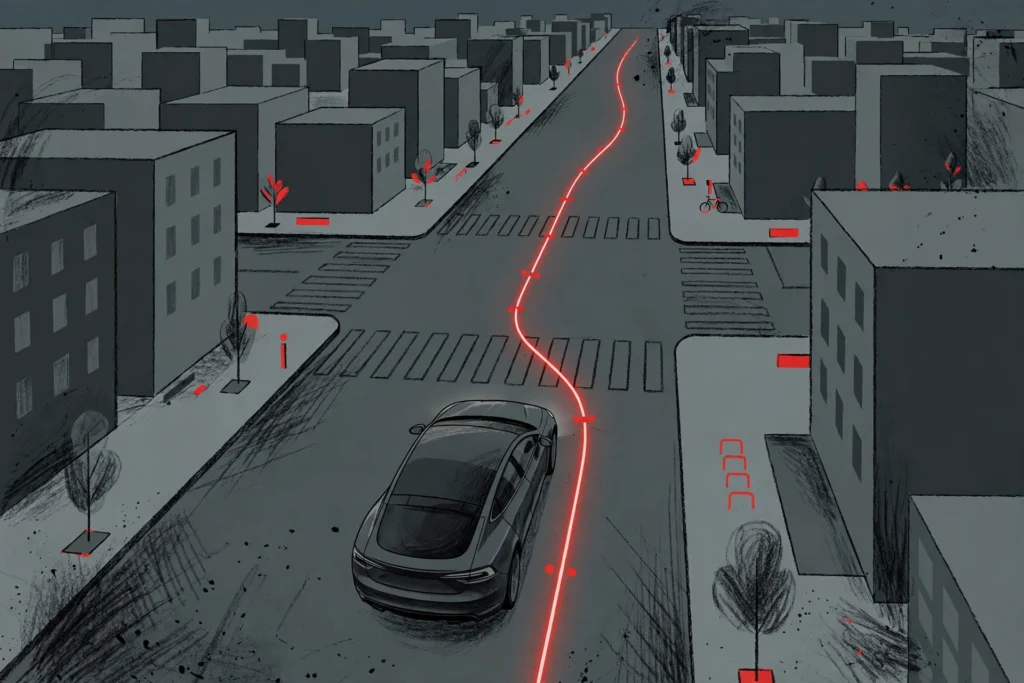
Reality View replaces the old display, a mostly colourless scene of lane lines, boxes and a simplified car shape. In its place, a movable virtual camera floats just above and behind your car, painting the street around you as you drive.
The view is photorealistic and it moves with the car. It shows building windows, crosswalk stripes, parked vehicles and pedestrians caught mid-step, all lit like a night scene in a big open-world game.
It is not a recording. The same neural network that decides how to steer and how fast to go draws the picture live, using the car’s cameras. Tesla calls the feature Tesla Augmented Reality in its release notes.
The display also shows what the car plans to do next. A blue path traces the route ahead, and small floating chevrons mark upcoming turns. At a roundabout, an arrow shows which exit the car intends to take.
Drivers can tap anywhere on the screen to pick a new destination or a parking spot, marked with a small pin. The view can fill the whole screen, share it with the map, or give way to the map entirely.
There is also a quieter cabin mode for drivers who want less on screen. Even the turn signal sound fades after a few clicks, a small touch that fits the calmer mood.
A 25x Safety Claim — With an Asterisk
The boldest number in the release notes is not about graphics. Tesla says version 15 handles safety-critical cases 25 times better than before, measured by what it calls the critical intervention rate.
That is the rate at which a driver has to take over in a situation that could become dangerous. A 25-fold improvement sounds enormous, and Tesla credits a new vision encoder for the leap.
But the claim comes with a catch. Tesla has not shared the baseline, so nobody outside the company can tell how often drivers were intervening before. A multiplier without a starting point is hard to judge.
The company says the new vision encoder was trained on millions of internet videos. It is shared across three very different machines: Full Self-Driving, the Robotaxi service and the Optimus humanoid robot.
That shared brain is the point. Every mile driven by a customer car, every Robotaxi trip and every Optimus step feeds the same understanding of the world. Tesla is betting that scale wins.
Independent testing will be the real judge. Until outside testers and safety data arrive, the 25x figure is best read as Tesla’s own claim, not a verified fact.
What Else Is New in FSD v15
Reality View is the showpiece, but the release notes read like a list of complaints owners and regulators have raised about Full Self-Driving. Version 15 tries to answer many of them at once.
The car is now better at spotting road signs, potholes, debris, small animals and tire chains. Chains matter more than they sound: they have caused crashes that drew federal attention in the past.
It also handles deep standing water more carefully, and it manages speed more smoothly in school zones, at speed limits and in bad weather. The behaviour adjusts to each driver’s profile.
Navigation has learned from the fleet. At the start and end of a trip, the system now plans routes end to end, based on the paths other Teslas actually take. Tesla says later v15 releases will extend that learning to the whole route.
The car can now slow down when it detects a speed camera, though pressing the accelerator or raising the speed profile cancels the slowdown. A new Bike Rack Mode lets drivers use FSD with a bike rack or similar hitch accessory.
Parking gets smarter too. The car can use a driver’s parking history to suggest a spot, and the map can show more than one parking option at the destination. Vision-based driver monitoring has also improved.
The Same Brain Now Drives Robotaxi and Optimus
Tesla’s release notes describe Reality View as a single end-to-end visualisation that replaces several separate model signals. The company says it also uses less computing power than the old display.
That efficiency matters because the same vision encoder now serves three products. What the car learns about a crosswalk can, in theory, help a robotaxi in another city and a humanoid robot in a warehouse.
It is a neat story, and it explains why Tesla keeps investing in one shared model instead of three separate ones. The risk is the same in reverse: a weakness in the shared brain shows up everywhere at once.
For now, the system remains Full Self-Driving (Supervised). The car can steer, brake and accelerate, but the driver must stay alert and remains responsible for the vehicle at all times.
Why the GTA Comparison Matters
Musk’s three-word verdict did more than describe a screen. It tied Tesla’s update to the biggest entertainment launch of the year. Grand Theft Auto 6 arrived on November 19 and earned a record $3.8 billion on its first day, according to Rockstar’s parent company.
The comparison cuts both ways. A game can afford to invent a building or blur a pedestrian. A driving system cannot. The software that paints a convincing world on the centre screen is the same software that has to read the real one through the windshield.
That is why the photorealistic view is more than a party trick. If the rendering is faithful, it shows the driver exactly what the car sees and what it plans to do. If it is wrong, the driver sees the mistake before it matters.
Tesla’s bet is that showing its work builds trust. Drivers who can see the car’s intentions are more likely to understand them, and quicker to step in when something looks off.
What Happens Next
The rollout began with early-access drivers on November 21. Tesla has not said when every FSD owner will get version 15, but the company usually widens access over days and weeks if no problems appear.
Later v15 releases will extend the learned navigation to the full route, not just the start and end of a trip. More of the fleet’s driving habits will shape how the car chooses its path.
Tesla has been moving fast across its businesses this month, from energy hardware to robotaxis. The FSD update is the latest sign that the company sees its software, not just its cars, as the product.
Watch for two things. First, whether independent testers can reproduce anything close to the 25x safety claim. Second, whether drivers actually find Reality View useful, or whether the novelty fades and the map takes over again.
For now, one thing is certain. The grey sketch is gone, and the drive home will never look the same again.