The Camera Comes Off the Phone
Picture a photographer on a city street, swapping lenses on a camera to catch a distant rooftop. Now picture that same photographer pulling the lens off a phone instead.
That is the idea Huawei is betting on. On November 24, the Chinese company will unveil the Huawei Mate X8, a foldable phone with a detachable camera module that clicks on like a real camera lens. It arrives alongside the Mate 90 Air, Huawei’s thinnest regular smartphone ever, and a brand-new sub-brand called OSTA.
Three phones, one event, and a clear message: Huawei is done playing safe with smartphone design.
Huawei Mate X8: A Foldable That Takes Its Camera Off
The Huawei Mate X8 is the eighth generation of Huawei’s large foldable line. He Gang, chief executive of Huawei’s consumer business group, recently said the Mate X series now has more than 20 million users.
The phone opens into an 8.15-inch inner display, with a 6.5-inch cover screen on the outside. Both panels use Huawei’s second-generation dual-layer OLED technology, which the company says brings higher brightness and better colour.
The crease, that faint line down the middle of every foldable, is reportedly much reduced this time. Huawei has teased a hinge with magnetic technology designed to keep the screen flat when closed and smooth when open.
Under the hood, reports point to Huawei’s own Kirin 9050 Pro chip. The battery is said to be at least 6,000mAh, up from the 5,600mAh cell in last year’s Mate X7, with 66W wired charging and 50W wireless charging, according to leaker Digital Chat Station.
The phone comes in five finishes. Three of them — Purple Gold Brocade, Qingyun Brocade and Danxia Brocade — have a woven brocade texture on the back. The other two, Sky Black and Snowfield White, are smooth and plain.
Buyers get four configurations. The standard model ships with 12GB of RAM and either 256GB or 512GB of storage. A Collector’s Edition pushes that to 16GB of RAM with 512GB or 1TB of storage. Prices will be revealed on launch day.
The Ruiying Z10: A Real Camera Lens on a Phone
The star of the show may not be the phone itself. It may be the accessory that clips onto it.
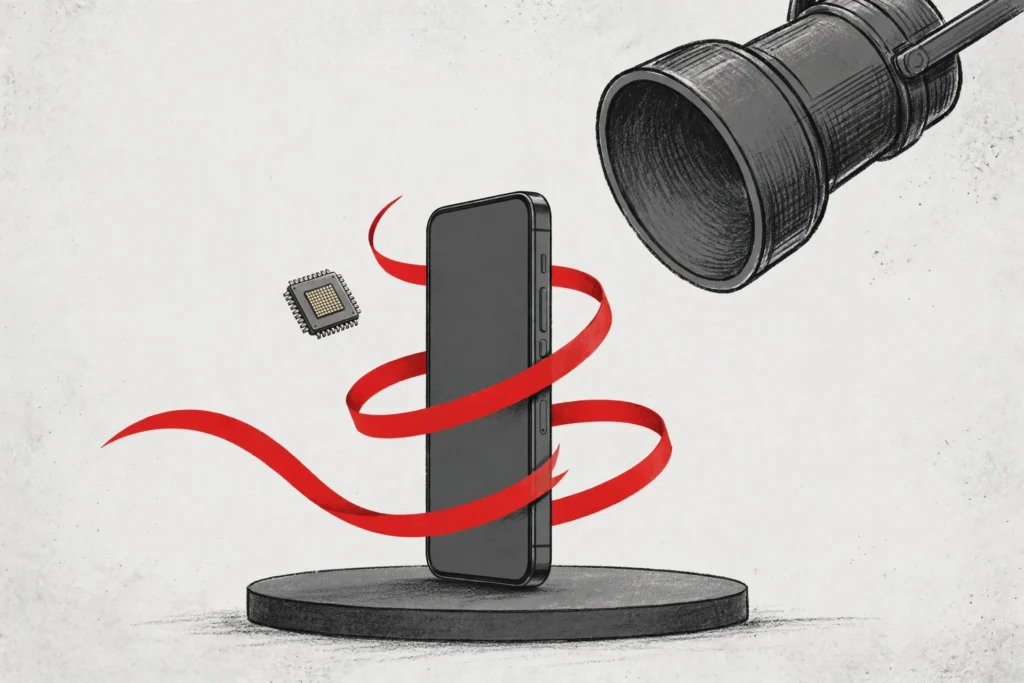
The Ruiying Z10 is an external camera module that attaches to the Mate X8 through a dedicated lens mount. Inside it sits a 1-inch, 50-megapixel RYYB stacked sensor — the kind of sensor size usually found in compact cameras, not phones.
The lens covers a focal range of 24mm to 240mm, delivering 10x continuous optical zoom. That means it zooms smoothly across the whole range without the quality drops that come with digital zoom. The aperture shifts from f/2.0 at the wide end to f/4.5 at full zoom.
The optics are serious. The module packs six lens groups with 19 all-glass elements, including ultra-low dispersion and aspherical lenses. It also carries Huawei’s third-generation Red Maple native colour camera and its own optical image stabilisation.
The phone’s own cameras are no slouch either. Reports describe a 50-megapixel main camera with a 1/1.28-inch sensor and variable aperture, a 50-megapixel macro periscope telephoto, an ultrawide lens and a new multispectral sensor, all under Huawei’s XMAGE imaging brand.
The rear camera housing has changed too. The old octagonal bump is gone, replaced by a large circular module with four lens cutouts, a central flash and XMAGE branding.
One catch: the Ruiying Z10 may only work with the Collector’s Edition. Reports suggest the detachable module is an exclusive accessory for the higher-end model, so buyers of the standard version may miss out.
Huawei Mate 90 Air: Thin, But With a Huge Battery
The second headline act is the Mate 90 Air, which Huawei calls its thinnest and lightest Mate smartphone in the regular bar-phone shape.
Huawei has not confirmed the exact thickness, but leaker Digital Chat Station puts it at around 6mm. That would make it thinner than last year’s Mate 70 Air, which measured 6.6mm and weighed 208 grams.
What makes that number remarkable is what sits inside. Reports say the Mate 90 Air carries a 6,800mAh battery — bigger than the cell in most full-size flagships, let alone a phone this thin. It is said to support 66W wired and 50W wireless charging.
The screen is a 7-inch quad-curved OLED panel with an adaptive 120Hz refresh rate and high-frequency PWM dimming, carried over in spirit from the Mate 70 Air. The design uses a dual-tone, dual-material back with a large circular camera housing, echoing the Mate 90 Pro Max.
It will ship with HarmonyOS 7 and a new Kirin chipset, with reports pointing to the Kirin 9030 series. Huawei’s store lists two configurations — 12GB of RAM with 256GB or 512GB of storage — in three colours: Rose Gold, Moon Silver and Obsidian Black.
Reservations are already open on Huawei’s online store in China. According to TechNode, full-payment preorders are scheduled to open at 6:08 p.m. Beijing time on launch day. For context, the Mate 70 Air started at 4,199 yuan in China, though Huawei has not hinted at the new phone’s price.
OSTA: Huawei’s New Sub-Brand Joins the Party
Huawei’s hardware blitz does not wait for November 24. Days earlier, on November 20, its newly established sub-brand OSTA launched its first phone, the OSTA O1 Pro.
OSTA is Huawei’s first phone sub-brand since it sold Honor in 2020. The O1 Pro is already open for preorders on Huawei’s Vmall store in Starry Black, Nebula White and Starburst Purple.
Reports say the phone packs a Kirin 9030S chip, a 7,000mAh battery and a 200-megapixel primary camera. If those numbers hold, OSTA is opening with a spec sheet aimed squarely at the mid-range crowd that wants flagship numbers without flagship prices.
The Huawei Watch Air will also appear at the November 24 event, rounding out what Huawei is billing as an all-scenario product launch.
What We Still Don’t Know
For all the detail already out there, the biggest questions stay open until the event itself.
No prices have been announced for the Mate X8 or the Mate 90 Air. The full camera specifications of the Mate 90 Air are still unknown, and Huawei has not confirmed whether the Ruiying Z10 will be sold separately or only bundled with the Collector’s Edition.
Then there is the question that matters most outside China: availability. Huawei has said nothing about a global launch for any of these devices, and its phones still ship without Google services outside China because of US sanctions.
The event starts at 2:30 p.m. China time on November 24, which is 11:30 a.m. in Pakistan. That is when the speculation ends and the real numbers begin.
Why This Launch Matters
Huawei’s November 24 event is really three bets in one.
The Mate X8 bets that phone photography can grow beyond the phone itself, with a detachable lens that turns a foldable into something closer to a real camera. If it works, other makers will follow.
The Mate 90 Air bets that thin no longer has to mean compromised. A 6,800mAh battery in a 6mm body would end the old trade-off between slim design and all-day power, and it answers Apple’s iPhone Air directly.
And OSTA bets that Huawei can build a second brand from scratch, six years after letting Honor go.
The timing is no accident. Google’s November Pixel Drop put Gemini Intelligence on the Pixel 10 this month, Samsung opened pre-orders for its Intelligent Eyewear, and AROTI’s featherweight R1 glasses are heading to Kickstarter. The whole industry is racing to make AI hardware disappear into everyday life.
Whether all three bets pay off is a question for November 24. But one thing is already clear: Huawei is not content to make the same phone as everyone else.