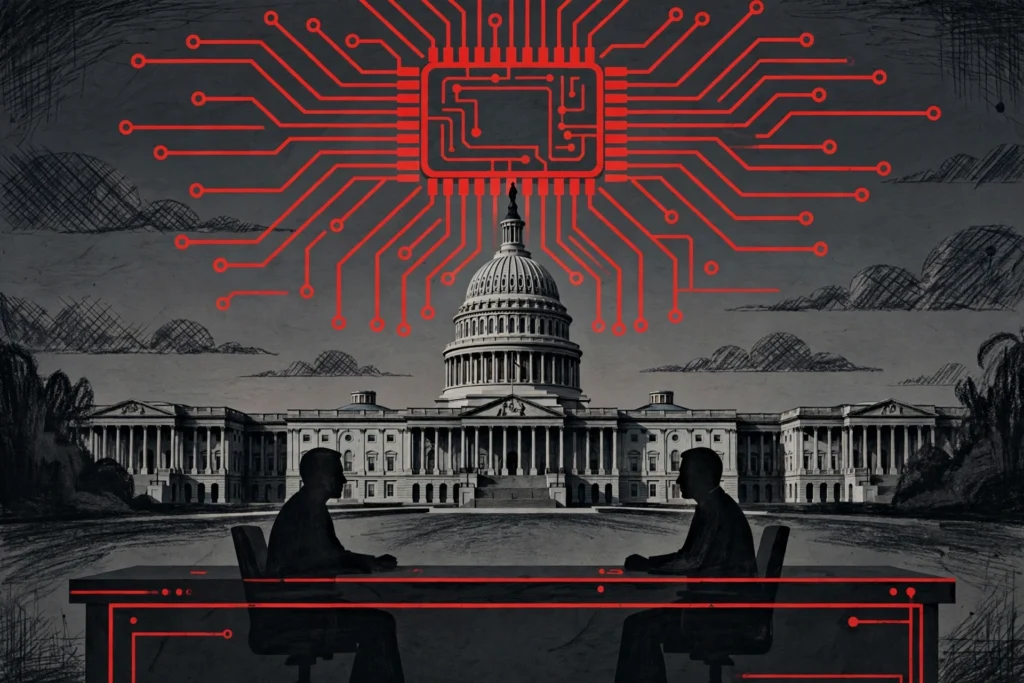
On Friday morning, Scott Bessent went on television and did something Treasury secretaries almost never do. He blamed a fellow cabinet secretary, by name, for the months-long delay on the Megaspeed blacklist — a failure now sitting at the centre of the biggest scandal in American technology.
The accusation was blunt. According to Bessent, the Commerce Department had spent months failing to blacklist a Singapore company at the heart of the Nvidia affair, even though most of the Trump administration wanted it done.
The man in charge of that department is Howard Lutnick. Within hours, the story was no longer only about a fallen chief executive. It was about a fight inside the cabinet itself.
The accusation: months of delay on the Megaspeed blacklist
Speaking on CNBC on Friday, Bessent said the Treasury, the State Department, the Pentagon and the US Trade Representative had all supported adding Megaspeed to the Entity List for months. The Entity List is America’s export-control blacklist. Once a company is on it, US suppliers need a special licence to sell it sensitive technology.
Bessent’s point was that the decision never came. The Commerce Department leads the listing process. According to Bloomberg Television, Bessent had challenged Lutnick directly, asking why Megaspeed had not been added. Lutnick, he said, responded that he would look into it.
The Commerce Department’s Bureau of Industry and Security handles the list. It is headed by Undersecretary Jeff Kessler. Commerce has been investigating Megaspeed since 2024, yet it stopped short of placing the company on the list. That gap is now the focus of the argument.
The White House said on Thursday that President Trump “maintains complete confidence” in Lutnick.
What is Megaspeed — and why Washington cares
Megaspeed International is based in Singapore. Three years ago, it was an inactive Chinese gaming subsidiary. Today it is one of Asia’s biggest buyers of cutting-edge American semiconductors.
Trade records show the company has bought more than $4.8 billion in advanced Nvidia AI chips over the past two years, according to reports this weekend. The scale is enormous for a firm that barely existed three years ago.
At the centre of the story is Alice Huang, also known as Huang Le. The 43-year-old Chinese executive played a central role in establishing Megaspeed, according to corporate documents and media reports.
She became a director when the company’s name changed to Megaspeed in March 2023 and stayed in that role until November of that year.
US intelligence officials believe she may be a Chinese intelligence asset, according to reports. That suspicion is what turned a corporate scandal into a national security question.
It is also what makes the Entity List delay so sensitive. If chips sold to Megaspeed were diverted to China, they would have slipped past the export controls Washington built to stop exactly that.
The cabinet split over China chip controls
The disagreement has been building inside the administration for months, according to CNN. Senior officials received intelligence raising concerns about Megaspeed and possible illegal transfers of sensitive technology to China. Yet the listing never happened.
Nvidia, meanwhile, had been lobbying the administration to keep the Chinese market open to its chips. The push included seeking permission to sell H200 chips, powerful processors that are not the company’s most advanced technology.
Huang himself was close to Lutnick. “Howard is the person I talk to most in the administration,” he once said. That closeness is now part of the scrutiny.
The H20 story shows how tangled the relationship became. Nvidia later disclosed that the government had told it H20 sales to China would require a licence, and that the requirement would stay indefinitely.
The deal was finished in August, negotiated by the president himself with Huang. Nvidia would pay the government 15% of its China chip revenue.
Now, with Huang gone, the administration’s divisions are in the open — and the question is whether the system for deciding blacklists works at all.
December dates: Huang and Lutnick called to testify
Congress has moved quickly. Lawmakers have requested several appearances in December.
Senate Banking Committee Chair Tim Scott has asked Jensen Huang to testify on December 3 and Commerce Secretary Howard Lutnick to testify on December 10. Three House committees have requested a closed-door briefing with Huang for December 1.
CBS reported that Lutnick has agreed to testify before the Senate Banking Committee on December 10. House Foreign Affairs Committee Democrats have also written to Lutnick, demanding to know what he and Kessler knew about Megaspeed, and when.
None of this is a finding of wrongdoing. The board inquiry into whether Huang was targeted by a foreign intelligence operation has produced no public findings, and no finding establishes espionage or export violations.
But the testimony requests show that Congress intends to ask the questions in public, even if the answers are not yet known.
What Megaspeed and its neighbours say
Megaspeed has pushed back. Its chief executive, Tan Yong Pong, said on Thursday that the company has cooperated with inspections by the US Department of Commerce and hired a US law firm to check its compliance.
In a new statement on Sunday, the company said Alice Huang left Megaspeed on August 30, 2025, and holds no role there. It added that media reports about its business were “not supported by verifiable evidence”.
Singapore has opened its own inquiries. Police and Customs began an independent investigation in February 2025 into several companies, including Megaspeed, over possible false declarations about server purchases.
Singapore’s Ministry of Home Affairs said there was insufficient evidence of declaration offences, but Huang had been barred from re-entering the country after providing inaccurate information “to downplay her role” at Megaspeed.
Malaysia is looking too. Its trade ministry said it had never cleared Megaspeed or its Malaysian affiliate Speedmatrix, and it is checking whether any imported chips were re-exported. Permits have been required since July 2025 for re-exporting high-performance US AI chips.
Why this matters for Nvidia — and for the chip war
Huang resigned on Thursday, November 12, after admitting to extramarital affairs with two women, one of whom may be connected to China. The company gave no reason for his departure.
Colette Kress, the chief financial officer since 2013, is interim chief executive while the board searches for a permanent successor. It has also appointed Harvey C. Jones as its first-ever chairman.
The market has punished the company. Nvidia shares slid 4.3% to $166.19 in Thursday trading, their lowest close since March 30, according to Dow Jones Market Data.
Two of its biggest shareholders, Brad Gerstner of Altimeter Capital and Gavin Baker of Atreides Management, have written to the board asking it to slow down and keep a possible Huang return on the table.
But the Megaspeed question reaches beyond one company. If a firm can buy billions of dollars of advanced chips and sit for years without being added to the Entity List, other buyers will notice.
That uncertainty arrives at a delicate moment. Trump is preparing to meet Chinese leader Xi Jinping next week in Shenzhen, the hub of China’s tech industry.
What happens next
The next test comes in December. Huang is due before three House committees on December 1 and the Senate Banking Committee on December 3. Lutnick is due before the same Senate committee on December 10.
Those hearings will be the first time the central figures answer questions under oath, in public, about what happened.
Nvidia, meanwhile, will report its third-quarter results on Tuesday, November 17, as previously scheduled. Investors will be listening for two things: how the business is holding up, and whether the board has any clearer idea of who runs it next.
The board’s own investigation continues, led by former acting US Attorney Joon H. Kim and the law firm Wachtell Lipton.
A personal scandal has become a corporate crisis, a corporate crisis has become a cabinet fight, and a cabinet fight is now heading for Congress. The chips, in the end, were only the beginning.