Picture a hospital room where every familiar weapon has already failed. The antibiotics did nothing. The doctors went hunting through nature’s own collection of bacteria-killing viruses, and none of them fit the infection either. The patient was running out of options, and the infection was not waiting.
Then a computer designed a virus from scratch — a virus built for one patient, one infection, and nothing else.
It was grown in a lab, tested against the patient’s own bacteria, and given to the person it was made for. According to reports from the New York Times and Northeastern University, it is the first time AI-designed viruses have ever been administered to a human patient.
The story comes from Radical Numerics, a San Francisco startup, and its genome model Omnii-1. It is a genuine milestone for AI in medicine — wrapped in caveats that matter as much as the headline.
When Antibiotics Stop Working
For nearly a century, antibiotics have been medicine’s magic bullet. But bacteria evolve, and the drugs that once worked reliably are losing their power.
More than 9.3 million drug-resistant infections occur in the United States each year, according to the Centers for Disease Control and Prevention. Radical Numerics warns that antibiotic resistance could claim nearly 40 million lives between 2025 and 2050.
That is the crisis behind this story. When the standard drugs fail, doctors are left with fewer and fewer moves. This patient had reached that point: an antibiotic-resistant E. coli infection that had shrugged off not only the drugs, but every naturally occurring virus doctors could find to fight it.
AI-Designed Viruses: Hunters Built to Order
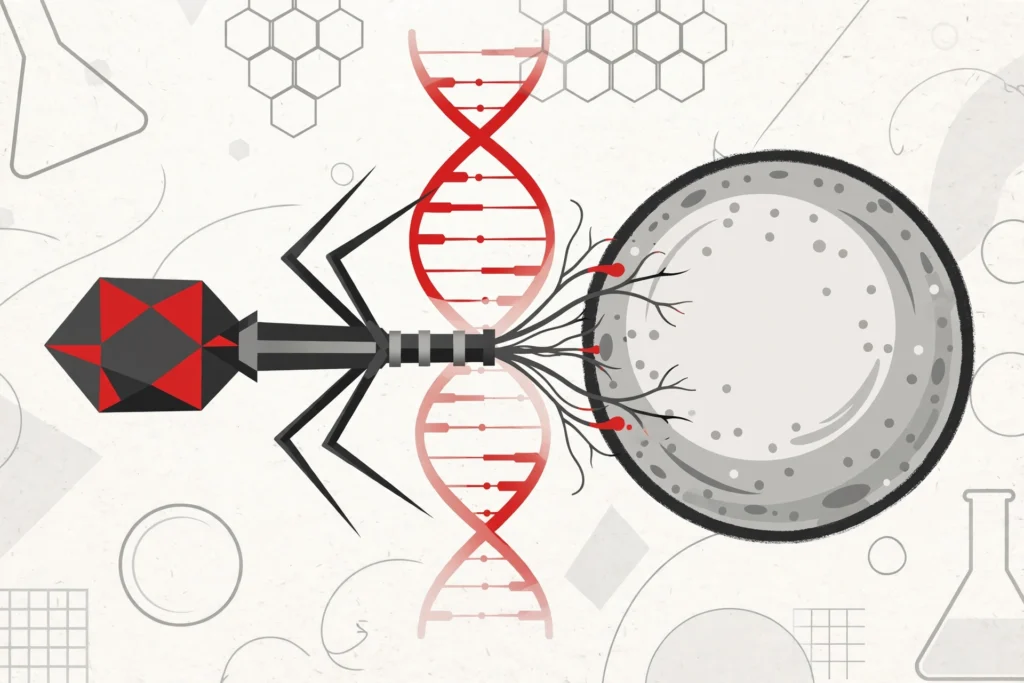
The viruses in question are bacteriophages, or phages for short. They are viruses that infect bacteria and leave human cells alone. Nature has been making them for billions of years, and doctors have used them as a treatment of last resort for decades.
The problem has always been matching the weapon to the target. Every bacterial strain carries its own set of molecular equipment, and a phage needs the right “legs” — spindly protein protrusions it uses to anchor onto a cell and inject its DNA — to grab hold.
Once inside, the virus turns the cell into a factory for more viruses until it bursts.
Radical Numerics’ answer was to stop searching and start designing. Its Omnii-1 model unifies 28 biological modalities — DNA, RNA, proteins, epigenomics and more — in a single system trained on trillions of tokens of biological data.
Instead of sifting through samples from soil and sewage, scientists could ask the model for a virus shaped to grip one specific bacterial strain. The model suggested changes to the DNA coding for the phage’s anchoring legs, and out came candidates to test in the lab.
It is part of a wider shift toward AI systems that design and improve their own tools, with new frontier models arriving almost weekly.
From Computer Model to Living Virus
The team started with T7, a well-studied phage that infects E. coli. Omnii-1 redesigned the genes for its tail fibres so the virus could latch onto the patient’s resistant strain — a strain that existing phages could not touch.
Researchers then synthesised the new DNA, grew the phages inside bacteria, and screened them for safety. In one of the company’s experiments, 69.9% of designs carrying 11 to 15 amino-acid changes produced viable phages, against just 4.8% of random controls.
Before the treatment was given, the AI-designed phage cocktail was tested against bacteria collected from the patient. Laboratory testing reportedly showed the mixture eliminated the patient’s antibiotic-resistant bacterial sample.
That is a result against a sample outside the body — not proof the infection cleared inside it.
The First Patient: What Actually Happened
The treatment was given in October under an authorised compassionate-use pathway, with special permission from the US Food and Drug Administration. It was a physician-led treatment for a patient who had run out of conventional options — not a clinical trial.
Dr. Marisa Azad, an infectious disease clinician at the Ottawa Hospital, collaborated on the treatment. The broader effort was led by another biotech startup, Tabula Bioscience — a partnership Radical Numerics did not disclose in its original announcement.
Radical Numerics has not disclosed the patient’s diagnosis, how the viruses were administered, or whether the infection cleared. The company says it is withholding the patient’s clinical course to protect privacy, and its October 20 report has not been peer-reviewed.
As Northeastern University reported, the treatment still has to make it through clinical trials, and the FDA has not given it an official nod. Results could take months.
What We Still Do Not Know
The honest answer is: most of the important things. Nobody outside the treatment team knows whether the patient improved, stayed the same, or got worse. A virus that kills bacteria in a petri dish does not always do the same job inside a human body.
There are also questions no one has answered yet. If every patient needs a different virus, would the FDA have to sign off on each one? How would a treatment like this be manufactured at scale?
These are open questions, as Northeastern biotechnology professor Sudhakaran Prabakaran put it. He called himself “cautiously optimistic” about the development — a phrase that captures the mood of most experts watching this space.
The episode also echoes a wider pattern in AI: powerful systems arriving faster than the safety frameworks around them. The same week, the AI world was still digesting a breach at Fireworks AI that exposed customer data, a reminder that verification and oversight have to keep pace with capability.
Even the strongest AI models now ship with safety testing as a headline feature, not an afterthought.
The Other Side of the Same Coin
Designing viruses is a dual-use technology. The same techniques that build a phage to kill a superbug could, in the wrong hands, be turned toward building something harmful. That is not a hypothetical worry; it is the reason biosecurity experts are watching this field so closely.
Alexander Sulakvelidze, chief executive of Intralytix, a company that develops bacteriophages, welcomed the work’s potential to make treatments more precise. He also flagged unreliable AI predictions, unintended effects, and the risk of using the technology to create harmful biological agents.
His prescription was human oversight. “AI should complement, rather than replace, scientific expertise and laboratory testing,” he said.
Radical Numerics itself seems aware of the tension. On November 11, the company launched Omnii Defense, an edge model designed to flag natural and AI-engineered pathogens using only a laptop and a small gene sequencer, working offline in the field.
To test it, the team removed the Bundibugyo virus — behind an Ebola outbreak in East Africa — from the training data, first at the species level and then across its whole genus. The system still flagged it. Access is limited to vetted testers working with national laboratories and government agencies.
There was also an awkward footnote. Harvard geneticist George Church, who advised both Radical Numerics and Tabula Bioscience, resigned from Radical last week over the company’s failure to disclose Tabula’s role in the treatment.
What Happens Next for AI-Designed Viruses
If this approach holds up, the payoff could be enormous. Radical Numerics CEO Eric Nguyen hopes the process could eventually custom-build a patient’s phage in days, not months.
That speed would change the maths of phage therapy entirely. Today, finding a matching phage can take weeks of searching — time a seriously ill patient may not have. Designing one on demand would turn a last resort into a routine option.
The benefits could also reach beyond individual patients. Minmin Yen, co-founder and chief executive of PhagePro, a Boston startup working to curb cholera, told Northeastern that tailored phages have “exceptional potential” for tackling diseases that burden entire communities.
Unlike broad-spectrum antibiotics, a designed phage attacks only its target strain, sparing the helpful bacteria antibiotics usually wipe out.
But none of that is proven yet. One patient, one unpublished report, and an undisclosed outcome is a beginning, not a verdict. The next steps are clinical trials, peer review, and the slow, unglamorous work of proving that a computer-designed virus is safe and effective in real bodies.
For now, the story stands as a marker: AI has moved from reading genomes to writing them, and from writing them to putting them into a human being. What happens next will decide whether that marker becomes a turning point in medicine — or a cautionary tale.