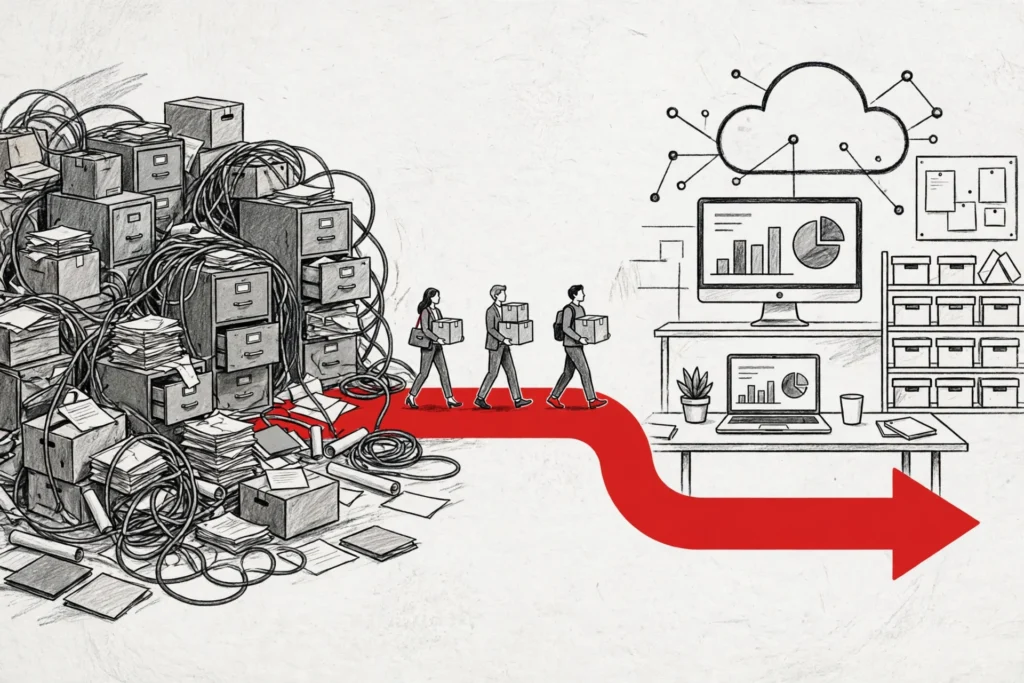
Picture the scene: a sales operations manager opens a spreadsheet on a Monday morning, and it is not a sales report. It is a CRM migration plan. Eighteen months long. Four consultants. Two hundred custom fields to untangle, forty workflows nobody remembers writing, and a dozen integrations held together by habit and hope.
That spreadsheet is why so many companies never switch CRM systems, even when the one they have is slow, expensive and out of date. The cost of leaving has always been higher than the cost of staying.
ServiceNow, according to a press release from the company, thinks its new Autonomous CRM Engine can finally change that arithmetic.
The ServiceNow Autonomous CRM Engine, announced on November 12, is an AI-native tool that promises to move an enterprise off a legacy CRM platform and onto ServiceNow CRM in weeks instead of months or even years. It is in Controlled Availability now, with expanded capabilities planned for 2027.
What the ServiceNow Autonomous CRM Engine Actually Does
At its simplest, the engine is a migration machine. It studies how a company actually uses its current CRM, redesigns those processes around ServiceNow’s best practices, builds the new setup, and then keeps watching it after it goes live. The AI does the discovery work, the mapping, and much of the building itself.
Four Stages: Discover, Design, Build and Monitor
The engine works in four stages, and the first is the one that usually eats the most time. In the Discover stage, it maps how the customer’s CRM is really being used today.
That means business processes, workflows, custom objects and integrations, including how each one is defined, configured and connected inside the customer’s own environment. Traditional migrations spend months on this manual discovery, with teams forced to reverse-engineer rules that were written years ago by people who have long since left.
Next comes Design. Here the engine builds a transformed future state based on ServiceNow’s industry best practices. The company stresses that this is not a lift and shift. The old system is not copied into a new home. It is redesigned.
Then the Build stage deploys the approved changes directly into the ServiceNow environment. The engine translates the current setup and the agreed redesign into ServiceNow code and configurations, using the company’s Build Agent technology.
Finally, Monitor takes over. Once the new CRM is live, the engine continuously watches the environment. It is designed to catch configuration drift and misconfigurations before they turn into support tickets or disrupt the business.
Why Switching CRM Has Always Been So Painful
Anyone who has lived through a CRM migration knows the real problem is rarely the software itself. It is the archaeology. A company does not just have a CRM. It has ten years of decisions baked into one, and untangling all of that by hand is slow, expensive and risky.
Custom objects pile up. Workflows reference fields nobody can explain. Escalation rules were written for a team structure that no longer exists. Integrations were built by contractors and never documented.
That is why migrations drag on for months or years, and why many companies simply give up and stay put. The status quo becomes the safe choice, even when everyone agrees the system is holding the business back.
ServiceNow is betting that an AI system can do this archaeology faster and more reliably than a team of consultants — the same kind of multi-step enterprise work that Databricks’ Genie now handles as an always-on AI coworker. If the claim holds up, it removes the single biggest reason companies do not switch.
The stakes are real. Research firm Gartner projects that, by 2029, organisations that fail to understand their current CRM system limitations will be restricted in their customer service experience improvements by 50%. In other words, not knowing what your CRM cannot do will soon cost you half your ability to improve service.
The Sweep Acquisition Behind the Engine
The engine did not appear from nowhere. It builds on ServiceNow’s acquisition of Sweep in September 2026, which brought the company’s Build Agent and other AI capabilities into ServiceNow’s platform. The Build Agent is the piece that turns a mapped-out design into working ServiceNow code and configurations.
Amit Zavery, ServiceNow’s President, Chief Product and Operating Officer, told Diginomica that the engine can show a customer the specifics before any contract is signed. It shows the mapping, and it shows how long the move will take.
Zavery also said that customers already using the engine have found migrations taking months instead of years, or weeks instead of months. Those are early-customer results rather than independent measurements, and they will need to survive contact with messier real-world environments.
What It Means for Salesforce and the CRM Race
ServiceNow is not the only vendor attacking switching costs. Microsoft has launched Dynamics 365 Activate, a migration tool that uses AI agents to map a CRM estate and build a new one.
Salesforce, meanwhile, spent its Dreamforce event this year pushing Agentforce and its new AIforce layer, while Anthropic’s Claude office suite shows how AI is moving into everyday workplace tools. The pattern is clear: the CRM market is no longer competing mainly on features. It is competing on how easy it is to arrive.
That makes the Autonomous CRM Engine a strategic product, not just a technical one. If ServiceNow can genuinely cut migration time from years to weeks, its sales conversations change completely. The question stops being whether the platform is better, and becomes how quickly a customer can get there.
John Ball, ServiceNow’s Executive Vice President and General Manager of CRM and Industry Workflows, put it plainly: “Autonomous CRM Engine shortens the move from legacy systems to AI-native CRM to weeks, giving enterprises a practical path off legacy CRM platforms.”
Salesforce will not be standing still, but a credible weeks-long migration path is exactly the kind of offer that makes a chief information officer start asking uncomfortable questions about the status quo.
What Is Still Missing: Pricing, Proof and Availability
For all the ambition, several important details are still unknown. ServiceNow has not published pricing for the Autonomous CRM Engine, and Controlled Availability means only selected customers can use it today.
The weeks-long timeline is also a vendor claim for now. It has not been independently verified across varied customer environments, and every enterprise CRM is different. Custom workflows and deep integrations are exactly the parts most likely to resist automation.
There is also a question about what happens to the consultants. CRM migrations employ a large industry of implementation partners, and if an AI engine does the discovery and much of the build, that industry changes shape.
ServiceNow has not said how its partner ecosystem fits into the new model, but the honest test will be the first wave of real migrations, with real custom objects and real integrations, measured in weeks rather than in press-release promises.
What Happens Next for the Autonomous CRM Engine
ServiceNow says expanded capabilities are coming in 2027. The company also expects the platform to evolve into an agentic layer that continuously manages and improves CRM operations, not just migrates them once.
That is the longer ambition. A CRM that migrates itself is useful, but a CRM that keeps itself clean, catches drift, and improves its own processes without waiting for a project team is a different kind of product entirely.
For now, the companies watching most closely will be the ones with that Monday-morning spreadsheet. If ServiceNow’s engine can turn an eighteen-month migration plan into a matter of weeks, the spreadsheet goes away — and with it, the best reason many enterprises ever had to stay exactly where they are.
It is the same enterprise-AI shift behind IBM and Microsoft’s Imagine Enterprise platform, which is putting thousands of AI agents to work inside big business.
Source: ServiceNow’s announcement, reported by Business Wire, with additional reporting from Diginomica.