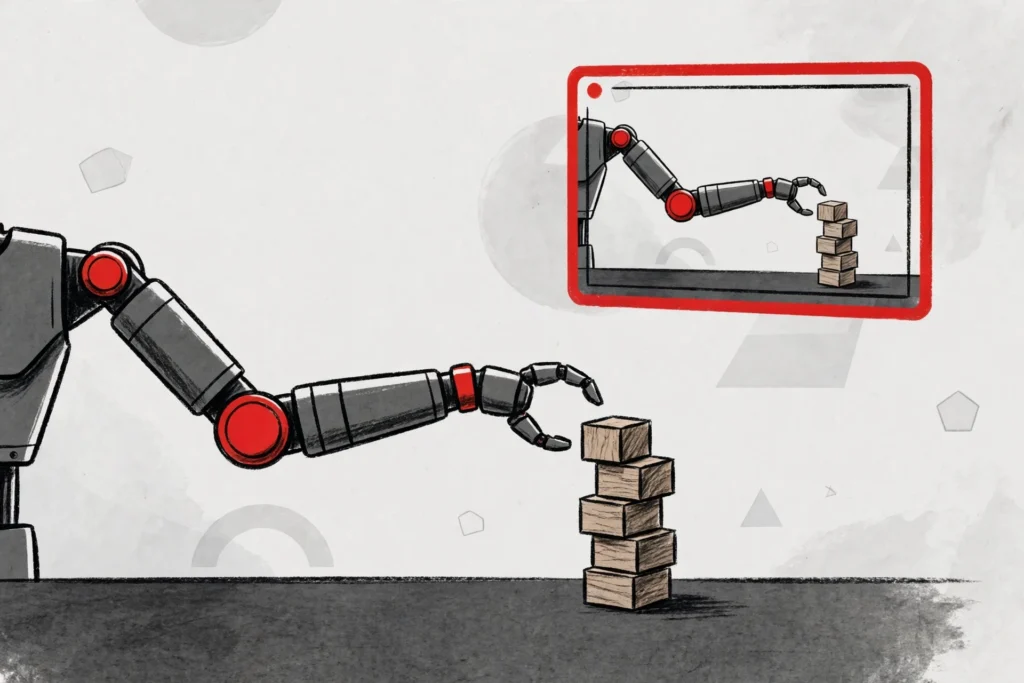
Picture a small robotics lab late at night. A researcher has a robot arm, a camera and a stubborn problem: teaching the arm to pick up a mug without knocking everything else off the table.
Until now, that meant months of collecting demonstrations, tuning code and starting over every time the task changed. On November 11, Runway handed that researcher something new — a robot brain she can simply download.
Runway, the company best known for its AI video tools, has released the weights for Praxis-1, its robot foundation model, under the Apache 2.0 licence. Anyone can download it, run it on their own hardware, fine-tune it for their own robot and even use it commercially.
No licence negotiation, no API gatekeeper, no waiting list. It is the most permissive release in a crowded week for robot intelligence, and it changes who gets to build the machines that move.
What Runway Praxis-1 Is
Praxis-1 is what Runway calls a world action model: a 27-billion-parameter mixture-of-experts diffusion transformer that predicts video and robot actions together. In plain language, it watches the world, imagines what should happen next, and turns that imagined future into movement.
That design is no accident. Runway built its name on video generation, and Praxis-1 is built on the same large-scale video pretraining behind its general world models. The company first introduced the model in September 2026 and promised it would ship as an open model.
The November 11 release delivers on that commitment. Each time the model is called, it produces 1.6 seconds of motion — 24 action rows at 15 hertz — in roughly half a second on a single H100 GPU, according to Runway’s technical write-up.
That speed matters. A robot that pauses to think for seconds at a time cannot work beside people, on a line, or in a home.
How Runway Praxis-1 Learns by Watching Video
The core idea behind Praxis-1 is simple to state and hard to build. Instead of learning only from robot demonstrations, which are expensive and slow to collect, the model learns from video — vast amounts of it.
It predicts a short clip of what should happen next, then derives the robot’s actions from that imagined future. This is why a video company was well placed to build it.
Runway’s world models already understand how objects move, how hands grasp and how scenes change over time. Praxis-1 takes that understanding and connects it to motors, grippers and wheels.
The result is a model that does not need to be re-taught from scratch for every new task. Give it a new robot and a new job, fine-tune it on a modest amount of data, and it can start moving with purpose.
That is the promise of a foundation model for robotics, and it is the same logic that made large language models so useful for text.
Runway Praxis-1 Benchmark Results: 46.2% on RoboLab-120
Runway’s headline number comes from RoboLab-120, NVIDIA’s simulated benchmark of 120 tabletop manipulation tasks with ten trials each. The DROID fine-tuned version of Praxis-1 completed 555 of 1,200 episodes, a 46.2% success rate, ahead of FLUX 3 Action at 42.9%.
Runway says that is the best result among the listed world action models and open-source robot foundation models. The model also reached 80.0% success on the SimplerEnv benchmark, another widely watched test of robot manipulation in simulation.
Two caveats belong next to those numbers, though. First, every figure so far is Runway’s own — no independent lab has reproduced the leaderboard result yet. Second, 46.2% is a first-place finish that still means failing more than half the time, on simulated tabletop tasks, not on a factory floor.
A robot that succeeds four times out of ten is a research milestone, not a worker. That honesty matters, because the gap between simulation and the real world is where robot projects live or die.
Runway’s launch partners have been running the model on real hardware rather than only in simulation, which is exactly the test that counts.
What’s Inside the Runway Praxis-1 Download
The release is unusually complete for an open model. Three checkpoints are available: the base mid-trained model, a version fine-tuned on the DROID robot dataset, and one fine-tuned for the bimanual YAM robot.
Alongside the weights come inference code and both full and LoRA fine-tuning code, on GitHub and Hugging Face with native support for the LeRobot robotics library. It is also available in the vLLM-Omni serving engine, and hosted inference runs on Reactor, Runway’s own platform.
The full model is 54.4 GB in bfloat16 format, so it fits on a single 80 GB GPU. A 4-bit NVFP4 quantised version shrinks the weights to 17.5 GB.
Runway says it runs out of the box across NVIDIA hardware, from H100 and B200 data-centre cards to RTX 5090 and RTX PRO 6000 workstation cards, and on the Jetson Thor computer that sits inside the robot itself.
That range is deliberate. A model that only runs in a data centre is a demo. A model that also runs on the computer inside the robot is a tool.
Runway Praxis-1 vs GR00T 2 and Gemini Robotics 2.5
Praxis-1 arrives in the middle of a crowded week for robot models. NVIDIA opened up its GR00T 2 model days earlier, and Google’s Gemini Robotics 2.5 is already running on a Mercedes-Benz factory line. Runway’s entry is the most permissive of the three: full weights, fine-tuning code and a licence that allows commercial use.
The comparison is instructive. NVIDIA’s GR00T 2, which also learns by watching human video, is aimed squarely at humanoid robots and the NVIDIA ecosystem.
Google’s Gemini Robotics 2.5, now working on Mercedes-Benz production lines, is a closed model deployed through partners. Praxis-1 sits between them in ambition and ahead of them in openness.
There is also a quieter parallel. Hedra’s Model Factory, announced this week as well, bets that robots and other physical systems need models that improve themselves after deployment. Praxis-1 takes the other route: give everyone the same strong starting point, and let the community do the improving.
Why Open Weights Matter for Robotics
Robotics has long been a gated field. The best models lived behind APIs, the best datasets belonged to a handful of labs, and a small team with a good idea could not compete with a company that owned the hardware. Open weights change that equation.
When a researcher in a university lab can download the same model a well-funded startup uses, the field moves faster. Bugs get found sooner. Fine-tunes for unusual robots — a farm arm, a lab pipette, a warehouse gripper — appear from people the original builders never met.
That is how open-source software transformed computing, and robotics is now getting its turn. The Apache 2.0 licence is the key detail here. It is not a research-only release or a non-commercial preview.
A company can build a product on Praxis-1, ship it and sell it. That is what makes this release different from many open model drops, which arrive with strings attached.
Three launch partners have already run it on real machines: Noble Machines on a legged humanoid, Standard Bots on a six-axis industrial arm, and Ultra on a dual-arm warehouse robot. Those are three very different bodies, which is the point — one model, many machines.
What Happens Next for Runway Praxis-1
The honest test of Praxis-1 starts now, in the hands of people Runway has never met. Independent researchers will try to reproduce the RoboLab-120 result. Hobbyists will run the quantised version on workstation cards.
Startups will fine-tune it for robots Runway never designed for. Some of those attempts will fail, and the failures will be public. That is the bargain of open weights: you cannot hide a weak model behind an API, and you cannot claim a benchmark nobody can check.
If the numbers hold up, Praxis-1 becomes the default starting point for robot builders. If they do not, the community will find out fast and say so.
Either way, something has shifted. A robot brain that once would have belonged to one company now belongs to everyone with a download link. The researcher in that late-night lab no longer has to start from zero.
She can start from Praxis-1 — and spend her time teaching the robot the one thing only she knows: the job that needs doing. That, according to Runway’s announcement, is exactly the point.