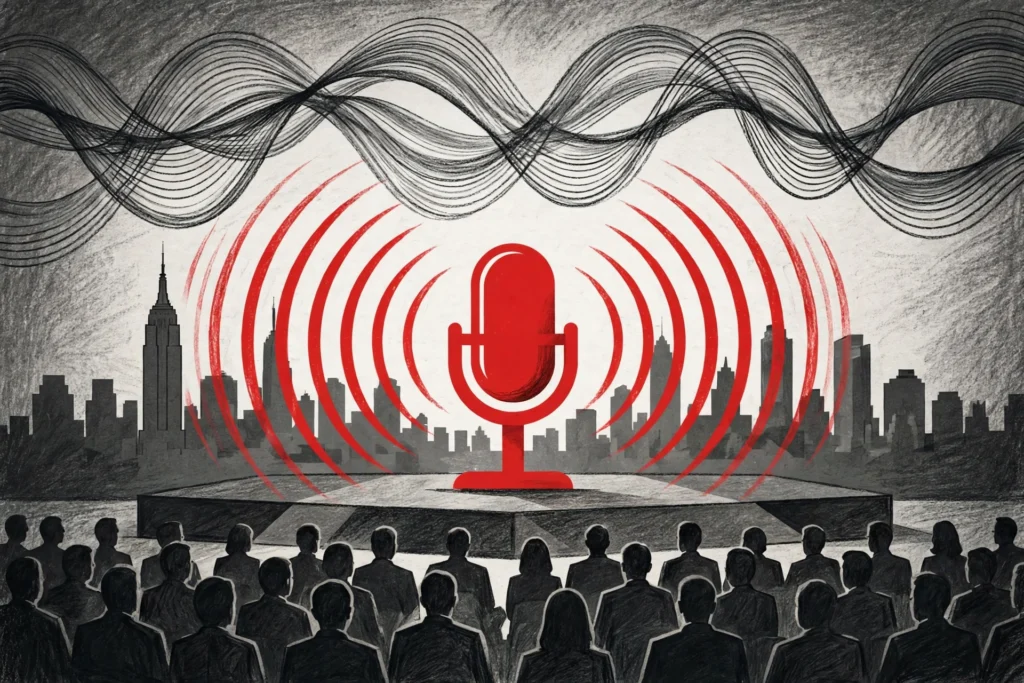
Greg Kellner spent his life teaching through song. Then surgery for brain cancer in 2019 took his singing voice away. On a stage in New York on November 11, he sang again.
Beside him stood Abdi Omar, who has cerebral palsy and has never had a spoken voice of his own. He designed one from scratch. Together, the two songwriters performed original music live, using voices that ElevenLabs helped them restore and create.
It was the most human moment of the ElevenLabs Summit, a one-day gathering of voice AI, business and technology leaders in New York. Behind the emotion sat a hard business message: ElevenLabs unveiled ElevenAI, custom-tuned models, agent memory and automation, and a partner program — moving from generating voices to managing conversations and employee work.
NVIDIA chief executive Jensen Huang joined co-founder and chief executive Mati Staniszewski on stage, underlining how central voice agents have become to the AI infrastructure story. Staniszewski put it bluntly: conversational agents will become “critical infrastructure for every enterprise, as essential as cloud or payments” within a few years.
Two Voices, One Stage at the ElevenLabs Summit
Gabi Leibowitz, who leads ElevenLabs’ Impact Program, shared the stories behind 1 Million Voices, the company’s effort to give voices back to people who have lost them or never had one. Then she sat down with Kellner and Omar to talk about losing a voice, building a new one, and making music again.
ElevenAI: A Meeting Assistant That Listens and Acts
The headline product was ElevenAI, a workplace app that listens to spoken conversations, including in-person meetings, and turns them into notes, summaries and action items.
It is designed to do more than transcribe. The app can provide live assistance during a conversation and pass context between people and agents, so the work does not stop when the meeting ends. Free early access opened with the announcement.
Dictation and meeting notes run on Scribe v3, the company’s recorded-audio transcription model, which covers 102 languages. A separate variant, Scribe v3 Live, is built for low-latency, real-time audio.
ElevenLabs stressed that the app takes meeting notes only with participants’ consent, with notice and consent mechanisms built in. That detail matters, because an app that listens to meetings will be judged as much on trust as on accuracy.
Custom Models Trained on Your Own Conversations
The second announcement targets a frustration every enterprise AI buyer knows: a general-purpose model sounds fine in a demo, then stumbles on the company’s own customers, jargon and edge cases.
ElevenLabs said it will help businesses fine-tune selected open-source language models and its own voice models using data from their live deployments. Companies will work with its researchers to tune models for their own customers and operating context, choosing what to optimise for, such as customer satisfaction or reliability.
Because the data comes from live deployments, the models can keep improving as interactions accumulate, instead of freezing at the quality of a single training run. The customisation work is set to begin in the coming months.
The company already applies this industry-specific approach through Scribe v3 Medical, a healthcare transcription model built to recognise specialised terminology. A domain-optimised financial-services model is also in development.
Memory and Routines: Agents That Remember and Finish the Job
ElevenAgents, the platform for deploying voice and chat agents, is gaining two features that push it beyond answering questions: Memory and Routines.
Memory will recognise returning authenticated customers and distil each conversation into a structured record of preferences, constraints and future occasions. A customer who prefers Spanish and can only talk after 5 p.m., for example, would not need to repeat those details on the next call.
The customer relationship management system stays the primary customer record. Memory is a layer on top of it, not a replacement for it.
Routines, also forthcoming, is designed to automate multi-step work before, during and after conversations, connecting with existing tools and systems. Examples include pre-screening a mortgage applicant and calling back within minutes, reminding patients about visits and offering cancelled slots to waitlisted patients, emailing reports, writing to a CRM or initiating calls.
Together, the two features move ElevenAgents from answering inquiries towards retaining context and completing the work that surrounds a conversation. That is the difference between a chatbot and a colleague.
The Interaction Engine: Cheaper Models for Easy Work
The summit also previewed the Interaction Engine, which tackles a quieter problem: deciding how a conversation should run.
It manages turn-taking and interruptions and can assign different language models to different parts of an exchange. A cheaper model handles triage, while a frontier model takes the complex tasks, keeping routine exchanges from requiring a frontier model at every step and limiting token use.
A Bigger NVIDIA Bet and 15 MW of Vera Rubin Compute
The NVIDIA partnership, already running since 2022, got a major expansion at the summit. NVIDIA’s Nemotron 3.5 Super VL open model is now available in ElevenAgents, helping AI agents understand workflows and human reasoning.
ElevenLabs also plans to add 15 MW of NVIDIA Vera Rubin compute capacity on top of its existing Blackwell Ultra systems. The added capacity is intended for large deployments with security or data-residency requirements, and to give ElevenLabs researchers access to optimised compute.
The expanded collaboration covers a striking real-world deployment: an on-premises voice agent for Centralna e-Rejestracja, the central appointment system in Poland’s national e-Health platform. Built with EasyCall, the agent calls patients who only have landlines to remind them about appointments and help them reschedule.
The central system handles 40 million appointments a year, with no-show rates of 10% to 20%. The deployment uses NVIDIA Confidential Computing to keep citizen data and audio within government infrastructure and protect it during processing.
Partners, Marketplace and the McKinsey Alliance
ElevenLabs reports more than 550 partners across 44 countries, including Google Cloud, IBM, Deloitte, DXC and Genesys. The new Partner Program lets consultancies, systems integrators, software vendors and agencies integrate ElevenAgents into enterprise technology stacks or work with ElevenLabs’ forward-deployed engineers on complex deployments.
An alliance with McKinsey and QuantumBlack, AI by McKinsey, pairs the platform with McKinsey’s enterprise-transformation work. The accompanying Marketplace initially offers a curated catalog of partner-built applications for healthcare, financial services, insurance, education and retail.
Enterprises can browse the applications and contact their developers. Purchasing through existing ElevenLabs commitments is planned to start in 2027.
Why Voice Agents Are Suddenly Enterprise Infrastructure
Step back from the product list and the pattern is clear. Anthropic is turning Claude into an office suite, Databricks is turning Genie into an always-on AI coworker, and IBM and Microsoft are bundling thousands of prebuilt agents for big business.
ElevenLabs is making the same move from a different starting point: the voice. If agents are going to do real work inside companies, many of them will talk to customers and employees first. The company that owns the voice layer owns the front door.
That is why the summit mattered beyond its own announcements. Huang sharing a stage with Staniszewski, the McKinsey alliance, the Vera Rubin capacity, the Poland health deployment: each one is a signal to enterprise buyers that voice agents are not a bolt-on feature any more. They are becoming core infrastructure.
What Happens Next
The near-term test is execution. The customisation work begins in the coming months, Memory and Routines are still forthcoming, and ElevenAI’s free early access will show quickly whether employees actually want an app listening to their meetings.
Watch for the first named enterprise customers on custom models, and for the financial-services model that is already in development. If those land, the summit will look like the day ElevenLabs stopped being a voice startup and became an enterprise software company.
And watch the quieter story too. Kellner and Omar sang on that stage because a voice model gave them something back. The enterprise pitch is about efficiency and cost. The human story is about what a voice is worth. ElevenLabs, for now, is selling both.