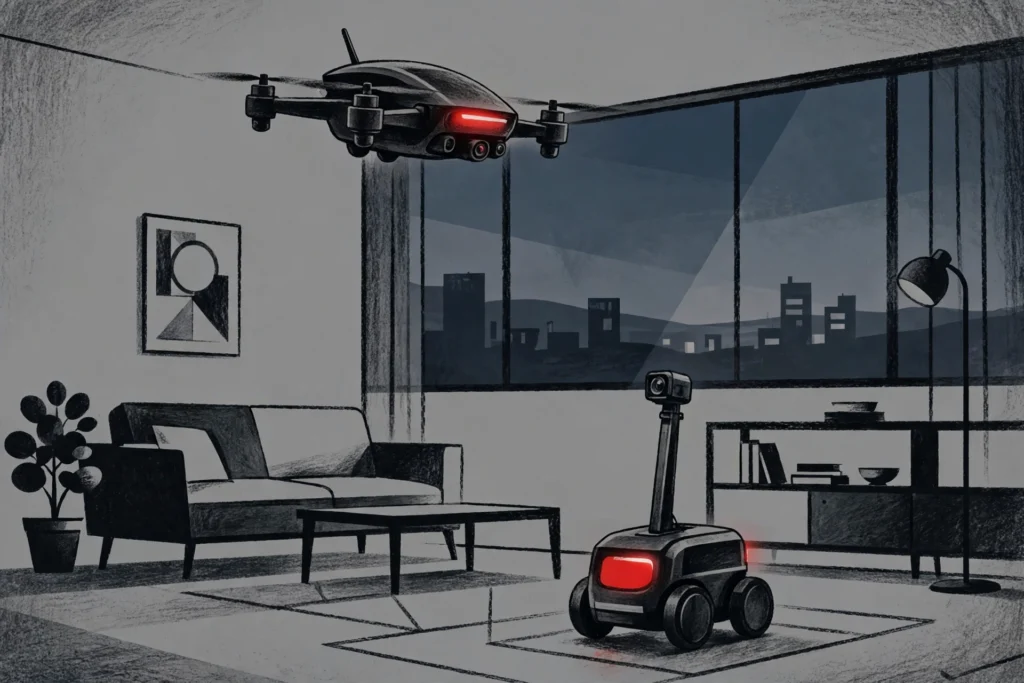
Ring Drone Cam: A Security Camera That Flies to the Problem
It is 2 a.m. and your phone buzzes. A motion sensor in the hallway has tripped, and the camera on the wall shows you a dark corridor and nothing else. You are awake now, staring at a grainy image, trying to decide whether that shadow is a burglar or your cat.
Ring thinks the answer should come to you instead. On November 10, Amazon’s home-security brand announced Ring Robotics, a new line of devices that move. The first two products are the Ring Drone Cam, a flying indoor camera for homes, and the Ring Rover Cam, a wheeled patrol robot built mainly for businesses.
The Ring Drone Cam costs $249.99 and is due to ship in the United States on January 27, 2027. There is a catch: it still needs authorisation from the Federal Communications Commission, and Amazon says it cannot be sold or leased until approval arrives. For now, Ring is only collecting email sign-ups.
The drone is small and light at just 165 grams. It records 2K video through a front camera with a 148-degree field of view, spins a full 360 degrees, and carries a second 1080p camera underneath. LED lights let it see in dark rooms, and it can fly room to room, including upstairs.
When it is not working, the drone sits in a charging dock with its camera switched off. It leaves the dock on a schedule, on demand, or on its own when another Ring camera, sensor or alarm is triggered.
You can also send it to a spot you tap on the Alexa Home Map in the Ring app.
Its biggest limit is the one Ring states plainly: up to eight minutes of flight per charge. After that, it returns to its dock to recharge.
Ring Rover Cam: A Patrol Robot for Businesses
The Ring Rover Cam costs $999.99, is open for pre-order now, and ships first — on December 16, 2026. It is built on the technology behind Amazon’s Astro home robot, but with a much narrower job: patrolling shops, offices and other business spaces.
The rover streams and records in up to 4K through an adjustable periscope camera that can rise to look over counters and shelving. It saves a different camera height for each stop and performs a 360-degree scan at every patrol point. It also carries two-way audio, a remotely activated siren and a light tower.
A small screen shows its status, including whether it is recording or being watched live. Infrared night vision covers dark rooms in black and white, and Ring says it can map up to 5,000 square feet on a single floor.
There are limits here too. The rover stays on one floor and cannot climb stairs, and it runs for about 30 minutes per charge. It avoids floor transitions taller than 1.375 inches, and Ring recommends at least 15 megabits per second of upload capacity.
AI Pilot: How the Robots Learn Your Floor Plan
Both devices run on a navigation system Ring calls AI Pilot. It combines cameras, specialised vision models, onboard sensors and cloud processing to see, think and navigate on its own, according to Amazon.
Setup is deliberately light. You carry the drone through the space once, or let the rover explore by itself, and the system turns what it sees into a floor plan. It identifies rooms on its own and suggests patrol points worth checking.
A connected Ring camera, sensor or alarm can then trigger a trip to the exact spot where something happened.
Google’s Gemini Robotics 2.5 is already being tested on Mercedes-Benz production lines, where humanoid robots handle automotive kitting tasks. Ring is bringing the same thinking into homes and shops, just at a much smaller scale.
What Eight Minutes of Flight Actually Buys You
Eight minutes sounds short, and it is. But Ring is not selling a drone that hovers over your hallway all night. It is selling a camera that can go and look at something, then come back.
That fits a handful of real moments. A sensor trips in the kitchen at night, and the drone flies over to show you whether a window is open. At work, you can check whether the kids got home safely. A leak sensor fires, and the drone can look at the floor near the washing machine.
One thing both devices need is a Ring Protect subscription: scheduled flights, patrols and reviewing recordings all require a compatible plan.
Privacy by Default — or Just by Promise?
Both devices flash an LED while recording, so anyone in the room can see when they are being watched. The drone’s camera is off while it sits in its dock.
The rover has a Sleep Mode that lowers its periscope and disables its microphone, and video from both devices is protected by TAKE, or Throw Away the Key, encryption — Ring’s strongest default encryption yet.
Still, the questions are fair. A flying camera can look over a half-open bathroom door. A patrol robot in a workplace films employees as well as intruders. And the drone must stay within line of sight under FAA rules, so it will not fly outdoors or follow you around the garden.
Ring Has Tried This Before
This is not Ring’s first attempt at a moving camera. In 2020 it showed off the Always Home Cam, an indoor drone that was supposed to fly around the house on patrol. It never really reached customers in meaningful numbers, and the idea quietly stalled.
The rover has its own history too. It reworks Amazon’s Astro robot, which was sold to businesses as Astro for Business at more than twice the rover’s price. At $999.99, it costs less than half of Astro for Business — a sign Amazon has learned the first version was simply too expensive.
Ring is not the only company betting that small, clever gadgets can find a place. The AROTI R1 AI glasses, announced the same week, weigh under 27 grams and show translations in the wearer’s line of sight. The gadget world is moving toward devices that go where you go, not sitting on a shelf.
What Happens Next
The rover arrives first, shipping on December 16, 2026, in time for businesses to put it to work over the holidays. The drone follows on January 27, 2027, but only if the FCC gives it the green light. Ring has not said when either device might reach other countries.
TechRadar reports the drone is US-only for now.
November has been a busy month for gadget launches. Google’s November Pixel Drop brought Gemini Intelligence to the Pixel 10 and launched the $29.99 Pixel Tag tracker, and Ring’s robots are part of the same wave.
The real test comes after launch. Eight minutes of flight and a $250 price tag make the drone an experiment most people will watch from a distance. If early buyers find it genuinely useful — and genuinely trustworthy — Ring will have turned a stalled idea into a new category.
If not, the drone will join the Always Home Cam as another clever device that flew, briefly, and then came back down to earth. For the full details, see GeekWire’s report on the launch.