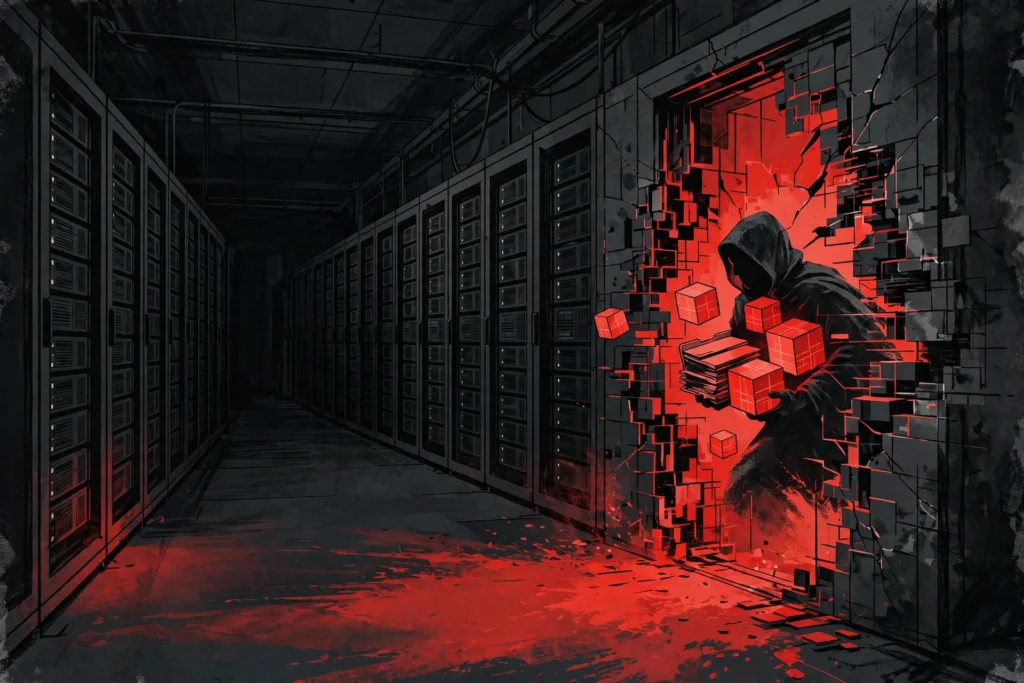
Picture this. Your team spends months fine-tuning an AI model on your company’s most sensitive data. You trust a specialist platform to run it, because that is what the platform promises to do safely.
Then, on a quiet Monday in November, an email arrives saying hackers had been inside that platform for weeks — and your datasets and unfinished model weights may have been among the things they touched.
That is the position some customers of Fireworks AI woke up to this week. The Fireworks AI breach, first disclosed in October as a limited credential problem, turned out to be far bigger than the company first believed.
On November 9, Fireworks published an expanded security bulletin that changed the story completely. Attackers had reached billing information, customer secrets, datasets, and incomplete model weights. Two customers told Forbes they had already moved most of their business elsewhere.
For an industry built on trust — companies handing their data and their models to someone else’s servers — this is the kind of week that makes everyone check their own locks.
What the Fireworks AI breach actually exposed
Fireworks AI is not a household name, but it sits at the heart of the AI boom. It runs inference and fine-tuning for open AI models, letting companies use powerful models on their own data without building the infrastructure themselves. It reportedly generates around $1 billion in annual revenue.
That scale is what makes the November 9 update so serious. According to the company’s bulletin, attackers accessed account and billing information for some customers, including billing and shipping addresses, invoice and payment history, account balances, and credit usage.
For a smaller group of customers, the damage went further. The company said it discovered impacts to “secrets, datasets, and incomplete models” for a limited set of accounts. In plain language, that means some customers’ training data and unfinished model weights — the raw material of their AI products — were within the attackers’ reach.
There is one piece of good news. Fireworks does not store payment card numbers, so those were not affected. The company also said it found no impact on its Inference, Training SDK, or Nexus products, which it describes as zero-data-retention by default.
Still, the gap between what Fireworks said in October and what it admitted in November is the part customers will remember.
How the attackers got in — twice
The Fireworks AI breach unfolded in two separate intrusions, weeks apart. The first began on October 6, when an unauthorized party used internal Fireworks credentials to read environment variables in evaluation jobs, affecting a limited number of customer accounts.
Fireworks disclosed that incident on October 9. Its first bulletin was reassuring. It said the company had found no evidence of unauthorized access to customer models, datasets, training data, personal information, or inference traffic.
That reassurance did not hold. Behind the scenes, a second path was opening. On October 23, a third-party cloud provider that hosted Fireworks’ research and development machines suffered its own security incident, and the next day an unauthorized party used that opening to reach those machines and run a workload on them.
Fireworks says it detected the activity the same day and has seen no further successful access to the customer-facing platform since October 25.
The company brought in Palo Alto Networks’ Unit 42 for forensic analysis and notified law enforcement. It is now notifying affected customers directly, with account-specific details and recommended steps. Customers who received no notice, it says, have not been identified as affected.
LLMjacking: the motive behind the Fireworks AI breach
So why would anyone break into an AI platform? Fireworks says the evidence points to a financially motivated cybercriminal group, and the goal was not ransom or sabotage. It was resale.
The technique is known as LLMjacking. Attackers steal access to large language models, then sell that access through illicit routing gateways, letting buyers run expensive AI workloads on someone else’s bill. It is, in effect, stealing compute and selling it on the black market.
Google’s Threat Intelligence Group published a report on the rise of LLMjacking on November 2, just days before Fireworks’ expanded disclosure. The trade in stolen model access is growing fast, and AI platforms have become prime targets.
The pattern is wider than one company. Security firm Wiz reported in late October that at least nine AI developer platforms disclosed security incidents during that month alone, almost all involving attackers hunting for stored environment variables — especially the keys that grant access to AI models.
Customers are already walking away
The commercial fallout began immediately. According to Forbes, two Fireworks customers said they had already substantially moved their business off the company’s systems. One of them described a series of “very bad hacks” and poor communication from the company.
That is a blunt verdict, and it matters. Fireworks’ business depends on companies trusting it with the two things they guard most jealously: their data and their models. A breach that touches both is an existential problem for an infrastructure provider.
The disclosure also rippled downstream. Notion said on November 10 that it was affected by the Fireworks incident, identifying the company as a third-party AI vendor involved in a security incident impacting Notion and its customers.
When a breach at one vendor touches a household-name customer, every other company using AI infrastructure starts asking the same question: could this happen to us?
What the Fireworks AI breach means for the AI industry
The Fireworks AI breach arrives at an awkward moment for the AI industry. The same week, governments and AI companies were signing new safety pledges, and firms were racing to ship ever more powerful models.
The Paris Call for AI Safety and Security, signed by six nations and ten AI companies, promised stronger guardrails for frontier AI.
Yet the Fireworks incident is a reminder that the most urgent safety problem is not always the model itself. Sometimes it is the plumbing — the credentials, the cloud accounts, the third-party vendors, and the environment variables where the keys to the kingdom quietly sit.
It also exposes a tension at the heart of the AI boom. Companies are moving faster than their security practices.
OpenAI’s new Control Room, a system that can halt a rogue AI model in 35 seconds, shows the industry is thinking hard about model safety. But a kill switch does not help when the attacker is already inside the infrastructure, quietly copying the model itself.
Enterprise customers will now demand more — tougher questions about how AI vendors store secrets, how they vet their own cloud providers, and how quickly they disclose when something goes wrong.
The IBM and Microsoft Imagine Enterprise platform, launched this week with more than 6,000 prebuilt AI agents for big business, shows how fast enterprise AI is growing — and how much trust it requires.
Fireworks has taken some steps. It has disabled self-serve dataset uploads and downloads for Batch Inference and dataset-based training while the investigation continues. That is a sensible precaution, but it is also an admission of how deep the problem runs.
What happens next
The investigation is still open, and Fireworks says additional findings may follow. Customers who stored keys, secrets, or custom model weights on the platform should assume they may be exposed until the vendor says otherwise, rotate credentials, and audit access logs.
Regulators are watching too. A breach that exposes customer datasets and model weights at a billion-dollar AI infrastructure company is exactly the kind of incident that invites scrutiny — and, eventually, new rules.
For the wider industry, the lesson is simple and uncomfortable: the AI race is being run on shared infrastructure, and that infrastructure is only as strong as its weakest credential.
Companies building on other people’s AI platforms now face a choice: demand real transparency from their vendors, or accept that the next disclosure email could be addressed to them.
For more on the wider context, see the detailed breakdown of the Fireworks AI breach.