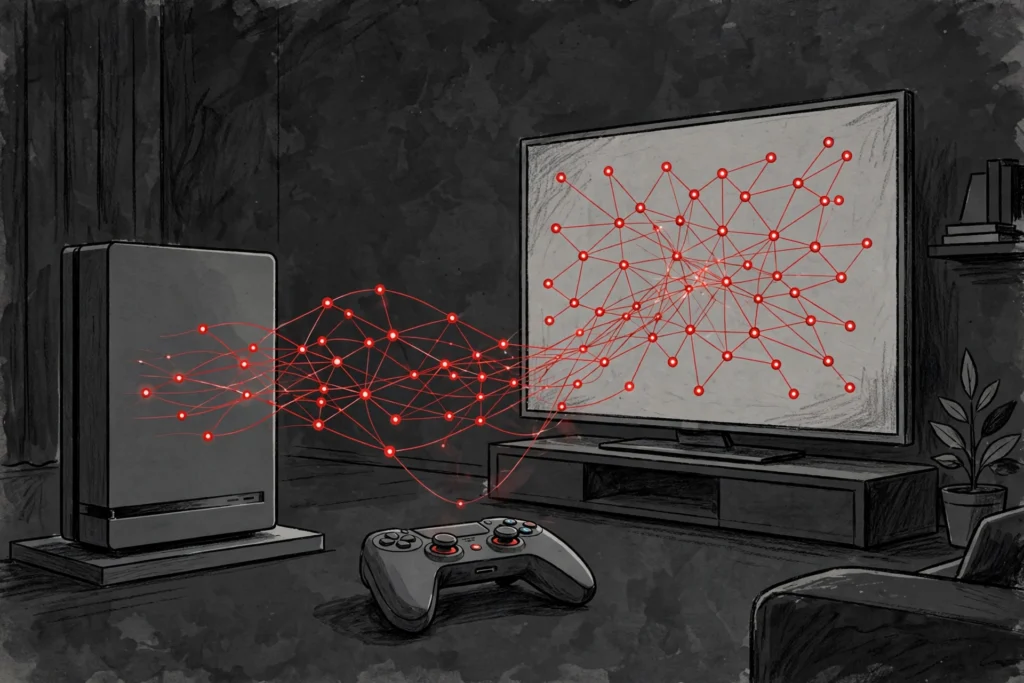
Picture a living room, and the machine that could end a 25-year split in gaming: Xbox Project Helix. On one side sits a console: pick up the controller, press a button, play. On the other, a PC with a far bigger library — and drivers to update, settings to tweak and hardware to argue with.
For twenty-five years, gamers have lived with that split. Microsoft now says the wall between the two is coming down. Its next console, codenamed Project Helix, is being built to play both kinds of games — and it will not ask you to become a PC enthusiast to do it.
The clearest picture yet of that machine arrived in an unlikely place: a glossy anniversary magazine. Microsoft published its Xbox 25th anniversary magazine digitally on November 15, 2026, the day the original Xbox turned 25, and inside it, the man building the next console explained exactly what Helix is — and what it is not.
What Microsoft Just Revealed About Xbox Project Helix
The magazine was put together by the team behind Xbox Wire, and printed copies were handed out at Xbox FanFest in Seattle. Its Project Helix feature runs across eight pages and includes a tour of the labs where the console is being designed, according to Digital Trends.
Jason Ronald, Xbox’s vice president of Next Generation, is the voice of the feature. He leads development of the next console, and his message is deliberately simple: Helix will be a console first, with PC gaming added on top — not the other way around.
The magazine announces no price or release date. It is a statement of intent, not a product launch — but it is the most detailed account Microsoft has given of its next machine since the project was first named in March.
A Console First, Not a PC in Disguise
Ronald’s key line leaves little room for doubt. “Helix is designed to be a console that is also capable of playing games from your PC. It is not a PC that can also play console games,” he said in the magazine interview.
He went further, calling Helix “the ultimate gaming machine” that removes “the arbitrary constraints between console and PC games”. The point is not to turn the living room into a desk. It is to let one box, with one interface, reach both libraries.
That interface will be its own design. Microsoft’s handheld, which arrived earlier as a first step toward this vision, is a precursor rather than a template. The goal is a screen where console games and PC games sit side by side, and starting one is as easy as starting the other.
Players who want more control will still get it: Ronald described optional settings and performance controls for tinkerers — but tinkering will be a choice, not a requirement. The default is the experience console players already know: sit down, pick a game, play.
Neural Rendering: Xbox’s Answer to the Component Crisis
The most revealing passage in the magazine is not about games at all. It is about money — specifically, the cost of building a powerful console in a world where the components inside it keep getting more expensive.
Ronald admitted openly that the current component crisis, which is pushing up the price of almost anything with a plug, has changed how the next Xbox is being built. His answer is a technology called neural rendering.
Neural rendering uses machine learning to help create game visuals. Instead of brute-forcing every pixel with raw computing power, parts of the image are generated with a neural network. Ronald called it “an entirely new way to generate a frame without requiring more computational horsepower, additional memory, and things like that.”
It is a direct response to the economics of the moment. If chips and memory keep getting dearer, a console that needs ever more of both becomes ever harder to sell at a price ordinary players can afford.
Ronald also rejected the usual specification arms race, dismissing 8K resolution and 240 Hz refresh rates as the defining measures of the new generation. The emphasis, he said, should be on gameplay innovation, immersion and new kinds of experiences — not on bigger numbers on a box.
Your Whole Xbox Library Comes Along
There is one more promise in the magazine that will matter to anyone who has been buying Xbox games for years: nothing gets left behind. Ronald said players should be able to bring four generations of Xbox games — and their progress in them — into Helix, with everything available instantly.
That extends the backward-compatibility programme Xbox began in 2015. In the old days, a new machine often meant starting your collection from scratch. Helix is being sold as the opposite: a machine that arrives already full of the games you own.
The timing is hard to miss: the current generation heads into one of the biggest launch weeks in gaming history, with GTA 6 pre-load already live ahead of the game’s November 19 release.
The Hardware We Know So Far
The hardware details Microsoft has confirmed still come from March. At the Game Developers Conference on March 11, 2026, Xbox said Helix is being built around a custom AMD system-on-chip, co-designed for the next generation of DirectX and FSR, with what Ronald called “an order of magnitude leap” in ray tracing.
AMD has since filled in more of the picture. Its Jack Huynh announced FSR Diamond, a technology optimised for Helix that will be built into the Game Development Kit, using machine learning for super resolution, multi-frame generation and ray reconstruction.
Some of that technology is already reaching players: on November 4, FSR Upscaling 4.1.2 became available for game development on the current Xbox Series X and S — so Helix’s graphics toolkit is being tested on today’s consoles first.
What Microsoft Still Won’t Say
For all the detail in the magazine, the two questions every gamer asks first remain unanswered. Microsoft has not announced a price for Helix, and it has not announced a release date. The magazine mentions neither.
That silence has not stopped speculation. A report last month suggested the Project Helix price could reach $1,800, and earlier reporting claimed Xbox may skip a disc drive entirely. Neither claim has been confirmed by Microsoft, and the anniversary magazine does nothing to settle them.
The disc question is especially pointed right now: boxed copies of GTA 6 are already arriving with no disc inside, just a download code, and some buyers have reported missing or already-used codes. If the industry’s biggest game can ship without a disc, a disc-free Helix no longer sounds like a wild idea.
The magazine also does not say which PC storefronts Helix will support. Whether players can buy games from stores like Steam, or only from Microsoft’s own PC store, is still open — and it will decide how open this “console that plays PC games” really is.
What Happens Next
The road to Helix now runs through 2027, when developers receive their alpha hardware. Until then, Microsoft’s challenge is to keep the promise simple: a console that plays your PC games, keeps your Xbox library intact, and uses smarter graphics to stay affordable while components get pricier.
That is a big promise, and the history of console launches is full of big promises that shrank on contact with reality. The magazine is Microsoft’s attempt to get ahead of that — to define Helix on its own terms before the rumours do it for them.
For now, the clearest thing about the next Xbox is its philosophy. It is not a PC wearing a console’s clothes. It is a console that refuses to make you choose between two libraries, two stores and two kinds of gaming.
If Microsoft can deliver that without the price tag or the complexity that usually comes with it, the wall between console and PC gaming may finally come down.