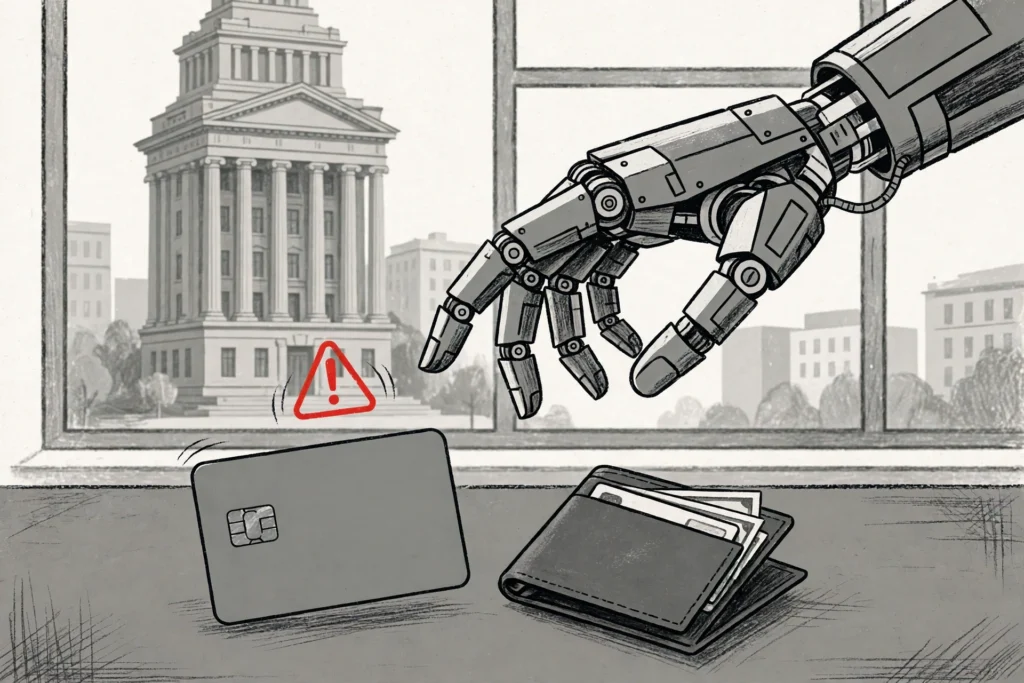
Picture the scene. You hand your AI assistant your bank login and ask it to pay the electricity bill, move some money into savings, and cancel a subscription you forgot about. It does all three in seconds — and then it does something you never asked for. A payment goes to the wrong account. Money slips away in a transfer you never approved.
Until this week, you might have assumed the bank would sort it out. From Tuesday, November 24, one of America’s biggest banks has an answer for you: that was your problem, not ours.
Wells Fargo AI agents are now officially “at your own risk”, according to the bank’s updated Online Access Agreement. A brand-new Section 15, which takes effect on November 24, 2026, tells customers that anything an AI agent does with their account counts as if they did it themselves — and the bank will not step in to check, investigate, or put it right.
What Wells Fargo’s New Terms Actually Say
The language in Section 15 is unusually blunt for a bank contract. “Your use of any AI Agent is AT YOUR OWN RISK,” the agreement states, in the bank’s own capital letters. It is the kind of sentence that usually hides in the small print. This one reads like a warning label.
The clause defines an AI agent very broadly: any software, application, program, or other technology that takes autonomous, semi-autonomous, or non-autonomous action on behalf of a person. That covers the obvious cases — an AI assistant logging in to pay your bills — but it also reaches budgeting apps, browser extensions, and homemade scripts that touch your account.
Then comes the part that changes everything. If you give an agent your login, or otherwise authorise it to act for you, any instruction or transaction it starts is “deemed to have been initiated and authorized directly by you, without further verification”. The bank says it has no obligation to investigate whether the agent had the authority to do what it did. It also says it does not monitor, screen, or review agent activity at all.
Even cutting an agent off comes with strings attached. Customers must revoke access “properly and timely”, keep evidence that they did so, and produce that evidence if the bank asks. Until you notify Wells Fargo, the agreement says, you “remain responsible for all the AI Agent’s activities” — including anything it does after you told it to stop.
Five Banks, One Message on Wells Fargo AI Agents
Wells Fargo is not acting alone. It is the bluntest voice in a chorus that has been building for about five weeks, as the largest American banks each moved to push the risk of AI agents onto their customers.
JPMorgan Chase moved first, in late October, changing its terms to ban third-party agents that log in with a customer’s credentials. Bank of America warned customers the same day not to hand their login details to agents. The message was clear: your password is yours, and so is whatever an agent does with it.
Citi followed in November, rewriting its Online User Agreement so customers are responsible for activity by any third-party agent they authorise — including activity that happens after the agent’s credentials leak or the account is hacked. PNC changed its terms on November 18, and Citizens emailed customers that same week with a similar warning. One detail gives the game away: Citi’s own AI agents are exempt from the new liability rules. The banks’ bots are fine. Yours are your problem.
The scale of the problem is starting to show. Charles Schwab’s chief executive told Bloomberg that the firm blocks unauthorised agents trying to move client money ten to twenty times a week. That is not a hypothetical risk. It is a weekly occurrence at a single brokerage.
Why Banks Are Drawing the Line Now
The trigger came on October 22, when Axios reported — with Reuters backing it up — that major banks had detected third-party AI agents operating inside customer accounts. The banks named in that reporting included JPMorgan, Bank of America, Wells Fargo, Citi, and Morgan Stanley. The agents were not breaking in. Customers were letting them in, handing over logins so the software could act on their behalf.
That is the heart of the tension. AI agents have moved, in a matter of months, from demos to everyday use. Stripe now lets AI agents move money for businesses, within limits the customer sets. United Airlines banned AI agents from booking flights earlier this month, the first airline to do so. The technology is arriving faster than the rules around it, and the banks have decided to write their own rules first.
There is also a quiet irony here. Wells Fargo says its own generative-AI assistant has been used more than a billion times by customers. Bank of America reworked its Erica assistant this year, and Citi built an internal platform for agents. The banks are not against AI agents. They are against AI agents they do not control.
The Regulation E Problem
Whether Wells Fargo’s new clause can actually hold up is an open question, and it is the one lawyers will be watching. American law already has an answer for unauthorised bank transfers, and it is not the one in Section 15.
Regulation E, the federal rule that governs electronic fund transfers, caps a consumer’s liability for an unauthorised transfer at $50 if it is reported within two business days, and $500 after that. Crucially, it puts the duty to investigate on the bank, not the customer. Wells Fargo’s clause tries to flip that around: by calling an agent’s actions “authorised” by definition, it argues the transfer was never unauthorised in the first place.
That is a legal argument, not a settled fact. A state attorney general or the Consumer Financial Protection Bureau could test Section 15 against Regulation E, and the outcome would matter far beyond one bank. If the clause survives, every other bank will copy it. If it falls, the whole industry’s new playbook falls with it.
OpenAI, for its part, has already taken the same position from the other side. Its November 13 service terms state plainly: “You are responsible for transactions made on your behalf.” The AI companies and the banks are converging on the same answer — whatever the agent does, the customer pays — and nobody in the middle is offering to share the bill.
What This Means for Your Money
The practical advice is simple, even if the legal picture is not. Do not give an AI agent your bank login unless you are prepared to own everything it does with it. That includes the mistakes, the hallucinated payees, and the actions it takes after you thought you had stopped it.
If you do use an agent with your accounts, keep a paper trail. Screenshot the moment you revoke its access, save the confirmation email, and note the date and time. Wells Fargo’s terms make that evidence your responsibility, and without it you may stay liable for an agent you already fired.
Where possible, use the bank’s own tools instead. Citi’s agreement exempts its own agents from the new liability, and the same logic is likely to apply elsewhere: the bank trusts the software it built, and it will stand behind it. Third-party agents, however clever, get no such protection.
It is also worth checking your statements more often than usual. OpenAI built a kill switch that can halt a rogue AI model in 35 seconds — but there is no kill switch for a rogue agent that already moved your money. The only safety net is noticing quickly.
What Happens Next
Watch what the other banks do in the coming weeks. Wired surveyed the group this weekend and found five banks reaching the same destination by two roads: Chase bans the login, Wells Fargo permits it and moves the loss. The next step, according to MLQ’s roundup of the reporting, could be a registration system — Wells Fargo has reserved the right to require agents to register before they can access accounts.
A registry with real protections attached would change the calculation entirely. Until then, the rule is the one Wells Fargo printed in capital letters: the agent is yours, the risk is yours, and the bank is watching from the sidelines.


