On a Sunday in San Francisco, ten governments put their names to the San Francisco Declaration, a document that reads like a warning and a promise at the same time.
The room was not a summit hall filled with cameras. It was a retreat of the Pax Silica coalition, a group most people had never heard of until this weekend.
By the time the pens were down, the United States and nine partner nations had agreed on something they had never agreed on before: a shared list of the technologies and infrastructure that must be protected if the age of super intelligence is to belong to them, and not to their rivals.
The document is called the San Francisco Declaration on the Secure Foundations of Enduring Prosperity. It was signed on November 15, 2026, and published by the US State Department the same day.
According to the State Department, the declaration marks the moment Pax Silica stops being a statement of intent and starts becoming a working partnership.
What the San Francisco Declaration Actually Says
The declaration is short, barely two pages, and it says very little about what any country must do. What it does, for the first time, is define exactly what the ten nations believe is worth defending.
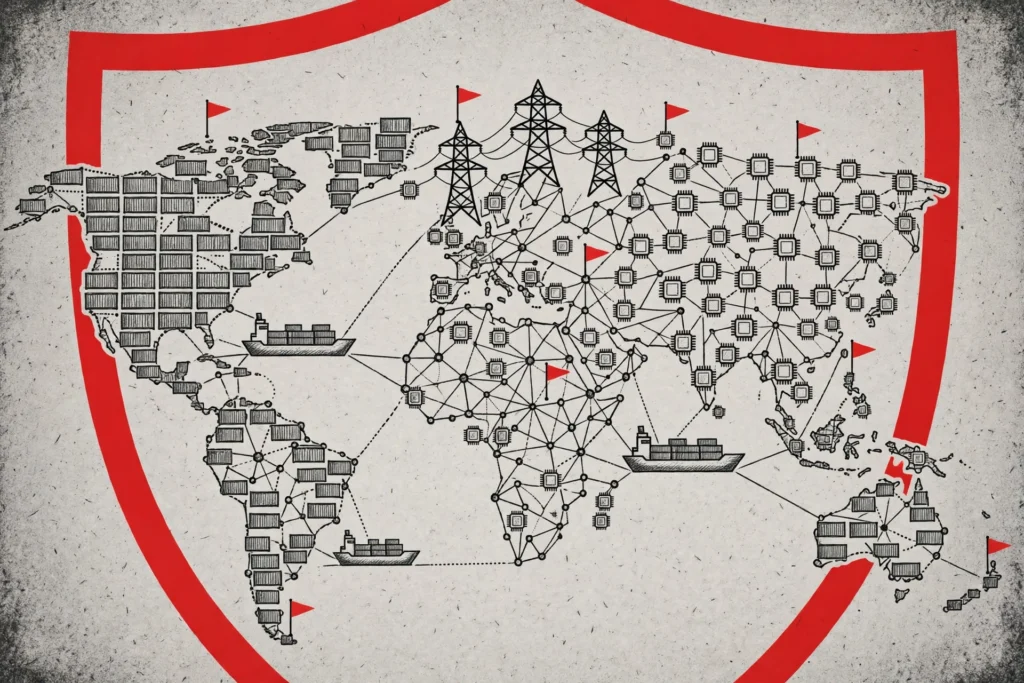
It names two categories. The first is sensitive technologies: the goods, software, materials, knowledge and components that go into super intelligence supply chains, along with the means of producing them.
The test is simple. If a hostile actor stealing or buying one of these things would gain a meaningful military or intelligence advantage, or undue economic leverage, it belongs on the list.
The second category is critical infrastructure. That means the physical and digital systems the supply chains run on: ports and terminals, transport and logistics networks, communications and energy infrastructure, and the digital platforms that coordinate it all. If disrupting or taking control of one of these systems would cause significant harm, it counts too.
The language is deliberate. The declaration states that economic security is fundamental to national security, and that no nation can be secure without securing its critical systems and technologies from those that would do it harm. It also commits the signatories to reduce excessive dependencies by building diversified, trusted supply chains instead of relying on a single source.
Who Signed, and Who Is Still to Come
The ten signatories are the United States, Australia, India, Israel, Japan, the Republic of Korea, Qatar, Singapore, the United Arab Emirates and the United Kingdom. The signing took place at the Pax Silica Founders Retreat, convened by Jacob Helberg, the US Under Secretary of State for Economic Affairs.
The list is not closed. Germany, Sweden, the Netherlands and the European Commission are expected to join next week, according to the Financial Times, which first reported the deal. If they do, the coalition will cover most of the democratic world’s chipmaking, capital and energy capacity.
That matters because Pax Silica itself is barely a year old. The initiative was launched in early 2026 as a US-led effort to secure the semiconductor stack, the chain of design, manufacturing equipment, materials and fabrication that makes advanced AI possible. The San Francisco Declaration extends that idea far beyond chips.
It now reaches into critical minerals, energy supply, industrial capacity and the logistics networks that move everything between them. In the words of the declaration, the prosperity that super intelligence makes possible will only be as durable as the supply chains and infrastructure beneath it.
Why “Super Intelligence” and Not Just AI
One word in the declaration has drawn almost as much attention as the signatures. The text talks about “super intelligence”, or SI, rather than artificial intelligence. A footnote quietly admits that some participants simply read the term as artificial intelligence.
The choice of words is not an accident. In Washington, super intelligence has become shorthand for AI systems far more capable than today’s models, systems that could reshape economies and militaries alike. Framing the declaration around SI signals that the signatories are not only protecting today’s chip supply. They are trying to secure the foundations of whatever comes next.
It also explains why the declaration reaches so widely. A super intelligence economy needs more than graphics processors.
It needs the rare earths and minerals inside them, the power plants that run the data centres, the undersea cables that carry the data, and the ports through which the hardware travels. Every link is a point of leverage, and every link is now, in principle, on the shared list.
The China Question Nobody Names Directly
The declaration never mentions China by name. It does not have to. The context is written all over the past month of technology news.
Washington has spent weeks tightening its grip on advanced chips bound for China, while reports have emerged of elaborate schemes to move them there anyway.
According to Reuters, a blacklisted Chinese university bought Nvidia H200 chips through intermediaries, and other records showed universities across China renting access to restricted hardware. The Financial Times reported that a broker called Megaspeed arranged nearly $12 billion in Nvidia chip orders for Chinese companies over two years.
The turmoil has already shaken Nvidia to its core. Its chief executive resigned this month, and a campaign to bring him back has gathered more than 150,000 signatures.
The declaration is, in part, an answer to that pattern. It reaffirms cooperation on enforcing each country’s policies to protect sensitive technologies from undue access, influence or control, and it pledges coordinated action against economic coercion, supply chain disruption and non-market practices.
Beijing, for its part, has denied the espionage claims at the centre of the Nvidia affair. But the ten signatories clearly believe the problem is bigger than any single shipment. The declaration treats supply chain security as a shared endeavour, declaring that the security of each participant is strengthened by the vigilance of all.
Five Working Groups and No Deadline
Signing a declaration is the easy part. The harder question is what happens on Monday morning, and here the document is deliberately vague.
It resolves to establish five working groups. They will cover pro-innovation policy frameworks, the adoption of super intelligence in key sectors, supply chain cooperation across the SI stack, safe harbours and supply chain security hubs, and SI security and resilience.
What the declaration does not include is a timetable, a set of binding rules, or any enforcement mechanism. As one analysis noted, the document contains no specific regulations or implementation schedule, so its real impact will only emerge in the follow-up working-level discussions.
Critics will call that a weakness, and they have a point. A declaration without deadlines can drift into another communique written to be photographed. But the signatories would argue that agreement on what to protect had to come first, and that the working groups are where the detail gets decided.
There is also a practical reason for the vagueness. Ten countries with different export control regimes, different energy systems and different relationships with China cannot harmonise everything in a weekend. The declaration gives them a common baseline and a structure for arguing about the rest.
What Happens Next
The first test will come quickly. If Germany, Sweden, the Netherlands and the European Commission sign on next week, the coalition will gain the industrial heart of Europe. If they hesitate, the declaration’s reach will look thinner than its ambitions.
The second test is the working groups themselves. Their first job will be to compile and exchange a shared list of high-priority technologies and critical infrastructure, the document the whole declaration is built around. Until that list exists, nobody outside the negotiations will know exactly which chips, minerals or ports the coalition considers sensitive.
The third test is whether the pledge survives contact with commerce. Every signatory trades with China, and every one of them has companies that would rather sell than restrict. The declaration asks them to accept that some sales are too dangerous to make, and some dependencies too risky to keep.
For now, the ten nations have agreed on the principle. They have agreed that economic security is national security, that the foundations of the super intelligence era need defending together, and that no nation can secure them alone.
The hard work of turning that principle into practice starts now, in five working groups, with a list nobody has seen yet, and a clock that has already started ticking.