Introduction
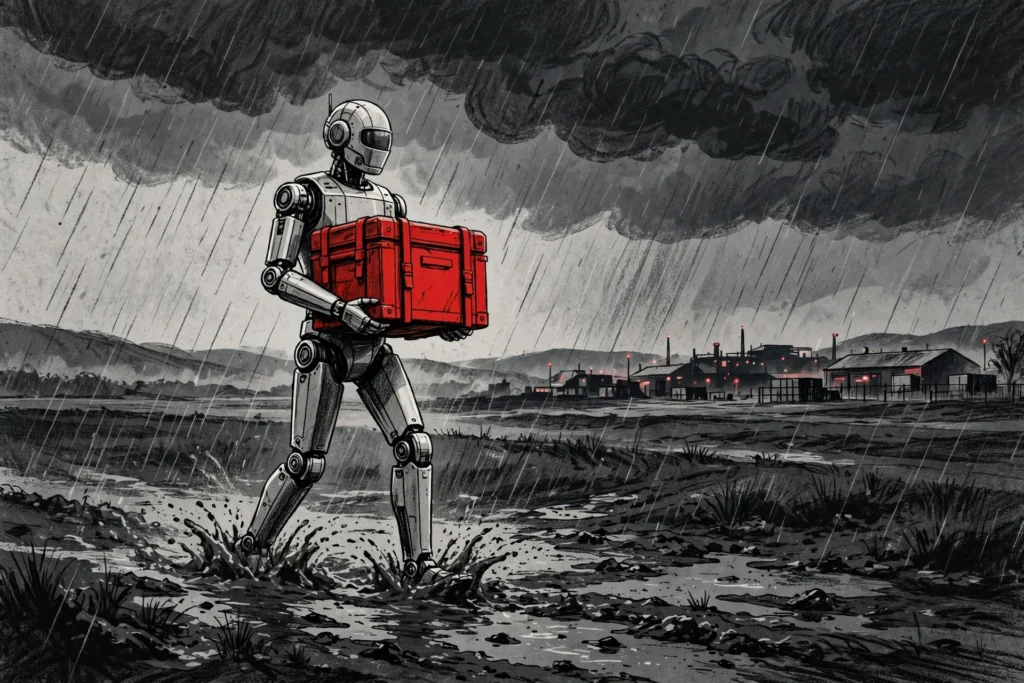
The rain has been falling for hours, and the track back to the supply point is churned mud. A figure picks its way through it, a crate balanced against its chest, water running off its sealed shell. It does not slip. It does not stop to wipe its face. It does not get tired.
That figure is not a soldier. It is a machine — and according to its makers, it is the first humanoid robot built for exactly this kind of day.
Foundation Future Industries, a San Francisco startup, has unveiled the Phantom MKII, a second-generation humanoid robot designed to carry up to 91 kilograms while walking through rain, snow and dust.
The company says its real job is not the warehouse floor or the living room, but the logistics yard, the construction site and the front line.
Phantom MKII: Built to Carry 91 kg in Any Weather
The headline number is the payload. The Phantom MKII can walk while carrying around 91 kilograms — roughly 200 pounds, or the weight of a grown adult. That is nearly double what its predecessor, the Phantom MK-1, could manage, according to reports of the launch.
The robot stands about 183 centimetres tall and weighs around 91 kilograms itself. Its body is wrapped in a sealed aluminium shell that keeps rain, snow and dust away from the components inside. Reports put its protection at IP67, and say it can tolerate shocks and vibration of up to 100G.
On a single charge it runs for roughly six hours, with heavier loads cutting that time down. Cameras give it 360-degree vision, and its computing runs on AMD Ryzen AI Embedded X100 processors, hardened for the knocks of field work.
Those numbers matter because most humanoid robots still live sheltered lives. They work on flat warehouse floors, under bright lights, in dry air. Step outside into bad weather, and the machines that look so capable indoors start to struggle. Foundation’s pitch is simple: the Phantom MKII was designed for the places other robots avoid.
Cortex II: Learning by Watching Humans
Hardware is only half the story. Alongside the robot, Foundation presented Cortex II, an updated AI control system that learns physical tasks by observing people do them.
The idea is that a human demonstrates a job — lifting a crate, stacking supplies, clearing debris — and the robot watches, then copies it. According to the company, as few as 60 demonstrations can be enough for the system to learn an individual operation.
That matters because programming a robot for every single task by hand is slow, expensive work. If a machine can pick up new jobs by watching, the same robot can be redeployed from one site to another without weeks of reprogramming.
Foundation is not alone in this bet — NVIDIA’s GR00T 2 robot brain is built around the same learn-by-watching idea.
Designed for the Battlefield, Not the Living Room
Foundation is unusually open about where it wants its robots to work. Military logistics is the primary application, and the company says the platform is also built for complex industrial tasks and for supporting military operations.
That is a deliberate break from the rest of the industry. Most humanoid developers say their machines will never be used in warfare.
Foundation does not. Its chief executive, Sankaet Pathak, told Fast Company that the company’s defence work is focused on logistics rather than robots taking part in combat directly — but he did not rule out installing weapons on the machines if the US military asked for it.
“I don’t think you can build a utopia and then not defend it,” Pathak said in the interview, which was published on November 18, 2026. He described a future in which fleets of machines take on dangerous work in construction, mining and national security.
The company says a human will stay in the loop, keeping final control over decisions — including any decision about the use of force. That promise will be tested hard if the robots ever move from carrying crates to carrying weapons.
Lessons From Testing in Ukraine
The redesign was shaped by real field experience. Earlier in 2026, Foundation sent two Phantom MK-1 robots to Ukraine to assess their ability to handle noncombat logistics tasks and reconnaissance work.
The trip exposed the first machine’s limits. In an interview with Fast Company, Pathak said the MK-1 fell short on autonomy, water resistance and payload capacity, which limited how long it could operate outdoors. Independent reports also questioned how actively the prototypes were actually used in the field.
Testing in an active conflict zone highlighted a list of problems that rarely show up in a lab: the robot needs to get back up on its own after a fall, its joints need to be stronger, and it needs to run longer between charges.
Without those fixes, a robot cannot deliver supplies to a front line or detect hazards in the field.
The MKII is Foundation’s answer to that list. A sealed body, stronger actuators, and a simpler assembly process — which Pathak says cut the cost of components and materials by half — are all direct responses to what the first machine could not do.
The Money Problem Behind the Machine
For all the engineering, the biggest question hanging over the Phantom MKII is not technical. It is financial.
According to CNBC and 36Kr, cited by Root-Nation, Foundation ran into cash-flow problems recently. At the end of October 2026, the startup was unable to pay its employees’ salaries on time.
That is a serious warning sign for a company planning to start production in early 2027 — the gap between a working prototype and a production line has swallowed bigger companies than this one.
It is also unclear how quickly Foundation’s initial military research agreements can turn into large-scale orders. A handful of research deals is not a production contract, and the company will need real orders — and real money — to keep the lights on.
Reports put the robot’s price at between $150,000 and $300,000, with the company planning to lease units to industrial and government customers. Production is due to begin in the San Francisco Bay Area, starting with several hundred robots and rising to a few thousand by the end of the year.
What Happens Next
If the plan holds, the first production Phantom MKII units will roll out of a Bay Area facility in early 2027. The company will be watching two things: whether the robot survives its first real deployments, and whether the military research agreements turn into orders big enough to fund the next phase.
The wider industry will be watching too. Humanoid robots are at a turning point. The machines that dominated headlines this year — warehouse robots, factory assistants, research prototypes — mostly work indoors, on flat floors, in controlled conditions.
Google’s Gemini Robotics 2.5 has already put humanoid robots to work on Mercedes-Benz production lines, and the same self-improving idea drives Hedra’s Model Factory, an AI platform that builds and improves its own models.
The Phantom MKII is a bet that the first real job for a humanoid is not in a living room, but in a logistics yard in the rain.
That bet cuts both ways. A robot that can carry 200 pounds through a storm is genuinely useful.
A robot built openly for military logistics raises questions that the industry has so far preferred to avoid — about who controls it, what it is allowed to carry, and where the line sits between a logistics machine and a weapon.
Foundation says the human stays in control. The next two years will show whether that promise holds — and whether the company itself survives long enough to keep it.
Why the Phantom MKII Matters
The Phantom MKII matters because it pushes humanoid robots out of the demo hall and into the weather. A sealed body, a 91-kilogram payload and a control system that learns by watching are real advances over the machine it replaces.
It also matters because it forces a conversation the robotics industry has been dodging. Most humanoid makers insist their machines are for warehouses and homes. Foundation is building one for the battlefield’s supply lines — and saying so out loud.
Whether that makes the Phantom MKII a breakthrough or a cautionary tale will depend on what happens next: the production line, the payroll, and the first customers. The robot can carry 200 pounds. The harder question is whether the company behind it can carry the weight of its own ambitions.
Source: Root-Nation