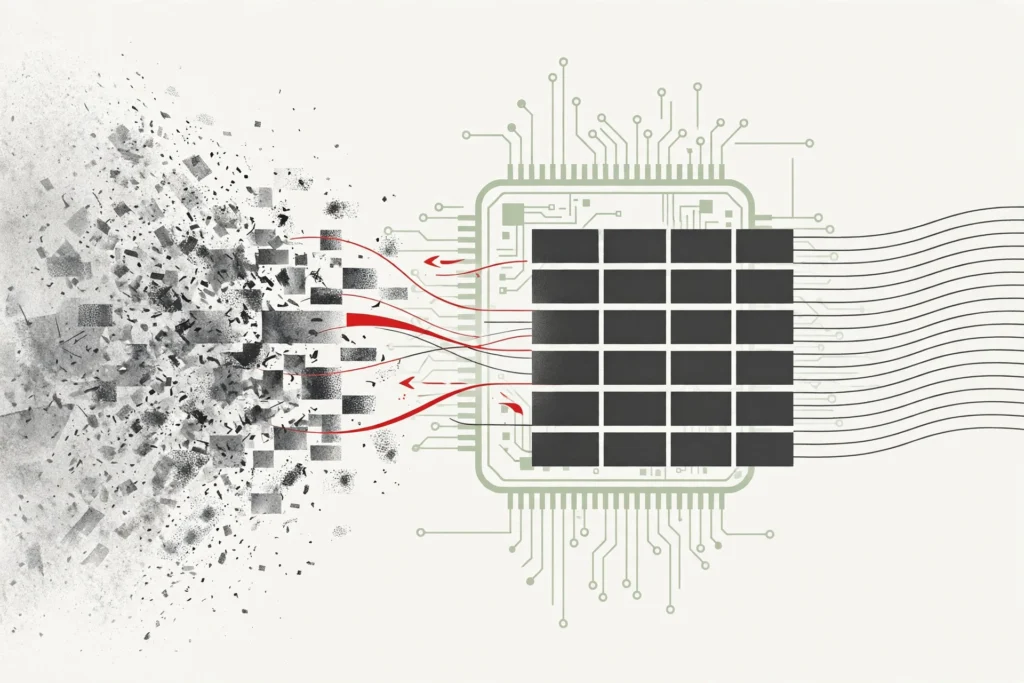
Picture a writer who never types one word at a time. Instead, she sketches an entire paragraph in rough, blurry strokes, then sharpens it, line by line, until every sentence lands. That is roughly how NVIDIA’s Nemotron-Labs-Sigma works.
On November 20, 2026, NVIDIA released the model, a family of open language models that generate text the way image generators paint pictures — by starting from noise and cleaning it up, block by block.
It is a sharp break from the way almost every chatbot you have used actually writes. And if NVIDIA’s numbers hold up, it could also be a much faster way to write.
What Is Nemotron-Labs-Sigma?
Nemotron-Labs-Sigma is a family of 14 open checkpoints in two sizes, 3 billion and 8 billion parameters. The research team behind it, from NVIDIA, Cornell University and Georgia Tech, calls it the first large-scale family of continuous diffusion language models.
The “continuous” part is the key idea. Most diffusion language models so far, such as LLaDA and Dream, work on discrete tokens. They pick words, mask some of them, and swap them around. Sigma works in a smooth, learned 16-dimensional embedding space instead.
Every token becomes a point in that space. Training adds Gaussian noise to those points, and the model learns to remove it. The geometry of the space is learned at the same time as the denoiser, so the model understands how words sit in relation to each other.
The weights are openly available on Hugging Face under the NVIDIA Nemotron Open Model License, which allows commercial use. The research behind the release is published as “Large Language Continuous Diffusion Models” (arXiv:2610.02665).
How Diffusion Writing Actually Works
A normal language model writes like a person typing with one finger. It predicts the next word, then the next, then the next. It can never go back and fix an earlier word once it has moved on.
Sigma writes in blocks of 64 tokens at a time. Each block starts as noise and is gradually denoised until it becomes text. Once a block is finished, it is committed to the model’s memory, and work begins on the next one.
This changes what the model can do mid-sentence. Because a whole block is refined together, the model can adjust a word in light of the words around it. According to NVIDIA, the smooth paths the model follows also degrade gracefully when fewer denoising steps are used.
Under the hood, the backbone is a familiar-looking decoder-only transformer, in the style of Ministral, with grouped-query attention, SwiGLU activations and rotary embeddings. Training began with an autoregressive warm start of about one trillion tokens, followed by roughly 0.3 trillion tokens of diffusion training.
Fourteen Checkpoints, Four Flavours
NVIDIA did not release a single model. It released a whole toolkit, with four variant types at each size, so researchers can test every flavour of the idea on the same underlying weights.
The base checkpoints, Sigma-3B and Sigma-8B, are the raw generators, meant for fine-tuning and research. The instruct versions are tuned to follow instructions, like a chatbot. Then come the distilled versions, trained to need far fewer denoising steps, at 2, 4, 8 and 16 function evaluations.
The fourth flavour is the most unusual. The self-speculative checkpoints add a diffusion head that drafts a 32-token block, while the model’s own autoregressive head checks it. The output matches greedy autoregressive decoding exactly, but the drafting step makes it faster.
Context is modest by 2026 standards: 4,096 tokens for most checkpoints, rising to 8,192 for Sigma-8B-instruct. That is a fraction of what flagship models offer, and it is one of the release’s clearest limits.
How Fast Is Nemotron-Labs-Sigma?
Speed is the whole point of the exercise, and NVIDIA’s own numbers are striking. On a single GB200 with SGLang, the self-speculative 8B model decodes 3.46 times faster than autoregressive decoding on average. Peak speedups reach 4.20 times at 8B and 3.18 times at 3B.
The launch thread frames the gain more simply: eight tokens per forward pass on maths problems, four on code. The base model generates about 120 to 140 tokens per second on a single H100.
Quality holds up surprisingly well at that speed. Sigma-8B averages 71.16 across NVIDIA’s six-task base suite with 256 denoising steps, ahead of the discrete diffusion model NLD-8B at 70.22 and well ahead of Dream-7B at 58.74 and LLaDA-8B at 41.78.
Coding is the standout. Sigma-8B scores 65.12 on HumanEval, against 62.80 for NLD-8B. And the eight-step distilled 8B model keeps a 70.34 average, close to its 256-step teacher, while scoring 88.44 on GSM8K.
There are caveats, and NVIDIA’s own figures show them. The instruct version averages 59.14 across ten tasks, just behind NLD-8B’s 59.92. Hard reasoning stays limited: 23.33 on AIME24 and 17.00 on AIME25. Its best single score, 91.96 on GSM8K, sits next to its worst. All of these numbers are NVIDIA’s own evaluations, not independent tests.
Where Sigma Still Falls Short
The honest picture is a model with a real speed advantage and real rough edges. The short context window is the most obvious. A 4,096-token window covers a prompt plus its output combined, which rules out long documents and long conversations.
Hardware is the second limit. Every checkpoint needs a CUDA-enabled NVIDIA GPU running in bfloat16, from Ampere through Blackwell. CPU inference is explicitly unsupported and produces unusable output. There are no official quantised variants, so the models cannot yet be squeezed onto smaller hardware.
Running the models also takes more setup than a typical download. Loading needs PyTorch 2.4 or newer, Transformers 4.55 or newer, and the trust_remote_code flag. NVIDIA hosts no API of its own, so developers serve the models themselves with vLLM, SGLang or Docker Model Runner.
The instruct models also trail their discrete-diffusion cousin slightly on average, which suggests the continuous approach is not yet a clean win on quality. It is a speed win with quality that is close, not clearly better.
Who Can Use It, and How
Anyone with the right GPU can download all 14 checkpoints from Hugging Face today. The licence permits commercial and non-commercial use, and the model cards recommend a guidance setting of 3 and a temperature of 0.3 at 32 DDIM steps as a starting point.
The natural audience is researchers and engineers who care about decoding speed. A customer-support bot, a code assistant or an on-device agent that needs fast responses could all benefit from a model that drafts whole blocks at once.
There is also a strategic angle. According to MarkTechPost, NVIDIA is reportedly near a $500 million deal to buy Inception Labs, another diffusion-model startup. Sigma looks like the in-house half of the same bet.
Why NVIDIA Is Betting on Diffusion
The timing matters. Language models have grown enormous, but the way they generate text has barely changed since the transformer arrived. Every major model still writes one token at a time, and that serial bottleneck is now one of the main limits on speed and cost.
Diffusion offers a way around it. Image generators already proved that starting from noise and refining in parallel can produce high-quality results quickly. Sigma applies the same logic to words, and the distilled checkpoints show that most of the quality survives even when the steps are cut to eight.
Whether diffusion replaces autoregression is still an open question. Sigma’s short context, GPU-only requirement and mixed instruct scores all say the idea needs more work. But a 4.2-times speedup with comparable quality is not a curiosity. It is the kind of number that makes an entire industry pay attention.
The next test is not a benchmark. It is whether developers actually build with Sigma, and whether the models keep their speed advantage once they leave NVIDIA’s lab and meet the real world.
Read our coverage of NVIDIA’s reported $500 million deal for Inception’s diffusion AI models, NVIDIA and Microsoft’s expanded AI partnership and Meituan’s LongCat-2.5. Launch details here are based on the release coverage by MarkTechPost.


