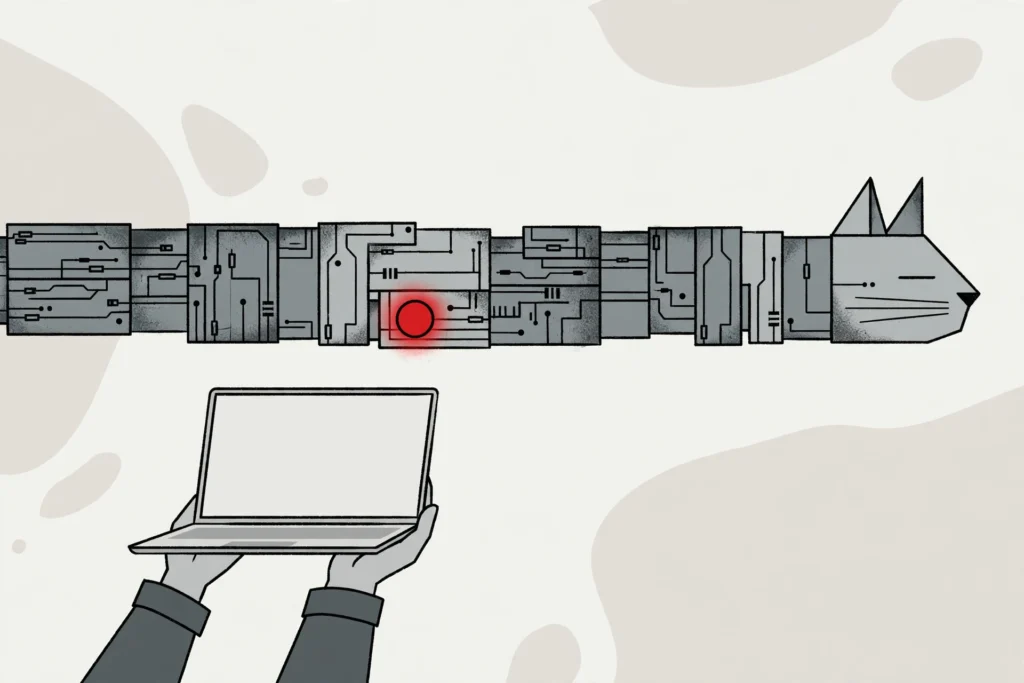
Picture a developer in Shenzhen, staring at a download progress bar that reads 3.5 terabytes. That is the size of the file she has just started pulling onto her company’s servers. Inside it sits one of the largest AI models ever handed to the public for free.
That model is LongCat-2.5, and this week its maker, the Chinese food-delivery and e-commerce giant Meituan, released its full weights under the MIT license. Anyone can download it, run it, modify it and even build a commercial product on top of it, without asking Meituan’s permission.
It is the biggest open-weight release of a very crowded November, and it arrives at a moment when the AI world is arguing hard about what “open” really means.
What Meituan Released With LongCat-2.5
Meituan first introduced LongCat-2.5 on November 2, according to reports, as a native multimodal model built for long-running agent work. For the first week, the only way to try it was through Meituan’s own website and API.
Then on November 9, the company published the full model checkpoint on Hugging Face, the platform where most open models live. The weights arrived under the MIT license, one of the most permissive licences in software, which allows commercial use, modification and redistribution.
The release was reported by VentureBeat, which noted that the model can inspect screenshots and video, work through a codebase, and write or revise software over multiple steps.
That combination matters. LongCat-2.5 is not a chatbot demo. It is built to do the kind of long, multi-step work that AI agents are increasingly asked to handle, from fixing bugs across a whole project to planning a task that spans hours.
LongCat-2.5 by the Numbers
The headline figure is the size. LongCat-2.5 has 1.6 trillion total parameters, organised as a mixture of experts. Only about 48 billion of those parameters are active for any single token, which is how the model stays fast enough to run at all.
It is a multimodal model, which means it takes images as well as text. It can read a screenshot, understand a diagram and reason about what it sees, then turn that understanding into code or a plan.
The context window stretches to one million tokens, with a maximum output of 256,000 tokens. In plain terms, the model can hold an entire codebase or a very long document in its working memory, and produce extremely long answers in return.
Meituan also published a smaller, quantised W4A4 version of the weights, which shrinks the model by compressing its numbers to four bits. That version is far easier to serve, though it still demands serious hardware.
One odd detail: the Hugging Face repository metadata displays 1.8 trillion parameters, while Meituan’s own technical description says 1.6 trillion. The difference is a quirk of how the checkpoint is counted, not a second model hiding inside.
The MIT License Changes Everything for LongCat-2.5
The licence is the real story here. Most large models from Chinese labs ship with custom licences that carry conditions, such as limits on commercial use or requirements to share improvements.
MIT has almost none of that. Developers can use LongCat-2.5 commercially, modify the weights, fine-tune them for their own data, and redistribute the result. The only real conditions are keeping the copyright and permission notice attached.
There is one reservation in the small print. The licence grants no rights over Meituan’s trademarks or patents. And the release is open-weight, not fully open-source: Meituan has not published its training data or the full training pipeline.
Still, for teams that were waiting on licence terms before touching a Chinese open-weight model, this is about as permissive as it gets. It is the same licence that made earlier open models so easy for startups to adopt.
Why 3.5 Terabytes Is the Real Price Tag
Free to download does not mean cheap to run. The full checkpoint in BF16 format takes up about 3.56 terabytes across 208 files. That is not a file for a laptop, or even a single powerful workstation.
Serving the model needs a cluster of servers with enough memory to hold a trillion and a half parameters. At two bytes per parameter, the weights alone would be roughly 3.2 terabytes before any of the machinery around them.
The quantised W4A4 version cuts that to around 800 gigabytes, which is still a multi-GPU undertaking. Meituan has published deployment guides for running the model on neural processing units, including Chinese AI accelerators.
For most developers, the practical route is Meituan’s hosted API. The limited-time rate card lists $0.30 per million uncached input tokens, $0.006 per million cached input tokens, and $1.20 per million output tokens.
That is the honest trade-off at the heart of this release. The permission costs nothing, but the operating cost is real. The licence is free; the electricity is not.
LongCat-2.5 vs the Open-Weight Rivals
LongCat-2.5 does not arrive in a vacuum. November has become the busiest month of the year for AI releases, and the open-weight corner of the field is moving fast.
Alibaba launched Qwen4-Max this week, but only as a two-week preview with no downloadable weights, no benchmarks and no price. Moonshot AI’s Kimi K3.1 Pro, another huge open-weight model, arrived earlier in the month with 2.8 trillion parameters.
What sets LongCat-2.5 apart is the combination of scale and permission. It is one of the largest models ever released with downloadable weights, and it carries the most permissive licence of any of them.
Google, meanwhile, took the opposite path with Gemini 4 Carbon, its strongest model yet, which is available only through Google’s API and paid plans. Anthropic’s Claude Fable 5.2 is likewise closed, however capable it is.
Meituan is betting that giving the model away will win it something money cannot buy: developers who build on it, fine-tune it and carry it into products Meituan could never build itself.
Why It Matters for Developers and Startups
For a startup, the appeal is control. A hosted frontier model can change its price, its behaviour or its terms with a single announcement. A model you hold the weights for cannot be taken away from you.
That control matters most in regulated industries and private infrastructure. A bank, a hospital or a government contractor can run LongCat-2.5 inside its own data centre, where sensitive data never leaves the building.
There is a catch, and it is a familiar one for Chinese models. In October, the US Department of Homeland Security ordered federal civilian agencies to remove technology from the Chinese lab DeepSeek from covered systems.
VentureBeat found no publicly disclosed US federal procurement or use restriction that specifically names Meituan or LongCat-2.5 as of November 9. But defence and civilian supply-chain rules around foreign models keep evolving, and any team in a regulated sector should check before deploying.
For everyone else, the calculation is simpler. A trillion-parameter model with vision, a million-token context and an MIT licence is now a download away, for anyone with the hardware to feed it.
What Happens Next for LongCat-2.5
The next test is not Meituan’s, but the community’s. Independent benchmarks will show whether LongCat-2.5’s agentic coding lives up to the promise, and fine-tuned versions will start appearing on Hugging Face within weeks.
Watch for two things. First, whether developers actually self-host it at scale, or whether most usage flows through Meituan’s cheap hosted API instead. Second, whether rival labs answer with equally permissive releases of their own.
Meituan built its name delivering food across China. With LongCat-2.5, it has delivered something very different: a giant model, free to take, with a licence that asks almost nothing in return.
The download bar will take a while. The model inside it, though, is ready to work the moment it lands.