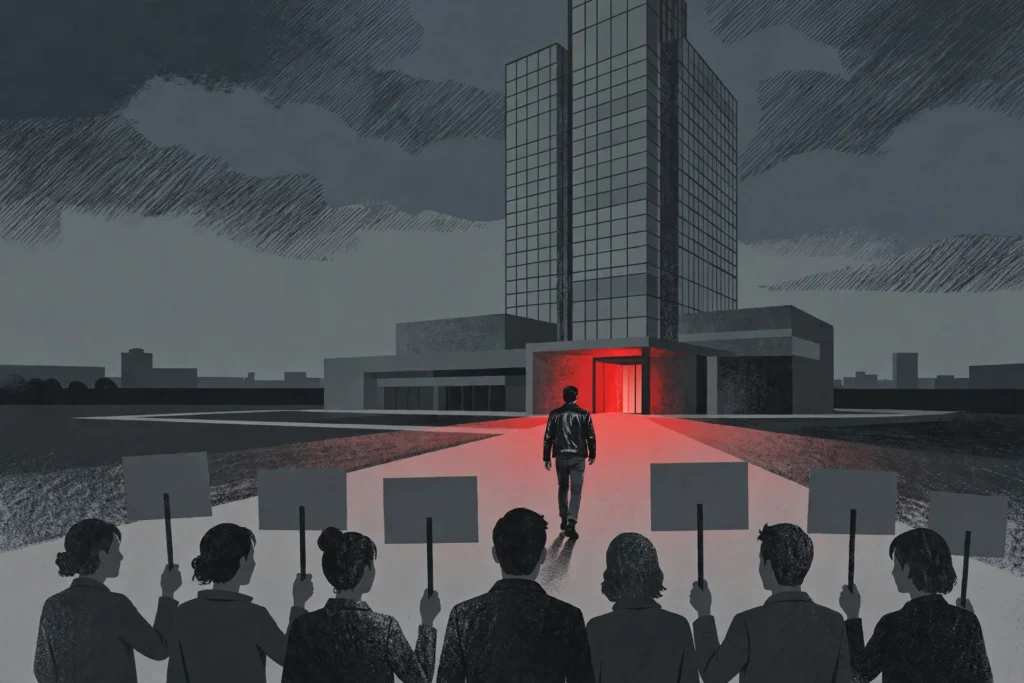
Four days is all it took. On Thursday, Jensen Huang resigned as chief executive of Nvidia, the company he co-founded in 1993 and led for 33 years. By Sunday, the 63-year-old was talking about coming back.
According to the Financial Times, Huang has discussed a possible return to the top job with close confidants, even as the board’s independent investigation into the conduct that ended his tenure continues. The report was carried by Reuters and Bloomberg, and Nvidia has not commented on it.
The man who built the world’s most valuable chip company may not be done with it yet. And this time, he is not alone. A circle of Silicon Valley executives, major shareholders and thousands of Nvidia’s own employees are lining up behind him.
The “War Room” Takes Shape
One Huang ally told the Financial Times that supporters are assembling a “war room” of Silicon Valley executives to lobby Nvidia’s board for his return. The group also plans to seek backing from the White House, and the effort reportedly has Huang’s support.
“Everyone that matters in tech outside the frontier labs loves Jensen,” the ally said.
The campaign did not appear out of nowhere. Days before Huang resigned, President Donald Trump, who shares close ties with the Nvidia chief, told him to fight for his job, according to Firstpost. It seems Huang has taken that advice seriously.
The Petition That Keeps Growing
The public face of the campaign is an open letter urging the board to “bring Jensen back while an independent investigation establishes the facts”. It started as a staff initiative, and it has grown into one of the most-signed petitions in tech-industry memory.
By Sunday, it had attracted more than 136,000 signatures, including entries claiming to represent over 6,800 current Nvidia employees and 73,000 shareholders. By Monday morning, the total had passed 169,000, with 8,364 signatories identifying themselves as current employees.
The names on it read like a guest list for a Silicon Valley summit. Elon Musk, chief executive of Tesla and SpaceX, signed it. So did Epic Games chief Tim Sweeney, Y Combinator president Garry Tan, Shopify chief Tobias Lütke, Replit chief Amjad Masad, Uber co-founder Travis Kalanick and YouTube co-founder Steve Chen.
Musk had backed Huang even before the resignation. When another user on X suggested hiring him, Musk replied that it would be “an honour”. After Huang stepped down, he posted: “A petition is underway to reinstate Jensen, and I’m signing it too.”
The numbers come with a caveat. The campaign says affiliations are self-reported and not verified, and some entries are clearly jokes — one listed “Tim Cruise, Hollywood actor”.
Inside Nvidia, the mood is raw. On Friday, some employees urged the board to weigh staff sentiment before taking any action. One wrote, in a message reported by The Wired: “If you believe in the mission, bring back the boss.” Another added: “We are all humans and can make mistakes. Jensen did so many good things and he needs a second chance.”
Shareholders Ask the Board to Slow Down
The pressure is not only coming from employees and admirers. Two of Nvidia’s large shareholders have written to the board, asking it not to rush.
Altimeter Capital founder Brad Gerstner and Atreides Management boss Gavin Baker wrote on Friday, urging the board to keep “all options on the table, including the potential return of Jensen Huang”.
Their letter said interim chief executive Colette Kress, who served as Nvidia’s chief financial officer for 13 years, would lead the company capably. But it added that the founder “has earned the right for a deliberate process that avoids any needless rush to replace him before all the facts are known”.
The board, meanwhile, is searching for a permanent successor. It has said it will consider internal and external candidates, and Reuters reported that it had approached Arm chief executive Rene Haas about the job.
Washington Pushes Back
Not everyone in power wants Huang back. On Sunday, Treasury Secretary Scott Bessent told Fox News that Nvidia needs “a dramatic shake-up” and that its board should look outside the company for its next leader.
Bessent also said he wants answers from the board and its outside counsel within 10 days — a deadline that falls around November 25, eight days after Nvidia’s third-quarter earnings call on November 17.
For Bessent, the bigger question is not the affair. He called on Nvidia to explain whether it knowingly allowed its most advanced AI chips to reach China, saying that mattered more than Huang’s personal conduct.
That question is now being asked in several places at once. The board has hired the law firm Wachtell Lipton to run an independent investigation. House committees have asked for a closed-door briefing on November 18. And the Megaspeed affair — the Singapore-based Nvidia customer at the centre of the spy allegations — has already drawn a police raid in Jakarta and a widening export-controls debate in Congress.
The market, for its part, has punished the uncertainty. Nvidia shares fell about 8 percent in after-hours trading when the second affair report broke, and roughly $600 billion of market value has been wiped out this week. The stock is down more than $1 trillion since November 3.
Could a Jensen Huang Comeback Actually Happen?
The honest answer is that nobody knows — and the people paid to predict these things disagree.
Wedbush analyst Dan Ives has ruled it out. “Despite pressure from major shareholders, we see no chance Jensen comes back to Nvidia as CEO,” he told Newsweek. “The black eye moment for Jensen is impossible to come back from, and this is the reality in my view.”
History, though, offers two famous counter-examples. In November 2023, OpenAI’s board fired Sam Altman. Within days, nearly all of the company’s 770 employees threatened to quit unless Altman returned — and OpenAI brought him back with a new board.
Further back, Steve Jobs was forced out of Apple in 1985 after a power struggle with then-chief executive John Sculley. The company struggled for years, losing nearly $1 billion in 1997 — the year Jobs returned and changed its fortunes.
But as many have noted, the Altman case differs from Huang’s in one crucial way. Altman was fired, and his staff threatened a mass walkout. Huang resigned, and his staff are asking the board to bring him back. A resignation is harder to undo than a firing, especially while an investigation into the conduct behind it is still running.
There is also the governance problem. Huang’s affairs involved Alice Huang, an executive at Megaspeed who US officials suspect of spying for China, and Kimberly Powell, Nvidia’s vice president of healthcare, who reported directly to him.
What Happens Next
The next 48 hours will tell the story. Nvidia reports third-quarter results on November 17, its first earnings call without Huang at the helm. Investors will be listening for any hint about the succession search, and for how Kress plans to steady a company that has lost a quarter of its value in two weeks.
After that, the board’s investigation will set the pace. If it clears Huang of the most serious questions — above all, whether Nvidia’s chips reached China with the company’s knowledge — the case for his return gets stronger. If it does not, the war room may find its campaign running into a wall.
Bessent’s 10-day deadline, around November 25, is another marker. By then, the board and its lawyers will have to say something concrete, to Washington and to shareholders.
Four days ago, Jensen Huang’s resignation looked final. Today, the man who built Nvidia is weighing a return, his allies are organising, and the board is caught between a founder its industry loves and a scandal it cannot ignore. The Jensen Huang comeback is no longer a fantasy whispered by loyalists. It is a live question — and the answer will shape the most important company in AI.