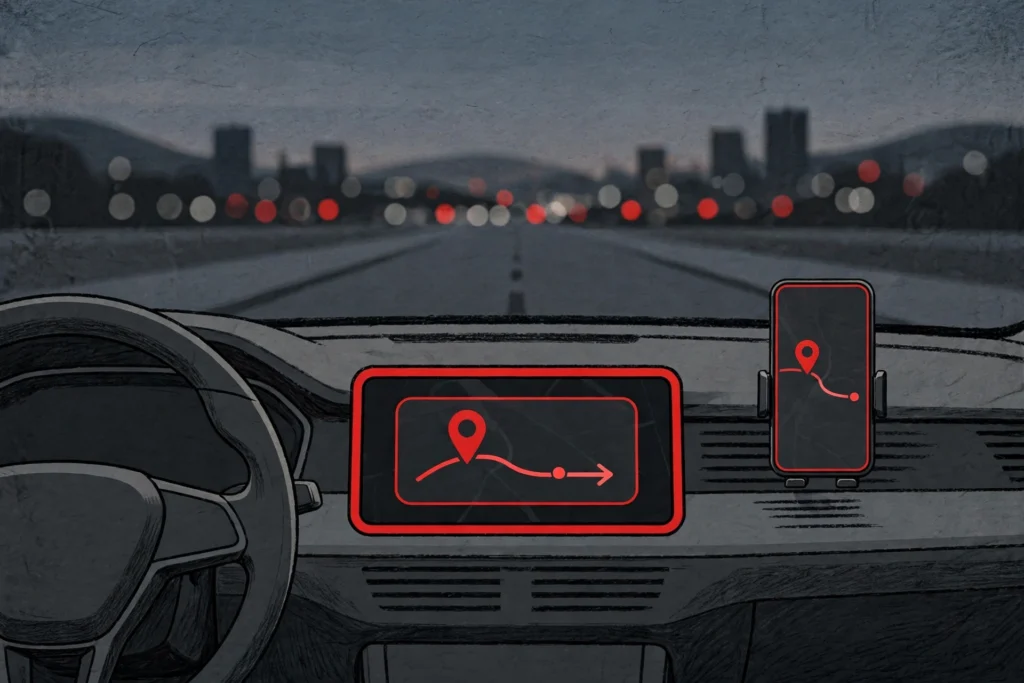
Picture the scene. You are driving home through evening traffic when a message lands on your phone. A friend wants to know where you are meeting for tomorrow’s pilates class. Normally, that means pulling over, digging through your inbox for the booking confirmation, and typing out an address while the traffic light turns green.
Soon, if you drive with a Pixel phone, your car may answer before you even reach for the phone.
Google has announced that Gemini Intelligence is coming to Android Auto, bringing proactive suggestions to the car. Instead of waiting for a voice command, the assistant will watch for the moments when it can help and offer the answer first. It is a small change on paper. In practice, it could change how the car screen feels to use.
The news arrived in a blog post from Google on November 10, 2026, written by Karthik Thirumalai, the company’s product director for Android AI.
The post covers a wider expansion of Gemini Intelligence, but the Android Auto detail is the part drivers will notice most. According to Google, the feature is coming soon, and it will start with a limited group of phones.
Gemini Intelligence on Android Auto: What Google Actually Announced
Gemini Intelligence is Google’s name for the AI features built directly into Android, rather than confined to the Gemini app. The company first introduced the program in May 2026, and devices began receiving it over the summer. Now it is spreading further, and the car is next on the list.
Google says that if you have a Pixel phone with Gemini Intelligence, it will soon bring proactive suggestions to Android Auto. The system will connect the dots across your apps and surface helpful, personalised suggestions when you need them.
That is the whole idea in one sentence: the assistant stops waiting and starts anticipating.
There is no firm release date. Google uses the word “soon”, and the fine print adds that the feature requires the Gemini app and a setup step. It will be limited to users aged 18 or over, in select countries and languages.
How Proactive Suggestions Will Work in the Car
Google’s own example shows the idea at its best. Imagine a friend texts you to ask where you are meeting for a pilates class.
Instead of searching for the booking yourself, Gemini Intelligence on Android Auto can find the confirmation email and instantly suggest sending the address with a single tap.
The key word is “proactive”. Today’s in-car assistants mostly react. You say “Hey Google”, you ask a question, and you get an answer.
The new version flips that order. It looks at what is happening across your connected apps and puts the next step on the screen before you ask for it.
That matters more in a car than anywhere else. A phone screen rewards fiddling; a car screen punishes it. Every tap you do not have to make is a moment your eyes stay on the road.
Of course, the usefulness of all this depends on how well the suggestions actually land. A suggestion that arrives at the right moment feels like magic. One that pops up at the wrong moment feels like clutter. Google has not said how often suggestions will appear, or how much control drivers will have over them.
The Pixel-Only Catch
There is a catch, and it is a familiar one. At launch, Gemini Intelligence on Android Auto will work only with Pixel phones that run Gemini Intelligence. That means the Pixel 10 series and the Pixel 11 series for now.
They received the assistant through this month’s November Pixel Drop, which brought it to the Pixel 10 line.
The Pixel 10a is excluded. Google’s requirements are strict: at least 12GB of RAM, a qualifying chipset, on-device AI models and Android 17 or later.
That hardware bar is what keeps the assistant’s work on the device, rather than sending everything to the cloud. It is also what keeps most Android phones out, for now.
Google has not said when the feature will reach other devices. The Samsung Galaxy S26, Galaxy Z Fold 8 and Galaxy Z Flip 8 are among the phones expected to support Gemini Intelligence eventually, since they are already on the wider device list.
For now, though, the car feature belongs to Pixel owners alone, and nobody outside that group knows how long the wait will be. The Pixel 10 line only received the assistant through this month’s November Pixel Drop, so the rollout is still young.
Part of a Bigger Gemini Intelligence Push
The Android Auto news did not arrive alone. Google’s November 10 post describes a wider rollout, and the car feature is one piece of a much larger pattern. Gemini Intelligence is moving from a Pixel-only experiment to something closer to a platform.
Task automation is also spreading. The feature that lets Gemini work through other Android apps on your behalf — ordering food, booking a ride, reserving a table — is now extending to the United Kingdom, India and Japan.
Google first offered it in a beta earlier this year, and it has been widening the circle ever since.
Motorola is introducing its first Gemini Intelligence device, the motorola signature 27, which opens for pre-order in the United States on November 19. It will be the first non-Google smartphone to support the full feature set. That matters because it shows Google is willing to let other manufacturers in, even if the car feature starts behind a Pixel wall.
Why a Proactive Car Assistant Matters
The car has always been the hardest place for a voice assistant to win. Voice commands work when you know what to ask for, but driving is full of moments when you do not know what you need until it is almost too late.
A proactive assistant fills that gap, if it gets the timing right.
That is also why the Pixel-only start makes sense for Google, even if it frustrates everyone else. A limited rollout lets the company watch how drivers react, fix the annoying suggestions, and tune the timing before the feature reaches hundreds of millions of cars.
The Privacy Question
There is a question hanging over all of this, and it is the same one that follows every proactive assistant.
To suggest the right thing at the right moment, the system has to look across your apps. It has to read the message, find the email, and connect the two. That is powerful, and it is also intimate.
Google says the work happens with on-device AI models where possible, and the hardware requirements exist partly for that reason.
The company has been under scrutiny on this front before, as we reported in our story on Google Gemini privacy and human review of Gmail and Drive data. Users care less about what an assistant can see than about who else can see it, and under what rules.
For now, Google has not published a detailed privacy explanation for the Android Auto suggestions. Drivers will want to know what data leaves the phone, how long it is kept, and whether they can turn the feature off entirely.
Those answers will matter as much as the feature itself once it starts rolling out.
What Happens Next
The honest answer is that nobody outside Google knows the exact date.
The company says “soon”, and the history of its Android rollouts suggests a staged release over weeks, starting with Pixel 10 and Pixel 11 owners in supported countries and languages.
The bigger picture is harder to miss. Google’s strongest AI model, Gemini 4 Carbon, arrived just days ago, and now the company is pushing its intelligence into the car.
The assistant is no longer something you open. It is becoming something that follows you from screen to screen, offering help before you ask. The drive home may be the next place it proves itself — or the place where its limits become obvious.