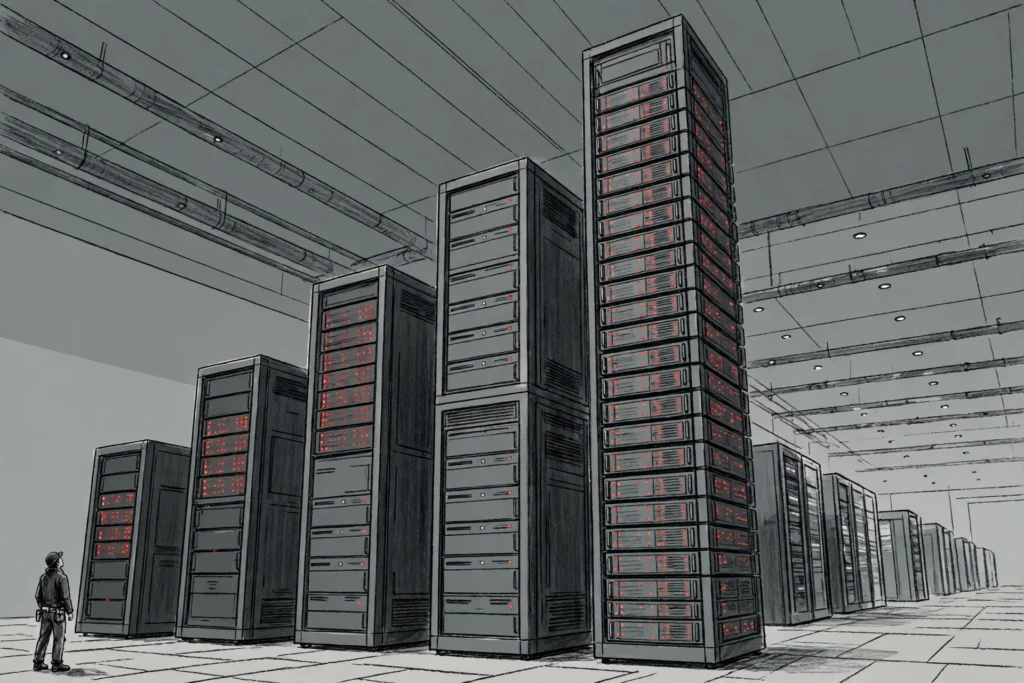
It was after the closing bell on Tuesday when the numbers landed in Round Rock, Texas. Traders had gone home, the screens had dimmed, and then the Dell Q3 earnings report arrived — a quarter so large it barely looked like the same company that reported a year ago.
Revenue had more than doubled. Profits had nearly quadrupled. And the order book for AI servers had swollen to a figure bigger than most companies earn in a year.
The Dell Q3 earnings report, released on November 24, 2026, is the clearest sign yet of who is actually getting rich from the AI boom. It is not only the chipmakers. It is also the company that bolts those chips into racks, tests them, ships them, and installs them in data centres around the world.
Dell Q3 Earnings at a Glance
The headline numbers are striking. Dell reported record revenue of $54.9 billion for its fiscal third quarter, up 103% from $27.0 billion a year earlier. Wall Street had expected about $49.3 billion, according to Reuters, so Dell cleared the bar by more than $5 billion.
Adjusted earnings per share came in at $9.45, up 265% year over year and far above the $6.59 analysts had pencilled in. On a GAAP basis, diluted earnings per share reached $8.82, up 287%. Net income rose 266% to $5.7 billion.
Cash flow told the same story. Dell generated a record $4.5 billion in cash from operations during the quarter and $10.8 billion across the first nine months of the fiscal year. It returned a record $4.9 billion to shareholders through dividends and buybacks.
The board also approved a further $25 billion increase to the company’s share repurchase authorisation, a signal that management believes the stock still has room to run. Shares rose about 2% in after-hours trading after the results, according to TradingView.
AI Servers Are Now the Business
Almost all of the growth came from one place: the Infrastructure Solutions Group, the division that sells servers, storage and networking gear to data centres. ISG revenue nearly tripled to a record $42.0 billion, up 198% from a year ago.
Inside that figure, AI-optimised server sales hit $22.0 billion, up 291% year over year. Traditional servers and networking brought in $15.0 billion, up 235%, while storage added $4.9 billion, up 24%. ISG operating income jumped 308% to $7.1 billion, with margins widening to 17.0% from 12.4% a year earlier.
That matters because Dell used to be known first as a PC company. Today, the infrastructure division accounts for 91% of the company’s segment operating income. The transformation chief operating officer Jeff Clarke described on the earnings call is no longer a plan — it is the balance sheet.
“We are now a different company, with Infrastructure Solutions Group driving the vast majority of our profit and growth,” Clarke said in the earnings release.
A $132 Billion Backlog — and the Orders Keep Coming
The number that will dominate every conversation about Dell this week is $132.3 billion. That is the size of the company’s AI server backlog at the end of the quarter, a record, after Dell booked $60.2 billion in new AI orders during the three months to October 30.
It was the second quarter in a row in which new AI orders topped $60 billion. To put that in perspective, the entire backlog is worth roughly two-thirds of the revenue Dell expects to collect across the whole fiscal year.
Clarke stressed that every order in the backlog has been vetted. Dell says it checks each customer for quality and for access to capital, land and power before counting the order. That detail matters because investors have started asking whether the AI build-out is built on solid demand or on shaky financing.
Dell also says it converts backlog into revenue faster than rivals. The company tests each complete rack before it ships, then stands it up within six hours of delivery. That shortens what Clarke calls “time-to-first-token” — the gap between a customer paying and a customer actually running AI workloads.
More than 7,500 customers are now deploying Dell AI Factories, the company’s bundled package of servers, storage, networking and services for running AI in-house. Demand, Clarke said, “continues to accelerate and broaden globally.”
Dell Raises Its Forecast for the Third Time
A strong quarter is one thing. A company raising its outlook for the third time in a year is another. Dell lifted its full-year fiscal 2027 revenue guidance to $202 billion, up from $192 billion, which would be a 78% increase on last year.
The AI server forecast rose too, to $78 billion from $74 billion. Adjusted earnings per share guidance climbed to $29.68 from $25.50. For the current fourth quarter, Dell expects revenue of about $56.3 billion, up 69%, and adjusted earnings of $8.40 per share.
According to Investor’s Business Daily, Dell’s quarterly revenue growth was its fastest in more than three decades. The last time the company grew this quickly, the internet was still a novelty and Dell was selling beige desktop towers by mail order.
The raised guidance also sets a high bar. Dell must now deliver roughly $56 billion in the fourth quarter, and the market will watch closely to see whether the backlog converts into shipped servers on schedule.
The PC Business Is Now the Side Hustle
While the server business roared, the PC division barely moved. The Client Solutions Group, which sells laptops and desktops, reported revenue of $12.9 billion, up just 3% from a year earlier. Operating income fell 6% to $704 million.
Commercial PC sales grew 6% to $11.3 billion, but consumer sales dropped 15% to $1.6 billion. The contrast with the infrastructure division could hardly be sharper: one side of Dell is growing at nearly 200%, the other at 3%.
That split also explains why Dell’s fate is now tied so closely to the AI data centre cycle. The PC business still matters, but it no longer decides whether Dell has a good year. The server order book does.
Why the Dell Q3 Earnings Matter Beyond Dell
Dell’s results land in the middle of a fierce debate about the AI boom. On one side are the optimists, who point to record orders and rising forecasts. On the other are sceptics who warn that memory prices, power constraints and stretched customer finances could slow the build-out.
That debate is not abstract. Memory has become the bottleneck of the AI era, with Samsung’s memory capacity reportedly booked through 2029 and server makers passing higher costs on to buyers. Dell itself was at the centre of that story, with AI server prices jumping by up to 45% after contracts were signed.
Dell’s numbers suggest the demand side of that equation is still very strong. Customers are not just ordering; they are ordering more, and Dell is charging more for each rack.
ISG margins widened even as AI servers became a bigger share of the business, which is the opposite of what happens when a company is discounting to win deals.
At the same time, the sheer size of the backlog raises a new question. A $132 billion order book is only as good as Dell’s ability to build and ship it.
Memory supply, component availability and power constraints at customer sites could all slow conversion. As Finimize noted, investors will now focus on how steadily those orders turn into sales and cash.
What Happens Next
The next test comes quickly. Dell’s fourth-quarter guidance implies another huge three months, and the company will report those results in early 2027. Any shortfall against the $56.3 billion target would be read as a warning about the AI cycle, not just about Dell.
Watch also for what rivals say. Dell’s backlog is built largely on Nvidia-powered systems, so its fortunes remain tied to the chipmaker’s supply and pricing. A separate report this month showed TSMC betting $1 billion on Anthropic and OpenAI, a reminder that the whole AI supply chain is now investing in its own customers.
For now, Dell has delivered the quarter the AI bulls wanted. Revenue doubled, profits nearly quadrupled, the backlog hit a record, and the forecast went up for the third time. Reuters reported that Dell has lifted its annual revenue target to $202 billion — a figure that would have sounded like fantasy two years ago.
The company that once defined the PC era has reinvented itself as the builder of the AI era’s factories. The Dell Q3 earnings show just how complete that reinvention has become.


