Picture this. It is a Friday afternoon and you realise the house is out of coffee, your mother’s birthday is on Sunday, and the flight you meant to book last week has quietly doubled in price.
You do not open five apps. You do not compare tabs. You simply tell your AI assistant what you need, and it goes and buys it. Until this week, that last step was the part that never quite worked.
An AI agent could find the coffee, compare the prices and even fill the basket. But when it reached the checkout, it stopped. Someone still had to type in a card number.
On Friday, November 13, OpenAI removed that final barrier. The company announced ChatGPT Wallet, a feature that lets its always-on agents, called dots, complete purchases on your behalf.
The agent never sees your real card details, and every purchase still needs a security check from you. But the checkout itself is now the agent’s job. It is a small change in how shopping works and a large change in what an AI assistant is for.
According to Reuters, OpenAI built the wallet together with American Express, Mastercard and Visa, and it describes the launch as setting a new bar for secure payments by agents.
What ChatGPT Wallet Actually Does
ChatGPT Wallet is not a bank account and it does not hold your money. It is a card wallet that sits inside dots, the always-on agents OpenAI introduced on September 29.
Dots run on their own cloud computer with their own browser, and they can connect to more than 4,000 apps. When you ask a dot to buy something, it searches for the product, compares options and prepares the checkout.
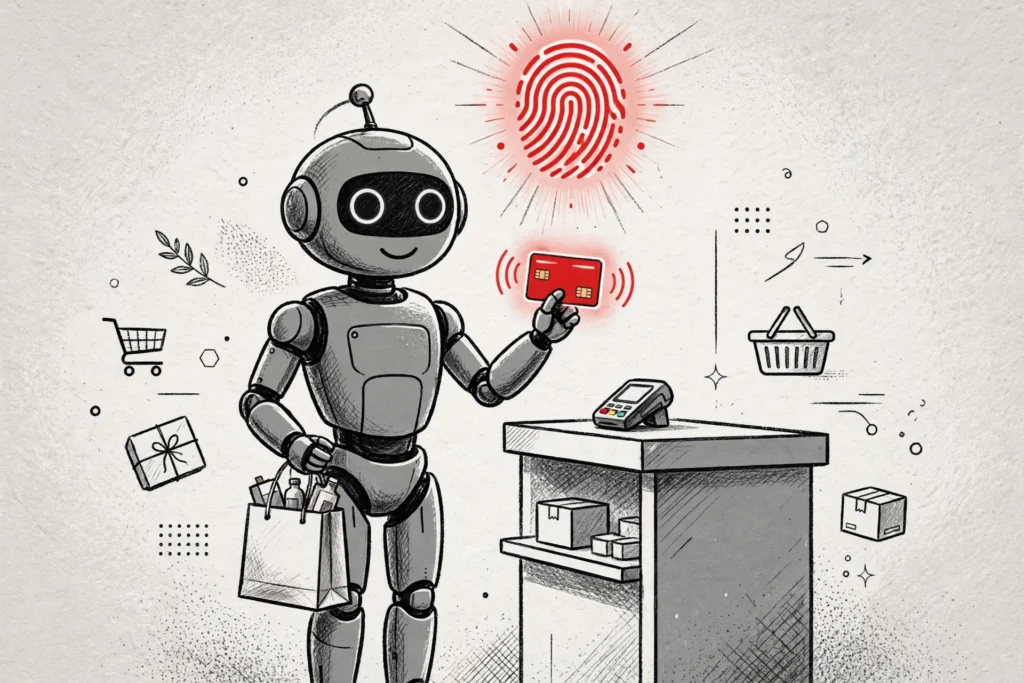
Then, instead of asking you to dig out your wallet, it pays with a token that stands in for your real card. The merchant gets paid. Your card number never leaves OpenAI’s system.
You stay in control of the purchase itself. Before the checkout goes through, you review the items, the total and the card that will be used. Every purchase requires a security check, such as Face ID or a fingerprint.
The wallet also keeps the benefits you already get from your card. OpenAI says existing rewards, points and protections for eligible disputes are preserved.
How the Payment Stays Safe
The obvious question is what happens when an agent has your money at its fingertips. OpenAI’s answer has three parts: the agent never sees the real card number, you approve every purchase, and the approval is tied to a biometric check.
Behind the scenes, the wallet leans on the existing payments industry rather than replacing it. OpenAI worked with Forter, Riskified, Sardine and Signifyd on fraud detection, and with Adyen, Checkout.com and Stripe on the payment side.
For now the rule is one purchase, one approval, though the wallet’s terms allow for prior authorisation in principle. OpenAI says users will eventually be able to set standing rules, such as spending limits or allowed categories.
That would let a dot handle the weekly grocery run on its own while still needing your approval for anything expensive. A payment feature that misfires is far worse than a chatbot that gives a wrong answer.
Who Can Use ChatGPT Wallet Right Now
The launch is deliberately narrow. ChatGPT Wallet is rolling out first to ChatGPT Pro subscribers in the United States who are 18 or older and hold an eligible US-issued Visa, Mastercard or American Express card.
Even then, the rollout is gradual, so an eligible subscriber may not see the wallet immediately. There is no announced date for ChatGPT Plus, Business or free users, and no timetable for any country outside the United States.
It is also limited to dots. The wallet does not work inside ordinary ChatGPT conversations or in ChatGPT Work. You need access to a dot agent, which today means Pro, Business Premium and Enterprise plans in eligible markets.
OpenAI says it started small so it can learn from real-world use before opening the feature up further.
Why OpenAI Is Charging Nothing — For Now
One detail stands out in the launch: OpenAI is not charging a commission on transactions. According to CNBC’s reporting, the company takes a 0% cut on every purchase its agents make at launch.
The play is distribution, not fees. If millions of people start buying through dots, OpenAI becomes the front door to online shopping, the way search engines and marketplaces have been before it.
That is also why OpenAI published a Commerce Partner Playbook alongside the wallet, aimed at retailers who want their products to be found and bought by agents. The playbook is live on OpenAI’s developer site.
There is an obvious comparison here. OpenAI has spent the year pushing its workplace products, from ChatGPT Enterprise on the AWS Marketplace to the business features announced alongside its office-suite rivals. ChatGPT Wallet is the consumer side of the same strategy.
The Permission Problem: Some Doors Are Already Closed
The wallet solves payment. It does not solve permission, and permission may turn out to be the harder problem. An agent can only buy from a website that lets agents in, and some of the biggest sellers are already saying no.
Two days before the wallet launched, on November 11, United Airlines rewrote its Contract of Carriage to define AI agents and list agent bookings as a prohibited practice. The airline moved to block unauthorised third-party agents from its platforms.
That means a dot cannot buy you a United ticket, however good its intentions. TechCrunch’s report on the launch notes that OpenAI named no specific merchant partners for the wallet, and that it will not work on sites that block AI agents.
The tension is genuine. The same technology that lets your dot buy groceries can also scalp concert tickets or scrape prices. Merchants must decide, site by site, whether an agent acting for a real customer is a welcome shopper or an unwelcome bot.
What ChatGPT Wallet Means for Shopping
If the feature works as promised, the change in daily life is easy to imagine. Reordering household supplies becomes a sentence instead of a chore. A dot could notice the printer is low on ink, find the best price, and ask you to approve the purchase with a fingerprint.
Travel and groceries are the obvious early uses. OpenAI’s own examples include booking travel, ordering groceries and buying retail goods. Those are the purchases people repeat most often, and the ones where the research is more tedious than the decision.
For retailers, the shift is more unsettling. If customers stop browsing storefronts and start sending agents, the storefront matters less and the product feed matters more. The merchant that wins is the one whose catalogue the agent can read and whose checkout does not block the agent at the door.
That caution echoes OpenAI’s other recent safety work, from the Control Room kill switch for rogue AI models to the Daybreak security tools announced the day before the wallet. Payments are simply the newest place where the guardrails matter.
What Happens Next for ChatGPT Wallet
Three things are worth watching in the months ahead. First, how quickly the rollout widens beyond US Pro subscribers, and whether Plus users get access in 2027.
Second, which merchants embrace agent shopping and which ones block it, following United’s lead. Third, whether the 0% commission lasts. A free checkout is a powerful way to win adoption, but it is also a subsidy, and subsidies end.
The bigger picture is that OpenAI is racing to make its agents the place where commerce happens, just as Anthropic and OpenAI are racing each other in the workplace.
The wallet is a bet that the next great shopping interface is not an app or a website, but a conversation with an agent you trust. That trust is the whole product.
A wallet that lets an agent pay without showing it your card, and makes you approve every purchase, is a careful first step.
Whether shoppers take the second step — letting the agent spend on its own, within limits they set — is the question that will decide whether agentic commerce becomes a habit or a curiosity.
For now, the checkout has a new customer. It is not a person. It is a dot, carrying a token, waiting for your fingerprint.


