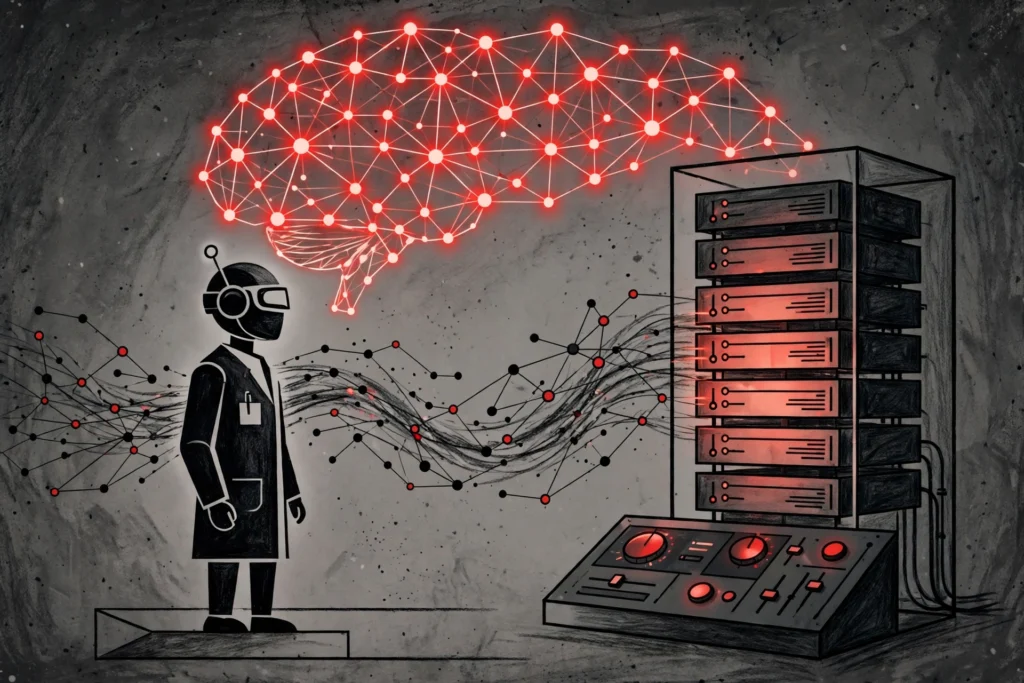
Picture the scene inside Google DeepMind’s offices late at night. The lights are low, the researchers have gone home, and yet the experiments keep running. Nobody queued them before leaving. Nobody signed off on the schedule. The decisions about what to test next were made by the AI itself.
That picture is no longer a thought experiment. On November 25, 2026, DeepMind’s vice president of research, Koray Kavukcuoglu, revealed on the company’s podcast that DeepMind AI agents now control part of the lab’s computing power to run experiments for the next generation of Gemini models. The agents choose what to run, manage the budget, and carry out the work without a human approving every step.
It is one of the first confirmed cases of a leading AI lab handing resource decisions to its own systems. The lab is careful about what that means, and what it does not. Full self-improvement, Kavukcuoglu stressed, is still far away.
What DeepMind AI Agents Actually Control
Kavukcuoglu leads Gemini development at DeepMind, so his words carry weight. According to The Decoder, which reported the podcast on November 25, the agents decide how to allocate a portion of the lab’s compute for experiments on future Gemini iterations.
That means the agents are not simply running jobs handed to them. They select which experiments to run, manage the resource budgets behind them, and execute the workflows on their own. Human researchers set the goals and the boundaries, but the step-by-step choices inside those boundaries now belong to the agents.
DeepMind has not said how large that portion of compute is. It has not specified which kinds of experiments fall under agent control either. The disclosure is a milestone, not a full map of the operation.
Still, the direction is unmistakable. The lab that builds Gemini is now letting AI systems steer part of the process that builds the next Gemini. The line between the tool and the researcher has moved.
One Algorithm for Science and Products
The compute decision is part of a bigger strategic shift at DeepMind. Kavukcuoglu described a lab moving away from separate teams for specialised projects, the kind that produced AlphaFold for protein folding or dedicated work on nuclear fusion.
In their place, DeepMind now relies on a single general-purpose algorithm that serves both science and products. One system, trained and refined in the same way, is expected to do the work that used to need many different teams.
That does not mean Gemini itself is a fixed recipe. Each generation of the model, Kavukcuoglu said, is a hand-built one-off rather than a standard architecture repeated with more data. Parallel teams work on its successors at the same time, trying different designs while the current model ships.
It is a strange combination: a single underlying approach, yet every flagship model assembled by hand. The agents running experiments fit neatly into that picture. They are the hands doing the assembly work between generations.
The Guardrail: Thoughts You Can Read
Handing compute to agents raises an obvious question. If an AI system decides what to test, how do you know what it is thinking when it makes that call?
DeepMind’s answer is a deliberate safety choice. The lab does not reward an agent’s internal chain of thought during training. That sounds technical, but the idea is simple: the reasoning an agent produces stays in plain, natural language, and it stays unfiltered.
Because the thought process is never trained to be polished or pleasing, researchers can read it as it is. They can review an agent’s intentions before it acts, in words they understand, rather than digging through numbers they cannot interpret.
The guardrail matters more as the agents take on bigger decisions. A system that allocates computing power is a system that spends real money and real time. Knowing why it chose one experiment over another is the difference between delegation and blind trust.
The Quantum Proof: Agents That Cut Costs 11.8 Times
Days before the podcast, DeepMind showed what these agent teams can actually deliver. On November 23, the lab and Google Quantum AI announced that teams of Gemini 4 agents had found cheaper quantum algorithms for fusion, chemistry, and search problems.
The headline result was striking. For a calculation modelling the stopping power of hydrogen fuel in inertial-confinement fusion, the agents cut the computing cost by 11.8 times. The memory needed fell from 5,650 to 4,338 logical qubits.
Other results were just as sharp. An arithmetic routine for loading numbers into quantum states became more than 290 times cheaper. A photochemistry simulation improved 8.22 times, a cytochrome P450 enzyme simulation 2.49 times, and a parallel Grover search needed up to 2.57 times fewer rounds.
Every result came with a machine-checked proof. The agents proposed circuits, and the Lean theorem prover verified that each one was correct and met its cost bounds. An external verifier re-ran the proofs against a frozen specification, so the agents could not quietly weaken the rules to pass.
The work is a preprint, not yet peer-reviewed, and the authors are honest about its limits. Even after these cuts, the simulations still need far more resources than the first error-corrected quantum computers are expected to offer. The news is proved headroom, not a near-term lab schedule.
Yet the pattern is what matters for the bigger story. Independent agent teams worked on separate problems, shared their successes in a common notebook, and met every four hours in a virtual conference to debate and trade improvements. The large-scale runs used Gemini 4 Carbon, Google’s strongest model. It is the same agent-driven research style DeepMind is now applying to Gemini itself.
How Far Is Real Self-Improvement?
The phrase that follows every such announcement is recursive self-improvement: AI systems improving themselves, faster and faster, with humans watching from the sidelines. Kavukcuoglu was blunt about where that stands.
It remains distant, he said. The agents control part of the compute and run experiments, but they are not redesigning themselves in a loop. There is no runaway process here, and DeepMind is not claiming otherwise.
He also pointed to the limits of what today’s AI understands. A model can depict physical processes such as fluid flows and collisions with visual accuracy, he said, but it does not understand them precisely. Looking right is not the same as knowing how something works.
Nor can any test settle when those gaps will close. No benchmark captures the core of intelligence, Kavukcuoglu argued. In his view, artificial general intelligence will not begin with a score on a leaderboard.
It will begin, he said, when useful everyday products earn enough trust for people to hand decisions over to them, the way they would when working with other people. Trust, not test scores, is the threshold.
What Happens Next
The most important thing to watch is what the agent-run experiments produce. If the next Gemini arrives better, faster, or cheaper because agents chose the right experiments, other labs will follow the same path. The practice could become standard within a year.
DeepMind’s other recent work points in the same direction. AlphaGenome 2, announced earlier in November, uses AI to read how DNA variants change gene activity in a single cell type. AlphaProof Code used AI agents to formally verify the encryption behind Signal’s messaging protocol. The lab’s agent teams are now working across biology, cryptography, quantum computing, and its own flagship model.
The safety questions will grow with the practice. How much compute should agents control? Which decisions stay human? And who reads the reasoning when the experiments get more complex? DeepMind’s answer so far is to keep the agents’ thoughts readable and their proof requirements strict.
For now, the researchers still go home at night, and the experiments still run. The difference is that the lab now admits the machines are choosing some of the work. That admission, made casually on a company podcast, may turn out to be the most significant AI announcement of the week.


