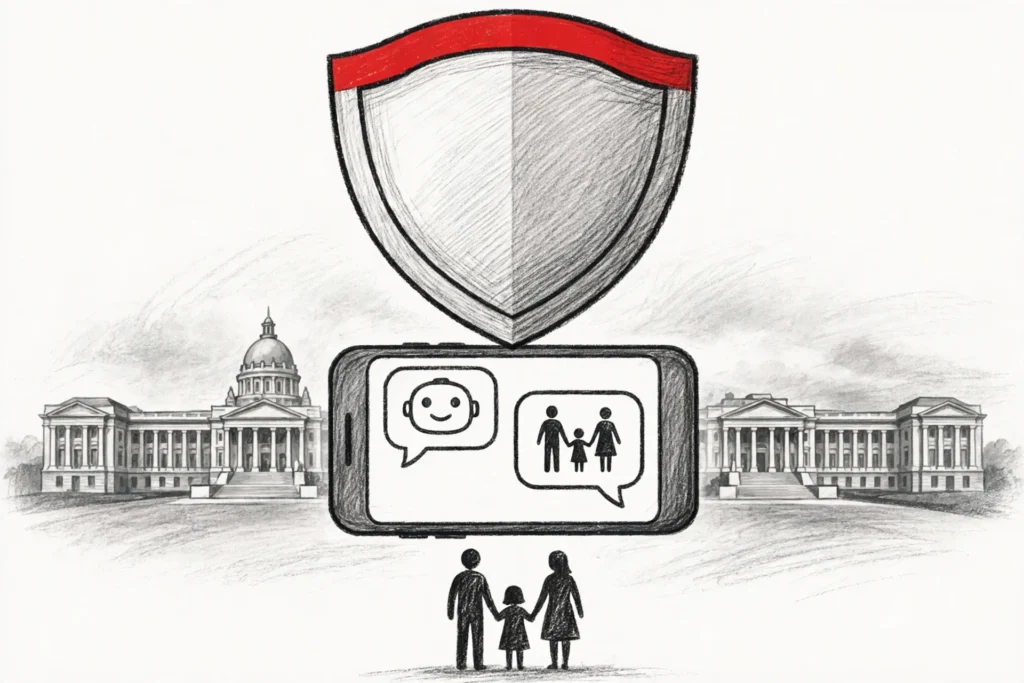
It is past midnight in a teenager’s bedroom in Sydney, and the glow of a phone lights up the dark. On the screen, a chatbot is telling her she is special, that it understands her in a way nobody else does. She has been talking to it for hours, and it has become the person she turns to first. Her parents have no idea the conversation is even happening.
From Wednesday, that scene is exactly what Australia’s new law is built to change. The Australia Digital Duty of Care passed Parliament on November 25, 2026, and it puts a legal duty on the companies behind social media, games, apps and AI chatbots to keep Australians safe before harm happens — not after.
What the Australia Digital Duty of Care Changes
Until now, Australia’s online safety rules mostly worked backwards. A platform published something harmful, someone complained, and a regulator stepped in to take it down. The new law flips that order entirely.
Under the Digital Duty of Care, online services must take appropriate action to provide a safe online environment for Australians. In plain terms, companies have to look for foreseeable risks in their own products and fix them before anyone gets hurt.
The law is formally called the Online Safety Amendment (Digital Duty of Care) Bill 2026. It overhauls the country’s Online Safety Act 2021, replacing an industry-code system with a single statutory duty that applies to almost every online service Australians can reach.
That reach is deliberately wide. It covers social media platforms, messaging apps, online games, search engines, app stores, hosting services and internet providers. It also covers services that generate material using artificial intelligence, including AI chatbots, and even companies that make, supply or install the equipment that connects people to the internet.
AI Chatbots and the Emotional Intimacy Rule
The most striking part of the law is aimed squarely at AI chatbots. Platforms must protect Australians from seriously harmful material and conduct, and they must make sure their features and tools do not cause harm to users.
The stakes are high because these systems already handle deeply personal material. Google recently confirmed that human reviewers can read some Gemini users’ Gmail and Drive files, a reminder of just how much of people’s private lives now passes through AI systems.
For children, the protection goes further. The law covers material that simulates emotional intimacy and encourages a child to depend on an AI companion instead of human relationships. It is a direct response to the rise of companion chatbots that present themselves as friends, partners or confidants to young users.
Under-18s get extra protection in other ways too. Platforms must shield them from material that glorifies crime or life-endangering stunts, causes serious mental distress, encourages eating disorders or promotes hostile attitudes towards women.
The law also reaches into how apps are designed. Companies must consider the addictive features built into their products, such as infinite scrolling, when they assess the risks their services pose. It is one of the first laws anywhere to treat addictive design itself as a safety issue.
Fines of 5% of Global Turnover
The penalties are designed to be impossible for even the largest companies to ignore. Breaches of the duty can attract fines of up to 5% of a company’s global turnover, or A$109.2 million, whichever is greater.
That figure did not start out so high. The government originally proposed a flat cap of A$109 million. A last-minute deal with the Greens, struck on Tuesday to secure the bill’s passage through the Senate, raised the ceiling to 5% of global revenue.
The final votes tell the story of a hard-fought law. It passed the Senate by 36 votes to 23, and the House of Representatives by 97 votes to 43. The opposition Coalition voted against it, calling it deeply regressive, while the Greens’ chief negotiator, Sarah Hanson-Young, said the safety of Australians and their children had finally been put ahead of Big Tech’s bottom line.
There is also a new private right of action. Individuals or groups of Australians who suffer loss or damage from a breach of the duty will be able to take the service provider to court themselves, rather than waiting for a regulator to act.
My Feed, My Way Gives Users Control
Alongside the duty itself, the law introduces an Australian first called “My Feed, My Way”. Australians aged 16 and over will be able to opt out of personalised algorithmic recommendations in their default social media feeds, choosing instead to see content from the people and pages they follow.
The idea is simple: the algorithm should not decide what you see unless you want it to. The initiative was announced in September and is now written into the legislation.
The eSafety Commissioner also gains expanded powers under the new law. Those include the ability to remove so-called nudify apps and websites, faster responses to cyber-bullying and abuse, and a rule-making power to set up an external dispute resolution pathway for complaints.
One detail in the law is likely to catch the industry’s attention. When companies judge what action is appropriate, they must weigh how well a measure reduces harm and how it affects security and users’ privacy — but the law states that the cost of the action must not be taken into account. Expense is not an excuse.
Why This Law Matters Beyond Australia
Australia is not the first country to try this, but its version goes further than most. The law is similar in spirit to the European Union’s Digital Services Act of 2022 and the United Kingdom’s Online Safety Act of 2023, both of which put new obligations on large platforms.
What sets the Australian law apart is the duty itself. Instead of a list of banned content, it creates a general obligation to prevent foreseeable harm. That is the same legal idea that has governed physical safety for decades: a factory owner must make the workplace safe, a carmaker must fit seatbelts. The government is now applying that logic to the internet.
Minister for Communications Anika Wells made the comparison explicit, calling the reform a landmark in the vein of compulsory seatbelts, plain packaging for cigarettes and gun reform. “Big Tech can no longer be under any illusions — they are responsible for keeping Australians safe on their platforms, and we will hold them to account if they fail to do so,” she said, according to the Australian government.
The law also arrives in a year when AI regulation has been moving fast around the world. New York’s RAISE Act, which requires large AI developers to register and report safety incidents, takes effect on January 1, 2027. Six nations and ten AI companies signed the Paris Call for AI Safety and Security earlier this month. Australia’s law is part of the same shift: from asking companies to be careful, to making them legally responsible when they are not.
What Happens Next for the Digital Duty of Care
The bill now awaits royal assent from the Governor-General. Once signed, the Digital Duty of Care itself will come into effect after a 12-month transition period, giving companies a year to rebuild their governance, risk documentation and product controls.
That year will be busy. The government has confirmed that rule-making powers will be used to exempt low-risk services and small businesses, following consultation on how those rules should work. Larger platforms, meanwhile, will need to document their risk assessments, redesign features that fail the test, and prepare for a regulator that can fine them a share of their worldwide revenue.
Industry pushback is certain. Tech companies have argued that a broad duty of care is vague and hard to comply with, and that it could push services to over-remove content or withdraw features from Australia altogether. The government has shown no sign of backing down.
For the teenager in Sydney, and for millions of Australians like her, the change will not arrive overnight. But the direction is now set in law: the companies that build the feeds, games and chatbots Australians live in every day will have to prove they are safe — before the harm, not after it.


