Picture a bank executive staring at a merger document on her screen. The numbers inside could move markets if they leaked. She knows an AI assistant could summarise the deal in minutes, but the file has to travel to someone else’s servers first. So she closes the tab and does the work by hand.
That hesitation is the problem OpenAI is now trying to solve. On November 25, chief executive Sam Altman announced on X that the company has started testing Private Inference, a new feature that lets businesses run queries on its most powerful models without OpenAI itself being able to see the data.
It is a small pilot for now, limited to a handful of enterprise customers. But if it works as promised, it could change which kinds of work companies are willing to hand to frontier AI at all.
What OpenAI Announced on November 25
Private Inference is the second piece of OpenAI Private Intelligence, the privacy framework the company first revealed at its DevDay event on September 29. The first piece, Private Safety Processing, arrived earlier and is already rolling out to API customers in phases.
Altman framed the pilot in plain terms. Stronger privacy protections will make frontier AI useful for a lot more work, he wrote, adding that business privacy matters for a healthy ecosystem. He pointed interested companies toward Shekar, the OpenAI employee leading the effort.
Shekar called the test a first step toward private intelligence for everyone. He also confirmed that OpenAI is lining up confidential computing capacity to scale the feature well beyond its first small group of testers.
For now, there is no list of supported models, no price and no date for a wider release. OpenAI’s product page lists Private Inference as an alpha feature with an API preview, and companies can register their interest and describe their privacy needs.
How OpenAI Private Inference Actually Works
The core idea is confidential computing. Instead of running a request on ordinary shared servers, OpenAI processes it on specially isolated hardware whose security can be independently verified.
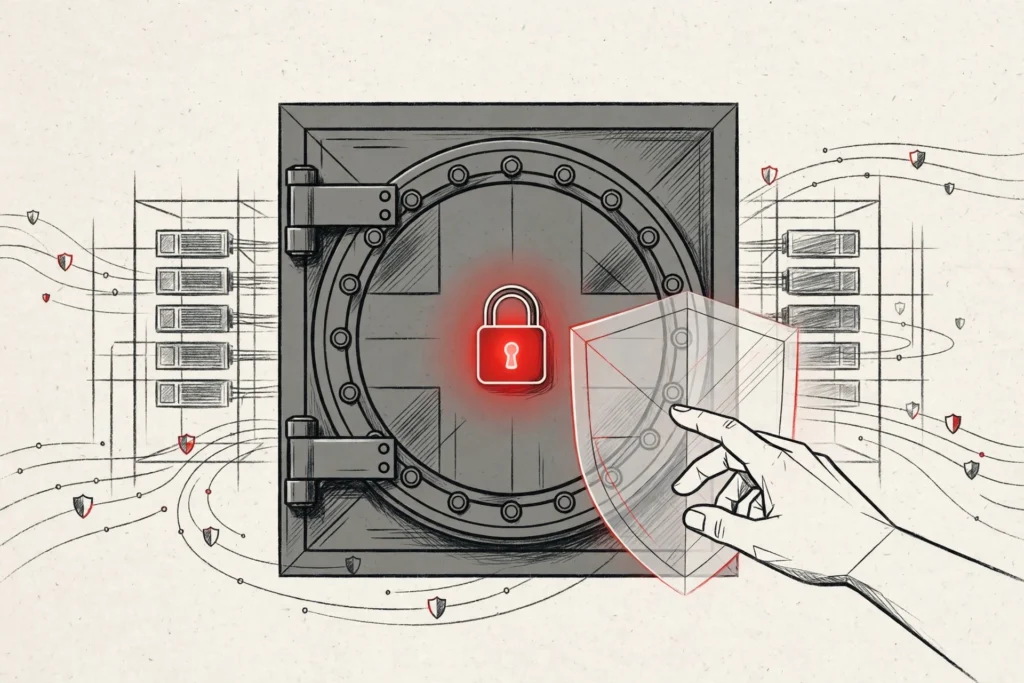
Think of it as a sealed room inside the data centre. The prompt goes in encrypted, the model works on it inside the sealed chip, and the answer comes back out. Even OpenAI’s own systems cannot peek at what is happening in between.
OpenAI pairs this with what it calls strict, verifiable controls. The hardware itself can prove it is running the expected software, so a customer does not have to take the company’s word for it.
Apple uses a similar approach for Siri requests sent to its cloud, and Google is pursuing the same direction with its Private AI Compute system. The idea is spreading fast because the trust problem is the same everywhere.
Private Inference vs Zero Data Retention: Two Different Promises
It helps to separate two questions that are easy to confuse. The first is what happens to your data while the model is working. The second is what happens to it afterwards.
Private Inference answers the first question. It protects prompts and responses during processing, the moment when data is normally most exposed.
Zero Data Retention answers the second. For eligible API workflows, OpenAI does not keep the prompt or the model response once the request is fulfilled. Nothing is stored, so there is nothing to leak later.
OpenAI also says business customers own their inputs and outputs, and that business data is excluded from model training by default unless a customer explicitly opts in. That baseline already covers its business products and API platform.
Location controls add another layer. Eligible customers can store content in specified regions and choose in-region GPU inference in the United States or Europe. Private Inference is the missing piece: it guards content during computation itself.
The Safety Check That Never Sees Your Data
There is an obvious tension here. OpenAI still has to check for abuse, but a safety review normally means someone, or something, reading the content. Private Safety Processing is designed to resolve that tension.
Under the system, a selected interaction is saved as an encrypted record in regional cloud storage controlled by the customer, on AWS, Azure, Google Cloud or Oracle Cloud Infrastructure. OpenAI keeps only operational details and a pointer to that record.
The automated review then runs inside a protected computing environment called the Safety Review Runtime, where human access is disabled. Its plain-text output is limited to predefined safety signals and approved operational metadata.
Detailed findings are encrypted before leaving the runtime and stored back in the customer’s cloud account. Customers must keep those encrypted records for at least 30 days, and an extra layer of customer-controlled encryption is available through Enterprise Key Management.
Revoking authorisation for the customer’s key prevents decryption of retained records. It does not erase them, and it does not undo processing that has already happened.
The result, according to OpenAI, is that automated safety reviews can run under zero data retention without any OpenAI staff member seeing the underlying content.
Why Businesses Held Back — and Why Rivals Are Moving Too
The timing is not accidental. In September, reports emerged that Nvidia, Palantir and Booz Allen Hamilton had begun scaling back their use of OpenAI and Anthropic models over fears the systems could learn from customers’ intellectual property.
Both AI firms deny training on corporate inputs, while acknowledging they hold some metadata. But the worry alone was enough to slow adoption in the most sensitive industries.
Anthropic is moving in the same direction. On November 23, just two days before Altman’s announcement, it launched Enterprise Frontier Safeguards in beta. Companies keep their own data while the system looks for abuse.
Anthropic had already tightened its cyber protections in October, a programme that required organisations to permit data retention so misuse could be monitored. Its new safeguards aim to match that protection with no data retention.
The pattern is clear. The race between the big AI labs is no longer only about which model is smartest. It is also about which one a bank, a law firm or a hospital can trust with its most sensitive work.
What We Still Don’t Know About Private Inference
For all the detail OpenAI has shared, the practical questions remain open. The company has not said which models Private Inference supports, how much it will cost, or when it will become generally available.
The trial is also a test of deployment, not just architecture. Confidential computing needs specialised hardware, and expanding the feature beyond the first customers depends on capacity that OpenAI is still securing.
That is why the pilot matters as much for what it proves about scale as for what it proves about cryptography. A privacy feature that only a handful of customers can use is a demonstration, not a product.
There is also the question of verification. OpenAI says the hardware’s security can be independently checked, but the industry will want to see exactly how that attestation works in practice before sensitive workloads move across.
What Happens Next for Private Inference
OpenAI is now collecting interest from businesses that want in, asking them to describe their privacy needs and AI use cases. The pilot group will grow as confidential compute capacity comes online.
The stakes go beyond one feature. If Private Inference works at scale, it removes the main objection that has kept frontier AI out of boardrooms, trading floors and hospitals.
For years, the pitch to businesses was simple: your data is safe with us. Now the pitch is stronger, and stranger: your data is safe even from us. Whether companies believe it will decide how far AI reaches into the work that matters most.
Source: The Decoder


