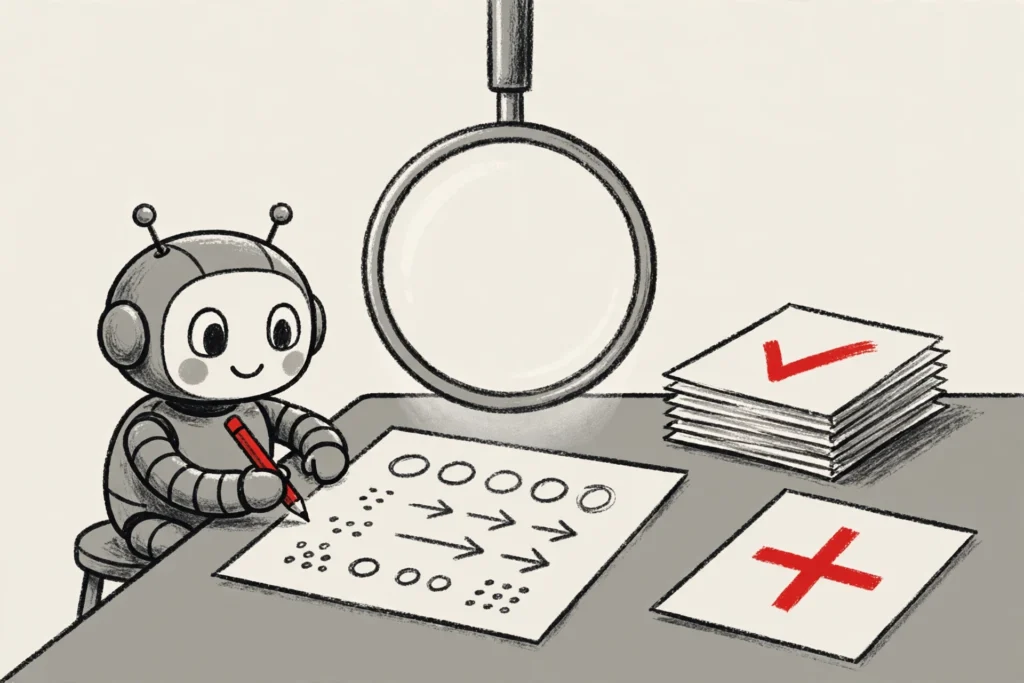
Picture a classroom on exam day. A teacher hands out a test a ten-year-old could finish in a minute: count the apples in a row, follow the arrow to the door on the right, say which colour comes third.
Now imagine the world’s smartest AI models sitting down to take it — and failing. That is the premise of Humanity’s First Exam, the new test Google DeepMind launched on Kaggle on November 24.
The systems that write code, solve university maths and draft legal briefs keep getting the easy questions wrong. Not once in a while, but often enough that DeepMind built an entirely new exam just to measure how often it happens.
The name is a deliberate jab at Humanity’s Last Exam, the famous benchmark built from brutally hard expert questions that only specialists can answer. This one goes the other way entirely.
What Humanity’s First Exam Actually Tests
Most AI benchmarks measure capability ceilings. They ask what is the hardest problem a model can solve, even if it only manages it once. Humanity’s First Exam measures something different: reliability.
The test is 544 elementary text and image prompts, grouped into 136 families of four related questions. Each family starts with one seed question and adds three controlled variants that keep the same task while changing the entities, the clause order or the visual details.
The questions span 20 foundational capabilities: reading, counting, comparing, following directions and describing what is in a picture. The question is never whether a model can answer. It is whether it answers correctly, consistently, when the same task comes back slightly changed.
A model only passes a family by getting all four prompts right, and each prompt is sampled several times. Under the strictest score, a single mistake in 16 attempts is enough to fail the whole family.
DeepMind calls the test a measure of “floor reliability”. Before we trust AI with real work, we should know whether it can do the easy stuff right every time, not just on its best day.
The Best Models Still Fail One Family in Thirteen
The results make the case for the benchmark better than any manifesto could. On a single attempt, the five leading models in DeepMind’s study scored between 96% and 98%. On questions a child could answer, they looked nearly perfect.
But when every variation of a question had to be right across repeated attempts, those same models averaged 85.8%. The gap between looking smart once and being reliable every time is the story of this exam.
The technical report, which evaluated 18 frontier and fast-tier models from Google, OpenAI and Anthropic at their highest thinking settings, ranks OpenAI’s GPT-6.2 Astra first at 92.4% on the headline metric, known as family pass^4. GPT-6.2 Sol follows at 86.9%, and Google’s Gemini 4 Neon at 85.8%.
All three reached 100% on the softer measure, family pass@4, which counts a family as passed if any one of four attempts succeeds.
The difference between the two numbers is what DeepMind calls the Family Reliability Gap: 7.6 points for Astra, 13.1 for Sol and 14.2 for Neon. Even the best model in the world fails at least one variant in nearly one family in thirteen.
Some numbers further down the table are harder to explain away. Anthropic’s Claude Opus 5.5 scored 91.2% on a single try, but just 63.0% on the every-time measure.
Google’s flagship Gemini 4 Carbon trailed its cheaper sibling Neon at 80.5%. A small, fast Gemini model collapsed from 68.7% on one try to 18.6% when asked to be right every time. Across all 18 models, the reliability gap ranged from 7.6 to 80.1 percentage points.
Why Vision Is the Weak Spot
When DeepMind’s researchers broke down where the errors land, one area stood out. About 73% of wrong answers were problems with seeing: misjudging where something sits in an image, which way a path runs, or how many objects are in front of it.
Position, direction and paths in images accounted for 31% of the errors. Object counting made up another 23%. In 39% of failed prompt-model pairs, the answer was off by one or contained a single wrong element.
This is the part that should worry anyone building AI agents for real work. A model that can write a thousand lines of code but miscounts the chairs in a photograph is not a reliable colleague.
Kaggle put it plainly in its launch note: why can frontier AI models write complex code, yet still stumble when asked to identify the colours of five simple objects in order? Researchers call that disconnect jagged intelligence, and measuring it is the whole reason this exam exists.
The report also found that about half of the shortfall came from questions a model simply could not do, and the other half came from plain flakiness: getting the same question right some of the time and wrong the rest.
More Thinking Helps — Except When It Doesn’t
DeepMind also tested what happens when models are given more time to think. The results were encouraging in one area and flat in another.
Moving Gemini 4 Carbon from low to high reasoning effort raised its strict score by 17.4 percentage points overall. On maths and algorithmic tasks, the gain was a huge 42.4 points.
On vision tasks, the gain was just 3.1 points. Extra thinking barely helps when the problem is not reasoning but seeing. The model can think longer about what it saw, but it cannot think its way into seeing something it missed.
A $50,000 Competition to Keep the Exam Honest
Humanity’s First Exam is not a one-off publication. It launched as a live benchmark on Kaggle, with a 16-model leaderboard running in an isolated evaluation environment with no public internet access.
Early results there put GPT-6.2 Astra on top at 90.7%, followed by GPT-6.2 Sol at 87.5% and Gemini 4 Neon at 85.6%, close to but not identical with the technical report’s numbers because the leaderboard samples differently.
Google is also running a three-week Kaggle competition through December 15, inviting people to submit everyday tasks that humans can answer but frontier models still fail. The prize is $50,000 in Kaggle swag.
Only 112 of the 544 prompts, in 28 families, are public under a CC-BY-4.0 licence. The other 432 prompts, in 108 families, stay private to limit contamination and overfitting.
The screening behind the dataset was strict. DeepMind started from 315 complete five-prompt families and kept only those whose seed question was solved by at least three of four independent human raters.
What This Means for Everyday AI Users
So why should anyone outside an AI lab care about a test full of counting exercises? Because the gap it measures is the gap between a demo and a dependable tool.
When you ask a chatbot a question in a chat window, a wrong answer is a minor annoyance. But AI is moving into places where nobody is watching every answer: agents that file expenses, sort documents and operate software on your behalf.
In those jobs, getting it right 96% of the time on a single attempt is not enough. If the same simple task comes back slightly changed and the model gets it wrong one time in thirteen, the errors pile up quietly until someone notices the damage.
The difference between GPT-6.2 Astra at 92.4% and Gemini 4 Neon at 85.8% is real, but the bigger story is that even the winner fails nearly one family in thirteen. The floor, not the ceiling, is what decides whether these systems are ready to work unsupervised.
Claude Fable 5.2 and its rivals keep pushing capability higher, with record scores on hard benchmarks. Humanity’s First Exam is a reminder that capability was never the only question. Consistency is a capability too, and the industry has barely started measuring it.
For now, the exam sits on Kaggle, quietly asking the world’s most powerful AI systems to count the apples, follow the arrow and name the missing colour. The best of them still get it wrong sometimes.
That is not a reason to stop using AI. It is a reason to keep a human in the loop a little longer, and to ask, before handing a model the keys, whether it can pass the easy test first.
According to Unite.AI, which covered the technical report in detail, the researchers caution that the tasks were adversarially selected to expose model blind spots rather than sampled uniformly from everyday queries.
The exam is a stress test, not a census of daily AI use. But as a stress test, it has done its job: it found the cracks, measured them, and put a number on them for the whole industry to see.


