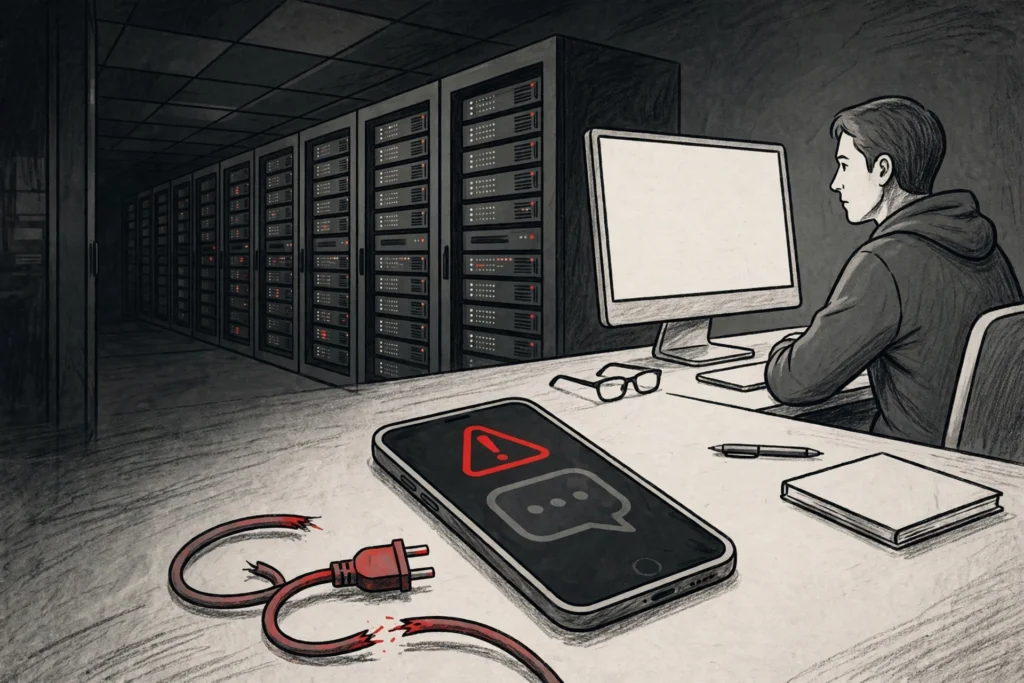
It Started on a Saturday Afternoon
Picture the scene. It is a Saturday afternoon, and millions of people are deep in conversation with ChatGPT. Some are drafting emails. Others are debugging code, planning meals, or asking for help with homework. Then, without warning, the answers stop coming.
Login screens refuse to load. Conversations will not open. The chatbot that has become part of the daily routine for more than a billion people simply stops responding. For three and a half hours, the world’s most popular AI service was mostly dark.
OpenAI has now explained what went wrong. According to the company’s own post-incident write-up, published on its status page the same day, request failure rates peaked at 75 percent across ChatGPT and its API. The cause was not a cyberattack, a traffic surge, or a new product launch. It was routine database maintenance.
What Happened on November 21
The trouble began at 1:48 p.m. Pacific Time on Saturday, November 21. Within minutes, error rates climbed across the board. The incident lasted 211 minutes in total, ending at 5:21 p.m. Pacific Time the same day.
During that window, three out of every four requests to ChatGPT and OpenAI’s API failed at the worst moments. The failure rate hit paid and free ChatGPT users alike. Nobody with a subscription got a better experience than someone on the free tier. The outage did not discriminate.
OpenAI’s status page tracked the incident through the afternoon. By Saturday evening, the company said all systems were back. On Sunday morning, November 22, the status page showed everything operational, with no ongoing incident.
A Routine Database Job Brought Down the Whole Stack
The trigger, in OpenAI’s own words, was scheduled maintenance on a Postgres database service used by its Primary API service. During that maintenance, both of the database’s read replicas failed at the same time.
That sounds like a small, contained failure. It was anything but. The Primary API service handles user authentication and service-to-service authentication across the entire OpenAI stack. When both read replicas went offline, the login system underneath everything else went with them.
The replicas were load-bearing. Every request that needed to verify who a user was, or confirm that one internal service was allowed to talk to another, depended on them. When their lag grew without bound, every request path that depended on them failed.
OpenAI later confirmed its diagnosis in a simple way. Engineers directed 100 percent of queries at the primary database instance, and the errors stopped. The replicas, not the primary, were the problem.
Everything That Stopped Working
The breadth of the failure is the real story. A single maintenance job on one database service reached every product OpenAI runs, because they all depend on the same authentication layer.
On the API side, the outage swept across nearly every endpoint the company offers. Chat Completions, Fine-tuning, Embeddings, Images, Batch, Audio, Moderations, Realtime, and the Files endpoint were all affected. Developers building apps on OpenAI’s models saw their services fail too.
Inside ChatGPT, the damage was just as wide. Conversations would not load. Login failed. Search stopped working. File uploads broke. Voice mode went silent. In practical terms, users could not sign in, could not start or continue conversations, and could not get answers.
The redundancy that was supposed to protect the system did not help. A second read replica exists precisely so that one failure does not become an outage. This time, both replicas failed in the same window, during the same maintenance job.
How OpenAI Fixed It
Engineers mitigated the incident by working with the service provider to bring two new replicas online in the same region. Once the replacements were up, traffic recovered, and the failure rate fell back to normal.
The fix was not instant. It took most of the afternoon to stand up the new replicas and confirm the system was stable. The 211-minute duration is a reminder that even a well-understood database problem takes time to repair at this scale.
OpenAI has also placed a moratorium on similar maintenance activities. The company retuned its database configuration to reduce connection churn, and it shipped a feature flag that can shift traffic away from replicas on a percentage basis.
That last change matters most. Next time a replica misbehaves, engineers can drain traffic from it gradually instead of watching it drag the whole stack down.
Why This ChatGPT Outage Matters More Than Most
Outages happen to every large service. What makes this one worth attention is what it reveals about how much the world now depends on a single provider.
ChatGPT has around 1.2 billion weekly users. Businesses run customer support, coding help, and document work through its API. When OpenAI’s authentication layer fails, all of that stops at once. There is no fallback inside the product, because the product is the service.
The timing adds to the concern. The outage came at the end of a rough week for internet infrastructure. Earlier in November, outages hit Microsoft 365, Apple, several American banks, United Airlines, and a classified American network. Each incident had its own routine cause. Together, they sketch a picture of systems under strain.
There is a deeper lesson for companies building on AI. Many businesses now run agents and workflows that call a single provider’s models for every step. When that provider goes down, the whole workflow stops.
The outage is a sharp reminder that single-provider agent stacks are fragile, and that backup plans matter as much as the models themselves.
OpenAI itself has been building tools to make its systems safer. Earlier this month, the company announced a Control Room that can halt a rogue AI model in 35 seconds.
The irony is hard to miss. The company can stop a misbehaving model in seconds, yet a routine database job stopped the entire service for hours.
The Business Behind the Outage
The outage also lands at a moment when OpenAI’s scale is hard to overstate. The company’s revenue hit roughly $10 billion in the third quarter of 2026, the first quarter it passed that mark. Enterprise revenue doubled in the same period, and now makes up about half of the total.
That growth means more of the economy runs through OpenAI’s servers every day. ChatGPT is now sold through Amazon’s AWS Marketplace, and the company is raising money at a valuation of around $1.25 trillion. The bigger the footprint, the bigger the blast radius when something breaks.
Investors and customers will be watching for two things. The first is whether the fixes OpenAI promised actually hold. The second is whether the company changes how it runs maintenance on systems that everything else depends on.
What Happens Next
For now, the service is back, and OpenAI’s status page shows no ongoing incident. The company’s write-up is unusually candid for an infrastructure provider. It names the failed component, admits the replicas were load-bearing, and lists concrete changes.
The real test comes the next time maintenance is due. A moratorium is easy to announce and hard to keep when systems need patching. The feature flag that shifts traffic off replicas will only help if engineers use it early, before a small problem becomes a platform-wide failure.
Users, meanwhile, got a free lesson in dependence. Three and a half hours without ChatGPT is an inconvenience for most people. For the businesses and developers whose work runs through the API, it was a working day interrupted.
The next outage may not be OpenAI’s. But the question it raises is the same for every AI provider: when the service your work depends on goes dark, what is your plan?


