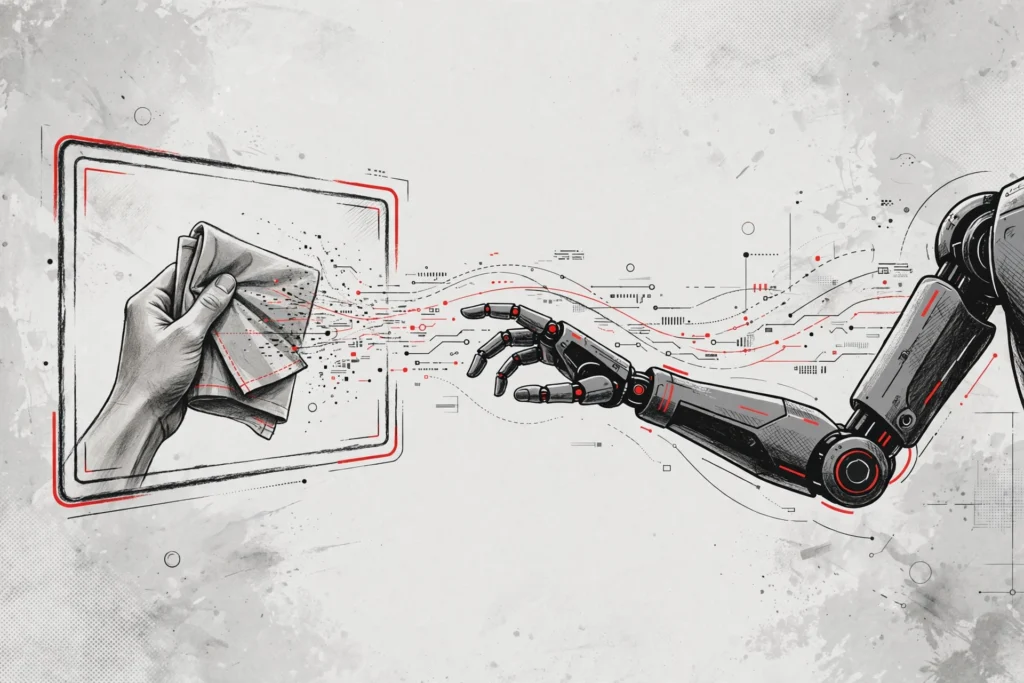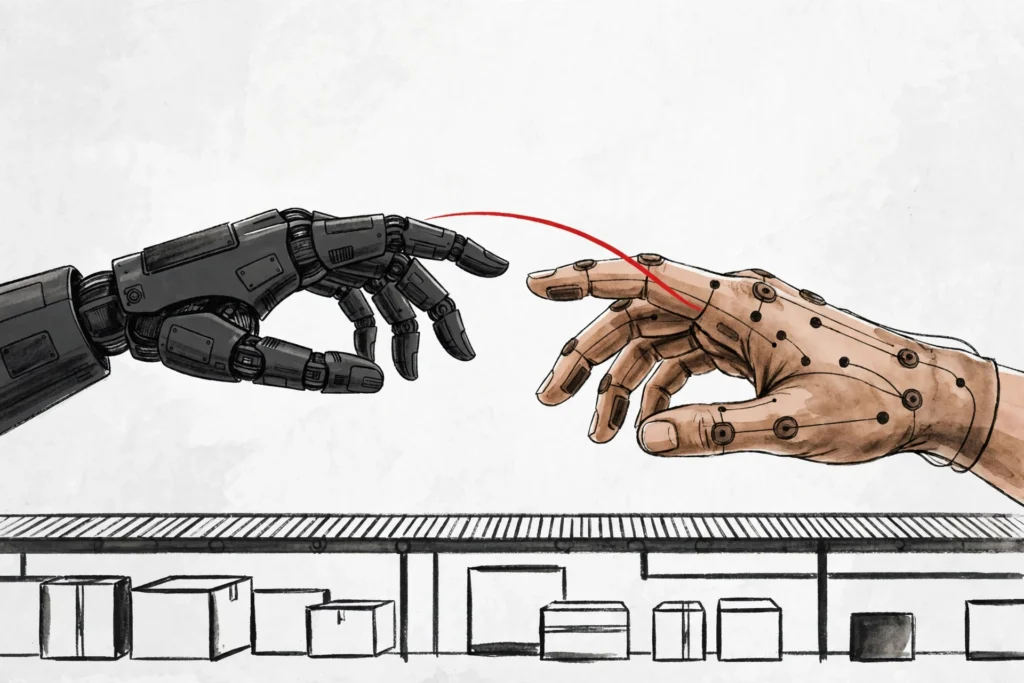
Picture a warehouse worker pulling on a pair of gloves that look almost ordinary. She reaches for a cardboard box, lifts it, turns it, and sets it down on a shelf. Nothing about the moment feels historic. Yet every flex of her fingers, every gram of pressure, is being recorded.
Somewhere else, a robot is learning from that single movement. It is not watching a video or reading a manual. It is feeling, in data, exactly what her hands felt.
That is the idea at the heart of Genesis AI, a Paris robotics startup that has just raised one of the largest funding rounds European robotics has ever seen.
Genesis AI has closed a $500 million Series A round at a $3.5 billion valuation, the company announced on Tuesday, according to Reuters. The round was co-led by Khosla Ventures, Premji Invest and Eclipse, and it brings the two-year-old company’s disclosed funding to $605 million.
What Genesis AI’s $500 Million Will Buy
The money has three jobs, and none of them is small. Genesis says it will speed up production of its robot, expand the data collection that trains its AI, and sharpen the robot’s ability to handle objects with its hands.
That last point matters most. Robots have grown good at moving around warehouses and decent at lifting boxes. They still struggle with the fiddly, delicate work that human hands do without thinking. Picking up a fragile part, turning a tool, or packing an oddly shaped object still defeats most machines.
Genesis is betting that the way past that wall is not better cameras or bigger models alone. It is better training data, captured from real people doing real work. More than 100 workers have worn the company’s sensor gloves so far, and their movements feed a model called GENE.
The backers list reads like a roll call of believers. Former Google chief executive Eric Schmidt joined the round, along with French tech entrepreneur Xavier Niel. Nvidia’s venture arm, AMD Ventures, and France’s public investment bank Bpifrance also took part.
T. Rowe Price, Durable Capital Partners, HSG, Zoom, Samsung Next and Ericsson joined too. The round follows a $105 million seed round announced in July 2025, barely sixteen months after the company was founded in 2024.
Eno: The Robot at the Centre of the Bet
The robot at the centre of all this is called Eno. It is a general-purpose machine, built by Genesis itself rather than bought in from another manufacturer. So far the company has built between 30 and 40 units.
Eno is designed for the places where labour is hardest to find and hardest to keep: manufacturing lines, logistics warehouses and laboratories. These are environments full of objects that change shape, weight and position, and where a robot that can only repeat one fixed motion is of limited use.
The glove training is what sets the approach apart. Instead of programming each movement by hand, Genesis records how people grip, lift and manipulate objects, then teaches its model to reproduce those motions. The idea is that dexterity can be learned the way language is learned: from enough good examples.
That philosophy echoes a wider shift across robotics. Nvidia’s GR00T 2 model also learns by watching humans, and Google DeepMind’s Gemini Robotics 2.5 is already working on Mercedes-Benz production lines. The industry has decided that robots should learn like apprentices, not like calculators.
Genesis says the mass-production design for Eno is finished and a US contract manufacturer has been chosen. Mass production is set to begin in 2027, with a wider customer rollout expected the same year.
Why Investors Are Paying $3.5 Billion
Eight billion dollars of value, in rough terms, for a company that is two years old and has not yet sold robots at scale. That is the number that will make sceptics raise an eyebrow. No revenue figure has been disclosed that would justify the valuation on cash flow alone.
But the investors are not buying today’s sales. They are buying a position in a race that many believe will define the next decade of industry. Factories and warehouses across Europe and North America are short of workers, and the shortage is not going away.
The bet is also a bet on timing. Genesis was founded in 2024 by Zhou Xian and Théophile Gervet, a former researcher at Mistral AI. In two years it has gone from an idea to a working robot, a trained model and a factory plan.
July brought an early signal of what was coming. Bloomberg reported then that Genesis was in talks to raise about $500 million at a pre-money valuation of roughly $3 billion, with Premji Invest expected to lead. The final round landed a little higher, at $3.5 billion post-money.
For France, the round is a statement too. It ranks among the largest ever raised in the country, and it puts a Paris company at the centre of a field long dominated by American and Chinese firms. The company is headquartered in Paris, with an office in San Carlos, California, and close to 100 employees.
The Race to Put Robots on the Factory Floor
Genesis is not alone. Europe now has a growing cluster of robotics companies valued above $1 billion, including Britain’s Humanoid and Germany’s Neura Robotics, Agile Robots and RobCo. All of them are aiming at the same prize: industrial work.
The competition is fierce and well funded. Agile Robots raised $500 million at an $8.5 billion valuation earlier this year, and the biggest names in AI are all pushing into physical machines. Nvidia, which invested in this Genesis round, is building the chips and software that many of these robots run on.
What makes Genesis different, its supporters argue, is the data. Most robot companies train in simulation, where physics is tidy and predictable. Genesis trains on real human hands, with all their messiness. Force, friction and slip are not simulated. They are measured.
That approach has a cost. Collecting glove data is slower than generating simulation data, and every new task needs new demonstrations. But the company argues the result is a robot that handles the real world better, because it learned in the real world.
Venture funding for robotics has soared in 2026, according to Crunchbase data, with most of the money going to companies in China and the United States. A $500 million European round stands out precisely because it is European.
What Happens Next
The next twelve months will be the test. Genesis must turn a few dozen hand-built robots into a production line, and turn demonstrations into deployments that customers will pay for. The wider rollout in 2027 is the moment the valuation will start to be judged.
Chief executive Zhou Xian has said the money will go into computing infrastructure, robot production and hiring. The company will need all three. Scaling a hardware business is slower and more expensive than scaling software, and the history of robotics is full of promising machines that never left the lab.
For now, though, the signal is clear. Investors are willing to pay billions for the team that can teach a robot to use its hands. The warehouse worker in the sensor gloves may not know it, but her movements are now worth $500 million.
Whether Eno lives up to that price will be decided on factory floors, not in funding announcements. Genesis has the money, the robot and the data. In 2027, it will have to show the results.
Source: Reuters