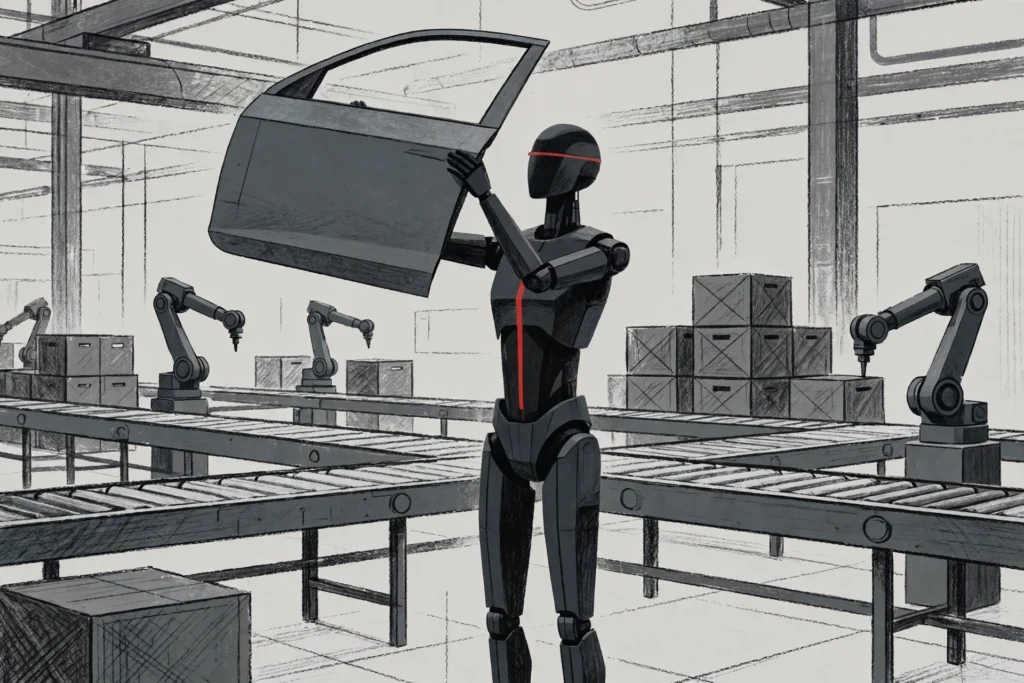
Picture a factory floor just before dawn. The lights come on in rows, a conveyor hums, and a humanoid robot steps up to a workstation. It lifts a car door panel with both hands and slots it into place — no joystick, no operator, no script.
It learned the movement the way a person would: by watching, practising, and getting it wrong until it got it right. That scene is the promise behind the Agile Robots Series F, the $500 million funding round the Munich robotics company has just closed at an $8.5 billion valuation.
Agile Robots Series F: What the $500 Million Round Means
Agile Robots announced the round on Thursday, November 12, 2026, according to PR Newswire. SoftBank Group led the investment, with Nvidia, Hitachi Group — including its venture arm, Hitachi Ventures — and T.Capital joining in. The deal takes the company’s total funding since its founding in 2018 to about $2 billion.
The headline number is striking on its own, but the valuation is the real story. The last time Agile Robots raised a major round, a $220 million Series C in September 2021, it was valued at roughly $1 billion. This round prices the company about eight and a half times higher.
That jump also comes with a caveat. Bloomberg reported in June that SoftBank was weighing a round of around $800 million. The round that actually closed was $500 million — about a third smaller than the figure that had been circulating. The valuation held up; the cheque did not grow as large as expected.
SoftBank and Nvidia Lead the Bet on Physical AI
SoftBank is no stranger to Agile Robots. Its Vision Fund 2 led the 2021 Series C, and the group has now led again. Dennis Chang, managing partner at SoftBank Investment Advisers, said physical AI will transform industries and that Agile Robots pairs deep robotics expertise with the ability to execute at industrial scale.
Nvidia’s participation matters in a different way. The chipmaker is both an investor and a technology partner. Agile Robots trains its humanoid models in the Industrial AI Cloud that Deutsche Telekom and Nvidia run in Munich, and its compact research humanoid ships preconfigured with Nvidia’s Jetson Thor computer and Isaac GR00T robot models.
Hitachi’s involvement runs deeper than money too. In September, Hitachi agreed to co-develop physical AI systems with Agile Robots and offer them through its HMAX Industry portfolio. The Series F turns a commercial partnership into a shared financial stake.
Inside Agile ONE: The Humanoid at the Centre of the Plan
At the centre of the plan sits Agile ONE, the company’s full-size industrial humanoid, unveiled in November 2025. It stands 174 centimetres tall, weighs 69 kilograms, and can carry up to 20 kilograms.
Its five-fingered hands have 21 joints each — a direct descendant of founder Zhaopeng Chen’s doctoral research on robotic hands at the German Aerospace Center.
The robot walks at up to two metres per second and has 40 degrees of freedom. Alongside it, Agile Robots sells a compact research model, Agile ONE S, and in October it teamed up with Nvidia on Agile ONE SN, a research humanoid built around Jetson Thor.
The company plans to build between 1,000 and 2,000 of the SN units next year.
That hardware sits on top of a much older business. Agile Robots began in 2018 as a spin-off from the German Aerospace Center.
It has since deployed more than 20,000 industrial robotic solutions for customers in automotive, consumer electronics, logistics and healthcare. The humanoid is the newest layer on an automation group, not a startup built around a single demo.
A Factory Built for 10,000 Humanoids a Year
Early in 2026, Agile Robots opened a new production site at Fürstenfeldbruck, near Munich, with the capacity to build up to 10,000 legged and wheeled humanoids a year. It is the kind of number that makes headlines — and the kind that invites a closer look.
Capacity is not output. Reports suggest the company expects to make about 2,000 humanoid units in 2026, with output possibly doubling or tripling in 2027. The humanoids shipping so far have reportedly been wheeled models rather than the legged version shown on stage. The factory can build the machines; the orders still have to arrive.
Rival systems are already at work on real production lines. Google DeepMind’s Gemini Robotics 2.5 is running humanoid robots on Mercedes-Benz production lines, and the race to prove that humanoids can earn their keep has already begun.
The Series F money is earmarked to close that gap. Agile Robots says it will strengthen its presence in the United States, add production capacity in Germany, and push into new markets. Chen has also floated the idea of a stock market listing at a later date, though no listing has been announced.
The Valuation Question: $8.5 Billion on What Revenue?
Every humanoid valuation invites the same question, and Agile Robots is no exception. The company said in mid-2025 that revenue had most recently reached about €200 million. Research firm Sacra estimates 2025 revenue at $339 million, up 51 percent, with guidance of $690 million for 2026.
By that arithmetic, $8.5 billion is roughly 25 times last year’s estimated revenue, or about 12 times the 2026 guidance. Those are estimates, not audited results, and the company has not disclosed humanoid shipments or orders. As Tech Times notes, the share of the valuation resting on humanoids cannot be read from public numbers.
The comparison with rivals is instructive. Fellow German firm Neura Robotics was valued at roughly $7 billion in June after a record $1.4 billion Series C. Figure AI was valued at $39 billion after its September 2025 round.
And Agility Robotics, which debuted on Nasdaq on November 5, reported just $1.8 million in sales alongside a $138 million net loss.
Agile Robots looks different from most of that field in one respect: it already sells robots at scale. J.P. Morgan has forecast that US humanoid output could reach 300,000 to 400,000 units a year by 2030.
If that demand materialises, the companies with factories, customers and service networks will have the advantage — and that is the bet SoftBank and Nvidia have just placed.
What Happens Next for Agile Robots
The immediate test is delivery. The Fürstenfeldbruck plant gives the company room to scale; the Series F gives it the cash to hire engineers, speed up robot applications and expand in the United States. The harder test is turning factory capacity into shipped machines working on real production lines.
Open models are spreading too. Runway’s Praxis-1 is an open-weight robot foundation model anyone can download, which means Agile Robots will not be competing only with other hardware makers — it will be competing with an open ecosystem as well.
Watch for three things. First, whether Agile Robots publishes humanoid shipment numbers — the figure it has so far kept private. Second, whether the Hitachi partnership turns into named industrial customers. And third, whether the wheeled models now shipping give way to the legged Agile ONE walking factory floors on its own.
For now, the funding round settles one question and leaves another open. The money says the world’s biggest technology investors believe physical AI is leaving the lab.
The $8.5 billion valuation says they believe Agile Robots will be one of the companies that takes it into the factory. The next two years will show whether the robots agree.