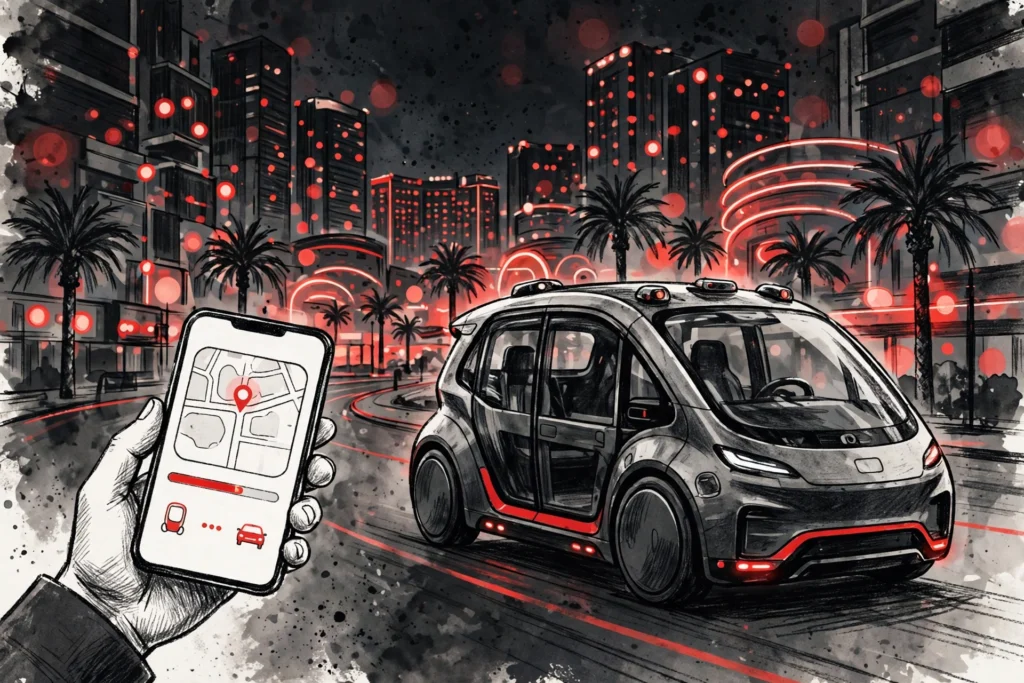
It is just after midnight on the Las Vegas Strip. The neon is still buzzing, the crowds are spilling out of the casinos, and a car glides up to the kerb. There is no driver inside.
No steering wheel. No pedals. No one to nod at as you climb in. The doors slide open on both sides, and the only question left is whether you trust a machine to take you home.
From Monday, that question is no longer hypothetical for Uber riders in Las Vegas. Amazon’s Zoox robotaxis are now live on the Uber app, according to TechCrunch, and the driverless pods are carrying real passengers at standard Uber fares.
Zoox Robotaxis on Uber: What Just Launched in Las Vegas
Zoox robotaxis on Uber went live on Monday, November 16, 2026. It is the first time the Amazon-owned autonomous vehicle company has put its vehicles on a ride-hailing app it does not own.
Until now, the only way to ride in a Zoox was through the company’s own app. Zoox launched that service in Las Vegas on September 10, 2025, and it has been running there ever since, most recently extending its hours to 6:00 a.m. to 3:00 a.m., seven days a week.
The Uber deal changes the audience completely. Instead of downloading yet another app, millions of people who already have Uber on their phones can now be matched with a driverless Zoox simply by requesting a ride.
For Uber, it is another step in a much bigger plan. The company wants to become the main place where people find autonomous vehicles, and it has now signed partnerships with more than 30 companies working on self-driving cars, delivery robots and drones.
For Zoox, the deal is about catching up. Waymo and Tesla dominate the conversation around driverless cars, and Zoox needs passengers who would never think to seek it out on its own.
No Steering Wheel, No Driver, No Extra Fare
A Zoox robotaxi does not look like a normal car with a driver removed. It was designed from scratch as a robotaxi, with no steering wheel, no pedals and no front or back in the usual sense.
The boxy pod carries passengers facing each other, and its doors slide open on both sides. It drives in either direction, which is why the company calls it bidirectional. There is simply no driver’s seat to take over from.
That matters because the ride costs the same as a normal Uber. Riders pay standard fares, with no premium for the novelty of a driverless trip. The companies confirmed there is no extra charge for being matched with a Zoox.
There is one catch for now. Passengers cannot choose a Zoox the way they choose UberX or Uber Comfort. When someone requests an UberX, Uber Comfort, Uber Electric, Uber Comfort Electric or Wait & Save ride, the system may match them with a Zoox — or it may not.
Riders who want better odds can turn on autonomous rides in the “ride preferences” section of the Uber app’s settings. Uber says it plans to add a dedicated autonomous option once availability and reliability improve.
Where the Robotaxis Run — and Where They Don’t
The service covers the places visitors actually go: the Las Vegas Strip, downtown Las Vegas and the Arts District. That is the whole map for now, and the fleet starting out is small — reportedly around 62 vehicles.
That is a deliberate choice. Dense tourist corridors give Zoox plenty of short, predictable trips, and they put the pods in front of exactly the kind of curious riders most likely to try one.
The ceiling is much higher. Earlier this year, the Nevada Transportation Authority unanimously approved a permit allowing Uber to deploy up to 1,000 robotaxis in Clark County, the county that contains Las Vegas, through its partnerships with Zoox and Hyundai subsidiary Motional.
Uber chief executive Dara Khosrowshahi has said Las Vegas will become the first American city where riders can reach two fully driverless partners through the Uber app. The company plans to start with limited fleets and expand supply over the coming months.
One detail stands out in the arrangement. Unlike some of Uber’s other autonomous partnerships, Uber will not provide maintenance or other services for Zoox in Las Vegas. Zoox keeps full responsibility for its hardware and its software updates.
The MGM Resorts Deal: Robotaxis at the Casino Door
Uber and Zoox also announced a multi-year partnership with MGM Resorts International. The two companies are now the official rideshare and robotaxi partners for MGM’s Las Vegas properties.
That is a practical deal as much as a branding one. MGM’s resorts are sprawling complexes, and finding the right pickup spot can be half the journey. The companies say they will work with MGM to improve pickup and drop-off locations, along with signage to help riders find the robotaxis.
For MGM, driverless cars fit a city that never sleeps and a clientele that is always moving between shows, restaurants and casinos. For Zoox, the resorts are a steady stream of potential first-time riders.
The partnership itself was announced on March 11, 2026, with a target of a summer debut in Las Vegas. The actual launch came about five months later than planned, which is worth remembering the next time a robotaxi company promises a date.
Why Uber Wants Zoox — and Why Zoox Needs Uber
Uber’s strategy is to be the shop window for everyone else’s driverless cars. It already hosts Waymo robotaxis in Austin and Atlanta, and it has told investors it expects around 700 robotaxis on its platform by the end of 2026, rising to more than 2,000 in 2027.
The Waymo arrangement shows how fast this market moves. That exclusive partnership, which matches Waymo cars with Uber riders in Austin and Atlanta, will end in January 2028. Waymo plans to offer rides directly through its own app, as it already does in other cities.
Not every company is rushing to hand control to AI. United Airlines banned AI agents from booking flights this month, drawing the opposite line. Uber has chosen the other side of that bet, and Las Vegas is where it is placing it.
Zoox gives Uber a second fully driverless partner in Las Vegas, and a purpose-built vehicle that looks nothing like a converted passenger car. That variety matters when Uber is trying to convince riders that driverless is normal, not experimental.
Zoox, meanwhile, gets distribution it could never build alone. Every Uber rider in Las Vegas is now a potential Zoox passenger, even if they have never heard of the company. That is the kind of exposure a small fleet in one city cannot buy.
Los Angeles Is Next
The partnership is expected to extend beyond Las Vegas. Zoox will begin initial robotaxi operations in Los Angeles before the end of this year, starting with rides for its own employees, their families and friends.
Commercial service in Los Angeles will not begin until 2027, and rides there will be available through the Uber app next year as well. Los Angeles becomes the second city in the Zoox–Uber rollout, and the test of whether the Las Vegas model travels.
That matters because the robotaxi race is now a city-by-city contest. Waymo is expanding steadily, Tesla has opened orders for its Cybercab, and Google’s Gemini is already riding shotgun in ordinary cars through Apple CarPlay. Every new city is a chance to prove the technology works at scale.
Zoox’s challenge is that it is still small. A fleet of around 62 vehicles in one city is a demonstration, not a network. The question is how quickly it can grow from here.
What Happens Next
The next milestone to watch is the dedicated autonomous option in the Uber app. Once riders can choose a driverless car directly, Uber will learn how many people actually prefer one — and how many just accept whatever car turns up.
The second is Los Angeles. If Zoox can repeat the Las Vegas launch there in 2027, the partnership starts to look like a national rollout rather than a single-city experiment.
And the third is the fleet itself. The Nevada permit allows up to 1,000 robotaxis in Clark County, and the gap between 62 vehicles and 1,000 is the difference between a novelty and a transport system.
For now, though, the story is simpler. A car with no driver is picking up passengers on the Strip, through the app most of them already have, at the same price as a human-driven ride. The future of the taxi just got a little closer — and a little harder to ignore. TechCrunch first reported the launch.