The call to prayer had barely faded over Brickfields on Friday afternoon when Malaysia’s prime minister stepped out to face the cameras. The question waiting for him was not about domestic politics. It was about Nvidia chips, a suspected spy, and $4.8 billion worth of hardware that may — or may not — have passed through his country on its way to China.
Anwar Ibrahim’s answer was short. There was, he said, no indication that artificial intelligence chips linked to the Megaspeed affair had been exported from Malaysia. But behind that calm denial, his government was already moving. Hours earlier, the trade ministry had announced it was working with customs officers to find out exactly where those chips went.
The Megaspeed Nvidia chips probe is now the newest front in a scandal that has already cost Nvidia its chief executive, wiped hundreds of billions of dollars from its market value, and pulled in investigators in at least three countries. Malaysia, it turns out, may hold some of the most important answers.
Malaysia opens its Megaspeed Nvidia chips probe
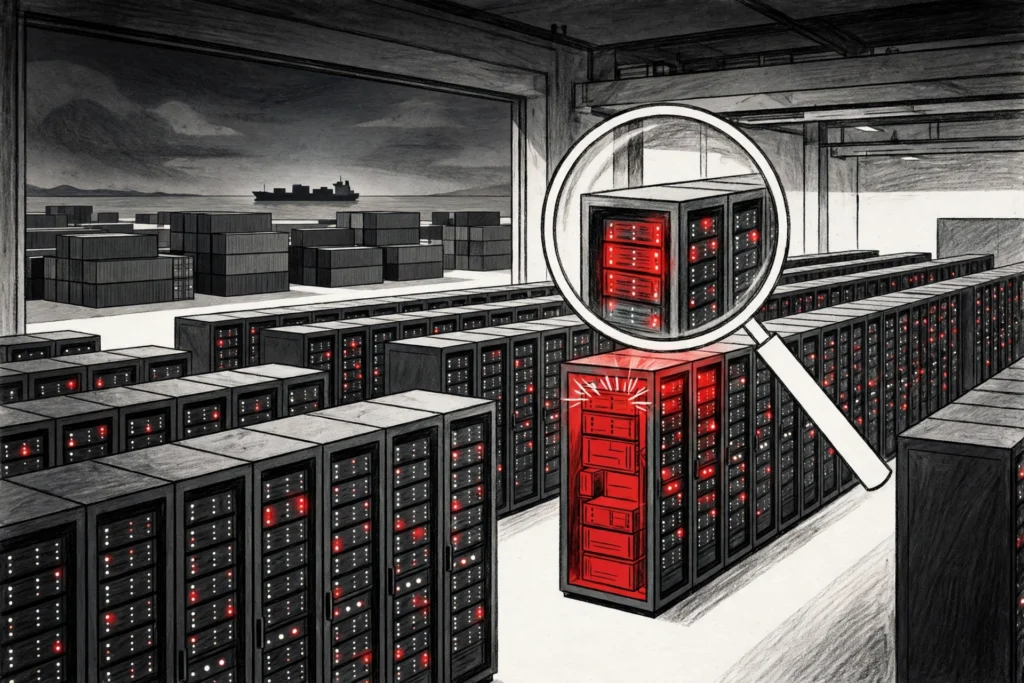
Malaysia’s Ministry of Investment, Trade and Industry, known as MITI, said on Friday that it was working with the Royal Malaysian Customs Department to determine whether any AI chips brought into the country by Speedmatrix had since been re-exported to other countries.
Speedmatrix is the Malaysian subsidiary of Megaspeed International, the Singapore-based cloud computing firm at the centre of the affair. The ministry said the company operates as a tenant inside Malaysian data centres, bringing in its own servers and AI chips to run them.
The statement carried a warning. MITI said it had “never cleared” Megaspeed or Speedmatrix, and that routine verification visits to data centre facilities should not be taken to mean a company had been approved. Giving false information to customs about such items, it added, is a “serious offence.”
The rules are clear on paper. Bringing AI chips into Malaysia currently needs no permit or licence. But since July 2025, anyone seeking to export, re-export, transship or transit high-performance US-origin AI chips from or through Malaysia must first obtain a permit under the Strategic Trade Act 2010.
“No indication” — the prime minister’s answer
Anwar spoke to reporters after Friday prayers in Kuala Lumpur, hours after the ministry’s statement landed. “There has not been any indication of that,” he said when asked whether there was evidence the chips had been exported from the country.
The prime minister added that the trade minister had delivered a report on the matter that morning, and that Malaysia would cooperate with any investigation. But he was equally clear on one point: neither Singapore nor the United States had made a formal request for assistance so far.
“Right now, we have not received any such request,” Anwar said, according to the state news agency Bernama, “but we will, of course, collaborate.”
The ministry struck a similar balance in its own statement. “While Malaysia does not enforce unilateral export controls imposed by other countries,” it said, “all companies operating in Malaysia are expected to take such controls into account in their international business.” Then came the line that will be quoted for days: “Malaysia welcomes investment in data centres and technology, but will not allow itself to be used to get around export controls.”
The $4.8 billion question
At the heart of the affair is a staggering figure. Megaspeed and Speedmatrix bought at least $4.8 billion worth of Nvidia equipment between June 2024 and February 2026, according to an investigation published by Le Monde on Friday.
The equipment was installed in data centres in Malaysia and Singapore. And according to Le Monde, the computing power was rented by Chinese technology group Alibaba to train AI models — the very outcome US export rules were designed to prevent.
It is important to be precise about what has been proven and what has not. No authority has yet found that any specific chip was illegally diverted. Megaspeed has said on its website that it takes its US compliance obligations “extremely seriously.”
But the pattern is what has investigators’ attention. A US senator has alleged the firm may have been used to circumvent American controls on advanced semiconductors. The question Malaysia is now asking — did chips that entered the country leave it again, and to whom — is the one that could turn suspicion into a case.
Singapore’s parallel investigation
Malaysia is not acting alone. Singapore, where Megaspeed is based, opened its own criminal probe into the affair, and on Thursday its home affairs ministry added a new detail.
Physical servers bought by companies under investigation had been exported through Singapore to Malaysia without entering the Singapore market, the ministry said. Police are now investigating whether those servers were subsequently routed from Malaysia to another destination, contrary to the declarations the companies made in Singapore.
Singapore also revealed on Thursday that it had barred Alice Huang from re-entering the country in February, after she gave investigators inaccurate information about her role at Megaspeed. She was not investigated for espionage, the ministry said.
Alice Huang is the former Megaspeed executive at the centre of the scandal. US authorities have alleged she spied for China — a claim Beijing denies — and her reported affair with Jensen Huang, Nvidia’s then chief executive, is what brought the whole affair into the open.
How the scandal reached this point
The affair has moved with extraordinary speed. On November 8, Jensen Huang admitted infidelity in a staff memo, and Nvidia’s board opened an investigation and hired the law firm Wachtell Lipton.
Three days later, after reports of a second affair with a Nvidia vice-president, the board was preparing to oust him. On November 12, Huang resigned as chief executive after 33 years, and Colette Kress, the chief financial officer, took over on an interim basis.
It is not the first time Nvidia hardware has surfaced where Washington did not intend it — a blacklisted Chinese university bought H200 chips earlier this year, despite export controls.
The fallout has spread far beyond the boardroom. The US Department of Justice has not reached a conclusion on whether Alice Huang is a spy, according to Attorney General Todd Blanche. House committees have demanded Huang appear for a closed-door interview on December 1, and Senate Banking Committee chair Tim Scott has asked him to testify on December 3.
Investors, meanwhile, have voted with their feet. Nvidia has lost more than $1 trillion in market value since November 3, and the scandal has wiped almost half a trillion dollars from the company’s value in a single week, according to Reuters. The company’s third-quarter results, due November 17, will be watched more closely than any in its history.
Why Malaysia matters to the chip war
The reason Malaysia finds itself in the middle of this story is geography — and timing. As the United States has tightened controls on advanced chips going to China, data centres in Southeast Asia have boomed, and with them the temptation to use third countries as a way around the rules.
Malaysia imposed its own controls in July 2025, requiring permits for the onward movement of high-performance American AI chips. The system was designed to stop exactly the kind of diversion now under suspicion. Whether it worked is now the question MITI and customs officers must answer.
The ministry said it is working closely with authorities in Singapore and the United States, and is considering further measures to strengthen its controls where necessary.
What happens next
For now, the investigation is a matter of paperwork and physical checks: customs records, shipping declarations, and the servers sitting in Malaysian data centres. MITI said it would carry out its own checks independently, “in accordance with Malaysian law and based on the evidence available.”
The timeline is crowded. Nvidia reports earnings on November 17. Jensen Huang is due before Congress on December 1. And somewhere in a Malaysian customs office, officials are tracing the path of chips worth billions — and deciding whether Malaysia was a destination, or a doorway.
The answer will matter far beyond Kuala Lumpur. If the chips stayed, Malaysia’s controls held. If they moved on, the world’s most valuable company and its most sensitive technology were routed through a loophole nobody closed in time.