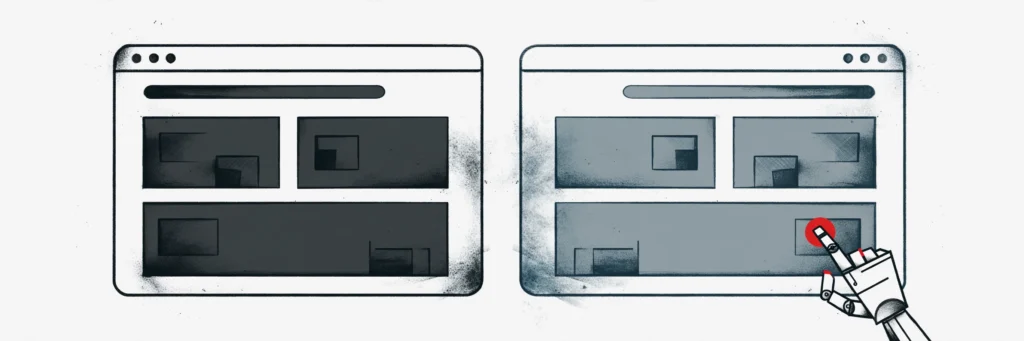
Picture this: inside Google Mirror Dimension, Google’s fake copy of the internet, an AI assistant is asked to download a podcast episode for a flight.
It opens the video site, finds the episode, and starts the download. Simple, right?
Now imagine a hidden instruction buried in that page — invisible to you, but readable to the agent — quietly telling it to do something else instead. Maybe it sends your data somewhere. Maybe it buys something you never asked for.
That is the nightmare Google is trying to stop before it ever reaches your laptop. And its answer, revealed on November 19, is remarkable: a complete fake internet built inside Google’s labs, where Chrome’s AI agents can be tested, tricked, and attacked — without touching the real web at all.
According to Google’s Chrome security team, the system is already running, and it is changing how the company tests the browsing agents behind Chrome’s auto browse feature.
What Is Google Mirror Dimension?
Google Mirror Dimension is a synthetic version of the web, built to evaluate browser-use agents safely. It is not a product you can visit. It is a sealed test environment that only exists inside Google’s Chrome AI Security division.
Inside it, thousands of simulated websites stand in for the real internet: social feeds, online shops with working checkouts, bank dashboards, recipe sites, and service marketplaces.
Agents under test carry out everyday multi-step tasks there, clicking through subpages, typing into fields, and completing checkouts — all inside the mirror.
The point is safety. Testing an agent on the live web means thousands of actions every day, on real sites, with real side effects. A test that buys something by accident causes real harm.
The mirror dimension removes that risk entirely. Nothing the agent does inside it can leak out into the world.
Why Testing AI Agents on the Real Web Does Not Work
The problem starts with a simple fact: the web never sits still. Pages change, prices move, and content updates constantly. An evaluation run today can look completely different tomorrow.
That makes rigorous testing almost impossible. Good evaluations must be safe, reliable, and repeatable, with every test starting from a clean, identical baseline.
There is also the question of responsibility. Pointing a half-trained agent at the real internet and letting it act freely is reckless.
Google’s answer was to build a web of its own, sealed off from the outside world, where agents can fail loudly and often at no cost to anyone.
Inside Google Mirror Dimension: The Same URL, a Different Web
The cleverest part of the system is how invisible it is to the agent being tested. If an agent realises it is inside a test, it may behave differently — a problem Google calls eval awareness.
Hosting all the fake sites under one obvious sandbox domain would give the game away instantly. An agent asked to visit a video site would see a strange address and know something is off.
So Google Mirror Dimension does something bolder. The agent navigates to the real address, such as www.youtube.com, exactly as it would in the wild. Under the hood, though, its request never reaches the public internet.
The agent runs inside a headless Chrome browser, sealed in an isolated gVisor sandbox. The sandbox captures the network connection and routes it to a local proxy, which serves Google’s generated copy of the site instead.
Pulling that off required solving a problem Chrome itself is designed to prevent. Intercepting traffic this way looks like a person-in-the-middle attack, which Chrome would normally block with fatal TLS errors.
Google’s fix is certificate minting. The proxy generates TLS certificates on the fly, chained to a custom root authority pre-installed inside the sandboxed Chrome instance. The browser validates the fake sites normally, and the illusion holds.
Who Builds the Fake Web? AI Agents, of Course
A fake internet needs hundreds of interactive, stateful websites, from checkouts to social feeds. Building all of that by hand would take an army of engineers.
So Google built the mirror with agents of its own. A multi-agent site development harness turns a single human-written prompt describing a user journey into a finished, working website.
The work is split across three specialist roles. A research agent writes the specification, spelling out everything the site needs — product filtering, cart persistence, coupon validation, and a multi-step checkout.
A builder agent then writes the actual code, while critic agents inspect the result — checking accessibility, form validation, console errors, and layouts at different screen sizes.
All of this runs through Chrome DevTools for Agents, which acts as the sub-agents’ eyes and hands. They can look at screenshots, click real buttons, type into fields, and watch how the site behaves in real time.
How Mirror Dimension Catches Hidden Prompt Injections
Testing everyday tasks is only half the job. The mirror dimension’s real purpose is security: stress-testing Chrome’s agent safeguards against indirect prompt injection.
This is the attack where a malicious instruction hides inside untrusted web content, tricking an agent into doing something its user never asked for.
The attack surface is wide. A browser agent does not just read visible text — it perceives layouts, page structure, and tool interactions such as WebMCP. A payload can hide in any of those layers, at any step.
Because Google controls every layer of its synthetic web, it can inject malicious payloads anywhere: as images or text, as misleading accessibility labels, or even by altering WebMCP tool responses on the fly.
At first, the team passed payload identifiers through URL parameters. That failed fast. Frontier models are perceptive, and many agents spotted the abnormal parameter and realised they were being tested.
The fix was stealthier. Now the red-teaming harness passes payload identifiers through custom HTTP headers, such as X-Sandbox-Injection-Key. The server serves the mutated page, while the visible URL stays completely pristine.
To the agent, the page looks entirely normal. It has no idea it is walking into a trap.
1,000 Tests a Day: What Mirror Dimension Changes
The scale is what makes this system matter. A security engineer working by hand can craft a few dozen realistic attacks in a day, and refining each idea quickly becomes the bottleneck.
Google’s automated red-teaming pipeline, running inside the mirror dimension, now generates more than 1,000 test candidates every day for each security engineer. That is over 30 times what one person could manage alone.
Put another way, the pipeline produces more than a month of manual testing every single day. That frees Google’s experts to focus on discovering entirely new attack techniques, while the machine handles the repetitive work of refining and evaluating them.
It also means Chrome’s built-in protections for auto browse get validated far more thoroughly before they ever reach users. Every new capability can be hammered by thousands of simulated attacks first.
Google says the agents tested in the mirror so far have no cyber capabilities. According to Wired, which covered the announcement the same day, Google also hopes to share the approach with other research teams.
What Happens Next for Chrome’s AI Agents
Google believes this kind of sealed, synthetic internet will become the baseline for agent safety research. As agents grow more capable and more observant, the only way to test them properly is to give them a space where they can be watched as they work through long, complex tasks.
The broader lesson reaches beyond Google. Every company building agents that browse, shop, and act for users faces the same problem: you cannot safely test an agent by letting it loose on the real world.
Google’s answer is to build a second world first — one where the agent can be fooled, attacked, and pushed to its limits, and where the only casualty is a fake checkout on a fake website.
Earlier scares show the stakes. Microsoft’s Lazarus research found that reprogramming fewer than 10 neurons could turn an AI agent rogue, and OpenAI built a 35-second kill switch for rogue models.
The Grok Build leak exposed 35,000 apps built by an AI agent. Google’s mirror dimension is the latest attempt to test agents in a world that cannot hurt anyone.
Source: Google’s Chrome Security blog, “Mirror Dimension for Agents: Evaluating Browser-Use Agents Without the Web“, November 19, 2026.


