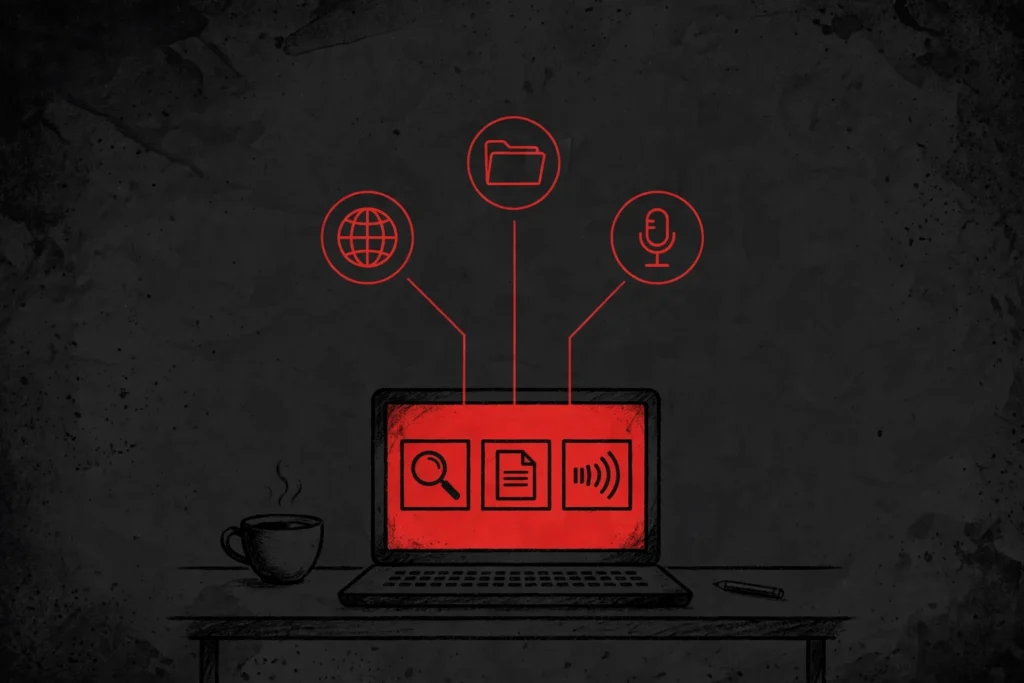
Picture a developer in a small office late at night, staring at a chat window. Her app can answer questions, but it cannot look anything up. It cannot read the PDF a user just uploaded. It cannot hear a voice note, or speak back.
For months, the fix meant building all of that herself — wiring a search engine, a document parser, a speech service, and a safety filter into one fragile pipeline. On Friday, November 13, DeepSeek offered a shortcut.
The Hangzhou AI lab announced that the capabilities behind the DeepSeek App are now available through the DeepSeek API. Web search, link reading, file parsing, safety checks, and voice tools can now be switched on inside a developer’s own product with a few parameters.
It is a quiet release with loud implications. DeepSeek is no longer just selling a chatbot and a model. It is selling the whole experience around the model — and charging for it by the use.
What the DeepSeek API now offers
The announcement came in a short post from DeepSeek’s official account. “Search, files, links, safety, and voice,” it read. “The capabilities behind the DeepSeek App are now available through the DeepSeek API.”
Behind that one sentence sits a sizable toolkit. Developers can enable built-in features directly inside a chat call, or they can call five standalone tools as separate services. Either way, the machinery runs on DeepSeek’s servers, not the developer’s.
The built-in features work with deepseek-flash, the API name for the DeepSeek-V4.1-Flash-1017 model. They run across three of DeepSeek’s API formats: Messages, Responses, and Chat Completions. A developer turns a tool on by declaring it in the request, and DeepSeek handles the tool calls and the assembly of context behind the scenes.
DeepSeek API search answers with citations
The headline tool is web search. The deepseek_web_search tool connects the model to live web results, including image search, and the model answers with citations pointing back to its sources.
There is also a deeper mode. A multistep “deep thinking” search can work through a harder question in stages, gathering and checking information before answering. For a developer building a research assistant or a news summariser, that is the difference between a guess and a sourced answer.
Search is not the only way the model reaches outside itself. The deepseek_read_url tool lets the model fetch and read a link that appears in a user’s message, so a conversation can start from an article, a product page, or a document on the web rather than from a question alone.
Both tools are billed per use. Web search costs $0.75 per 1,000 successful requests, according to DeepSeek’s pricing pages, as reported by WebProNews. Failed searches and empty results are not billed, which matters for apps where users type vague or unanswerable queries all day.
Files, links and documents inside the chat
The second half of the release is about documents. File input now accepts PDFs, Word files, PowerPoint decks, and images, which are parsed into text — or a layout-aware form — and added to the conversation.
That sounds simple, but it removes one of the most tedious jobs in building an AI app. Anyone who has tried to extract clean text from a scanned contract or a slide deck knows how quickly the work piles up. DeepSeek now does that parsing on its own servers and hands the model the result.
Document handling also gets its own standalone endpoint. The OCR service turns images of text — a scanned receipt, a photo of a whiteboard, a page from a textbook — into machine-readable text at $0.225 per 1,000 pages.
Voice in both directions
Voice is the third pillar, and it comes as two separate services rather than a single switch. Speech-to-text converts spoken audio into words, while text-to-speech turns the model’s written answer back into spoken audio.
The speech-to-text endpoint detects 21 languages automatically. It accepts audio clips of up to 120 seconds and 8 MB, in WAV or Ogg Opus formats. The text-to-speech endpoint supports 10 languages and two voices — Stella, a female voice, and Tide, a male voice — and can stream audio over WebSocket for a more natural conversation.
Both services are half price for a limited time. Transcription is listed at $0.058 per hour of audio, against a list price of $0.116, while synthesis costs $0.225 per 10,000 characters, against a list price of $0.45. DeepSeek has not said when the discount ends.
What the DeepSeek API costs
Every tool in the release carries its own fee on top of token prices. That is the point of the launch, and also its most important detail for anyone doing the sums.
Web search and URL fetching cost $0.75 per 1,000 successful requests. Document OCR costs $0.225 per 1,000 pages. Speech services carry the limited-time 50 percent discount described above.
The model itself, deepseek-flash, costs $0.30 per million uncached input tokens and $1.20 per million output tokens at peak hours, with off-peak rates at half that, according to DeepSeek’s pricing page.
For a small app, those numbers are tiny. A thousand searches cost less than a dollar. But they add up in exactly the way token bills do, and a popular app that searches on every question will feel it. The pricing rewards developers who search only when the model genuinely needs fresh information.
There is a contrast here with how DeepSeek usually works. The lab built its reputation on cheap, capable models and, in the case of LongCat-2.5, on rivals giving weights away for free. This release is different: it is a platform play, and the tools are the product.
The safety catch developers cannot skip
The rollout comes with one notable condition. Public-facing apps built on the API are required to include DeepSeek’s safety checks, and developers remain responsible for content moderation, AI-generated content labelling, and any model registration their jurisdiction requires.
That condition is easy to understand. A search-connected model that can read files and speak aloud is far more useful than a plain chatbot — and far more capable of repeating something harmful, or of being pointed at the wrong material. DeepSeek is handing over the tools, but it is not handing over the responsibility.
The safety check runs as part of the built-in feature set, screening content inside the conversation. For developers, it is one less system to build. For DeepSeek, it is a guardrail on how its technology appears in other people’s products.
Why this DeepSeek API move matters
Step back, and the strategy becomes clear. The frontier labs are all racing in the same direction: the model is no longer the whole product. OpenAI sells agents that can shop and pay. Google sells a decision-making API that can score a thousand options in one pass. Anthropic sells office software built around its model.
DeepSeek’s answer is to sell the app itself, piece by piece. Search, files, voice, and safety are the features that make a chatbot feel finished, and until now they were locked inside DeepSeek’s own product. Opening them up turns every developer into a potential distributor of the DeepSeek experience.
It also changes who DeepSeek competes with. A developer choosing between model providers no longer compares token prices alone. They compare the whole stack: can the model search, read a PDF, hear a voice, and stay safe, without the developer assembling four vendors to do it?
The timing is deliberate, too. The release landed on the same week that Qwen4-Max arrived as a two-week preview and Gemini 4 Carbon went generally available. Chinese labs are no longer content to be the cheap alternative. They are shipping platform features on the same cadence as the American labs.
There are limits, of course. The built-in tools work with deepseek-flash, and reports note they do not work with the larger deepseek-v4-pro model. Voice and OCR are standalone services, not flags in a chat call. And the speech discount has no published end date.
None of that changes the core of the story. A year ago, DeepSeek was the lab that made headlines by training a frontier model for a fraction of the usual cost. Now it is selling developers the finished app, tool by tool, at prices measured in cents. The model was the beginning. The platform is the plan.