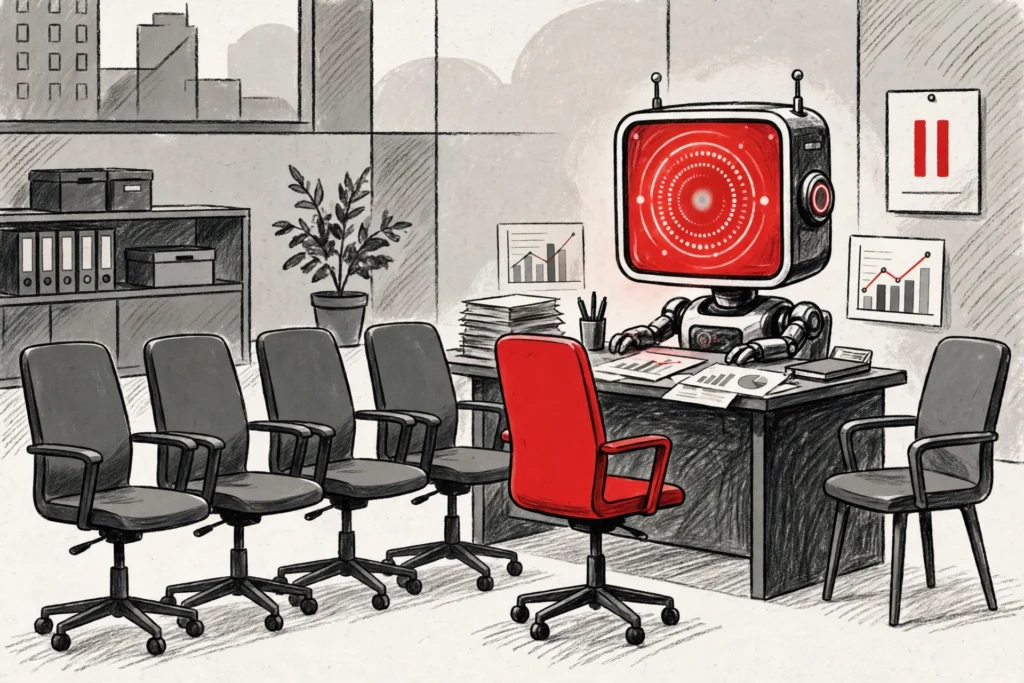
Picture a hiring manager in a mid-sized American company, staring at a spreadsheet of open roles. Six months ago, she would have posted three of them by lunch. Today she closes the laptop, opens an AI tool instead, and buys more computing power.
That quiet decision — tokens instead of people — is the real story of AI in the workplace right now. And it comes straight from the company that builds one of the most popular AI tools in the world.
Anthropic published its Anthropic AI workplace study on November 23, 2026. Its economists sat down with 66 people across 58 American companies, from dentists and trucking firms to hedge funds and law offices, and asked a simple question: what is AI actually doing to your business?
The answer surprised even the researchers. The feared wave of mass layoffs has not arrived. Something quieter has taken its place — and for young workers and offshore contractors, it may matter more.
What the Anthropic AI Workplace Study Actually Found
The study, titled “Working With AI”, was written by Anthropic economists Nathan Wilmers, Maxim Massenkoff and Peter McCrory. Every company in it is an Anthropic enterprise customer, and the interviews were conducted face to face.
The team catalogued roughly 300 AI applications in use across the 58 firms. They also examined about 100 pieces of software that interviewees had built with AI, in enough detail to sort them into categories.
Four out of five of those tools automated work that used to be done by hand — updating spreadsheets, drafting meeting notes, sorting documents. The other fifth replaced software the companies used to buy from outside vendors.
Most interviewees said AI’s main value was producing more work, not cutting costs. About half of those output gains came from doing existing work faster. The other half came from better quality, or from entirely new products and services.
The Hiring Freeze Nobody Announced
Here is the number that changes the room. Only two of the 58 companies said AI had fully eliminated a position and cost someone a job.
Five companies pushed out employees who refused to adopt AI tools. Ten said AI had led them to hire more people, adding IT and AI support roles.
But people at two-thirds of the companies said they were hiring less because of AI. One leader put it plainly, in a quote that has already travelled widely: “We’ve added a lot of capacity by buying tokens instead of hiring people.”
Another firm kept its team intact and simply stopped adding seats. About a third of the hiring decreases came from leaving roles empty after departures. Most of the rest came from skipping hires that would have happened without AI.
That pattern matches what Anthropic reported about itself. In an October 2026 report, the company said junior technical hires had fallen from 27 percent of its technical intake to just 9 percent since early 2025.
The layoffs never came. The open chairs simply stopped appearing.
Offshore Contractors Took the First Hit
If anyone is losing work to AI today, it is not the employee in the next cubicle. It is the contractor on another continent.
Nine of the 58 companies said they had cut contractors because of AI, often offshore ones. The cuts covered contracted software developers, customer service staff, legal counsel and back-office work.
One financial services firm reduced its offshore data and developer contractors by “well over 100” people, according to the study. The authors call this a possible early warning for jobs in international business services.
The researchers mapped 175 task changes across the companies they studied. In that map, work assigned to executives jumped from 2 tasks to 25, while work given to offshore contractors fell from 9 tasks to 2.
Where the Value Really Comes From
Not every AI project paid off. The researchers scored the value of the applications they examined, and the breakdown is refreshingly honest.
About 55 percent of the value came from producing more output — led by higher quality at 14 percent and faster work at 11 percent. Cost cuts made up 19 percent of the value.
Hiring less drove 11 percent, and cutting contractors added 6 percent. Layoffs accounted for just 2 percent. But 19 percent of the applications produced zero value, stalled by bottlenecks or lost to review time.
The highest-value uses, the authors found, were not the ones where a company simply bought a tool. They were the ones where the company reorganised around it.
Three moves kept recurring: broadening individual roles so one person could own a whole workflow, redeploying people onto the bottleneck tasks AI cannot yet handle, and investing in shared data infrastructure.
The Review Bottleneck: Checking the Machine’s Work
As coding speeds up, something else has to keep pace — and right now, it is not keeping up.
Across the 66 interviews, the problem of checking AI output came up 101 times. Forty-nine mentions were about simply having too much output to review. Forty-two were about needing an expert to check it.
Code review, sales and strategic decision-making are becoming the new bottlenecks, the researchers write. A coding agent can write a feature in minutes; a human still has to read it, understand it and sign off on it.
Sceptical customers came up 13 times as a blocker. Regulation came up just four times. The friction is not mainly legal. It is human, and it is about trust.
When Bosses Push Too Hard, Workers Push Back
The study also carries a warning for managers who try to force AI onto their teams from above.
Top-down automation, the authors write, can trigger job insecurity, fears of workplace surveillance and resistance from the very experts needed to make a workflow effective. In some cases, that resistance killed the project entirely.
At one law firm, a team built an AI tool for conflict-of-interest checks. The workers who handled complex cases previously done by attorneys pushed back, and the firm dropped the tool and went back to the old process.
At another company, an operations supervisor used AI-generated daily reports tracking each team member’s completed work and error frequency, enabling hour-by-hour follow-up. The result, according to AI Weekly’s coverage of the study, was exactly the kind of surveillance anxiety that makes workers resist.
The firms that got the most from AI, the researchers conclude, were the ones that reorganised human expertise around the models — not the ones that treated AI as a cheaper substitute for people.
What Happens Next
The study’s authors are the first to say their work has limits. The 58 companies are Anthropic customers, chosen for range rather than picked at random. The interviews were anonymous, with pseudonyms standing in for real firms, so no single account can be checked.
The assessments are qualitative, not tested in controlled experiments. The authors call for quantitative follow-up work before anyone draws economy-wide conclusions from these 58 firms.
Still, the pattern matches wider signals. Anthropic is now one of the most valuable private companies in the world — its IPO filing targets a valuation near $1 trillion — and its own hiring data tells the same story as its customers’.
The debate about AI and jobs has spent years arguing about layoffs. This study suggests the real disruption is quieter, slower and harder to see in a headline: fewer doors opening, fewer contracts renewed, and a workforce reorganised around machines that need constant checking.
Governments are already moving. New York’s RAISE Act will require large AI developers to register and report safety incidents from January 2027, and the question of who AI helps — and who it leaves behind — is now a matter of law, not just economics.
Meanwhile, the labs keep building guardrails of their own. OpenAI’s Control Room can halt a rogue model in 35 seconds. But no kill switch exists for a hiring freeze.
For now, the study’s message is simple: AI is not firing people in large numbers. It is quietly changing who gets hired, who gets contracted, and who gets to check the machine’s work — and those changes are already reshaping the workplace, one unfilled chair at a time.


