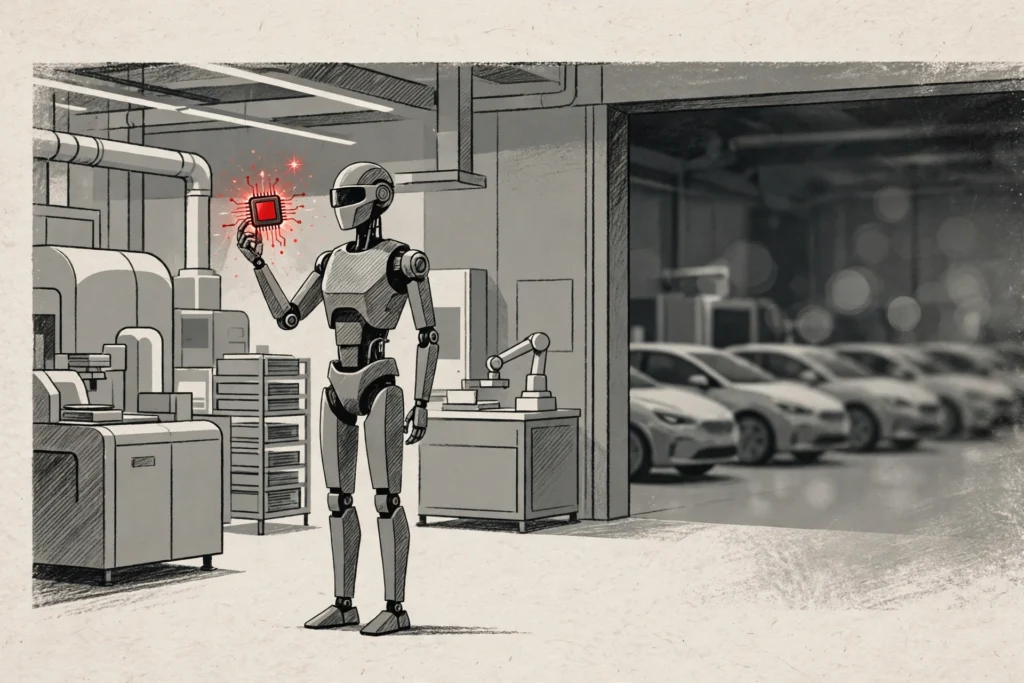
Picture the scene on a Tesla production line in late 2027. A brand-new computer brain, ten times more powerful than anything the company has shipped before, rolls off the line in a small, precious batch.
The engineers look at it, and then they look at the cars waiting for it. Then they walk past the cars entirely.
That chip is going into a robot instead.
According to a supply-chain report published on November 27, 2026, Tesla’s next-generation AI5 chip will not reach the company’s cars at scale until 2028. The problem is not the design. It is the factory floor, and a queue that Tesla is not at the front of.
The report, from Taiwan’s Commercial Times and covered in detail by TrendForce, says the scarce 3-nanometre chips will go first to Tesla’s Optimus humanoid robot. Cars, which need millions of chips a year, will have to wait for more manufacturing capacity to come online.
The Report: GUC Lands Tesla’s AI5 Chip
The story starts with a company most Tesla owners have never heard of. Global Unichip Corp, known as GUC, is a chip design house based in Taiwan and an affiliate of TSMC, the world’s largest contract chipmaker. TSMC is also GUC’s biggest shareholder.
According to Commercial Times, GUC has now secured the design work for Tesla’s AI5 project, alongside orders from Microsoft and Google. That puts GUC at the centre of one of the hottest markets in technology: custom AI silicon, the chips that big tech companies now design for themselves instead of buying off the shelf.
GUC does not make the chips itself. It designs them, and TSMC manufactures them on its advanced 3-nanometre production lines. And that is where the trouble begins, because those production lines are already booked solid.
Industry sources told the paper that GUC’s allocation of TSMC’s 3-nanometre capacity for 2027 is substantially larger than this year’s. Even so, it is not enough to cover everyone. The report says GUC will give priority to its biggest cloud customers first, and Tesla’s cars will have to wait their turn.
Why Tesla AI5 Cars Have to Wait Until 2028
The bottleneck is a single number: wafer capacity. A wafer is the silicon disc that chips are cut from, and TSMC’s 3-nanometre lines can only produce so many of them each month. Every major chip buyer in the world wants a slice.
GUC’s limited 2027 allocation is being steered toward North American cloud projects, according to the report. That includes Google’s Axion 2 and Axion 3 server processors and Microsoft’s in-house chips. Those are data-centre chips, built in relatively small numbers for enormous machines.
Tesla’s cars are the opposite problem. A single model line needs millions of chips a year, every year, at a price that works for a mass-market vehicle. The report’s conclusion is blunt: GUC’s initial 2027 wafer quota cannot support annual shipments for a fleet of millions of cars.
Supply-chain sources cited by Commercial Times say large-scale deployment of AI5 in Tesla’s electric vehicles may have to wait until 2028, when additional 3-nanometre capacity comes online and the squeeze eases.
TrendForce, reporting the same story, puts it the same way: TSMC’s 3-nanometre node already powers Google’s TPU v7 and v8, Microsoft’s Maia 200 and Amazon’s Trainium 3, so the whole industry is queuing for the same factories.
Optimus Jumps the Queue
So if the cars cannot have AI5 yet, who gets it? The answer, according to Tesla chief executive Elon Musk, is the robot.
Musk said on November 22 that AI5 will first power Optimus, Tesla’s humanoid robot, while cars remain on the current AI4 hardware. He has argued that AI4 is already enough for what he calls superhuman driving, and that the robot is where the extra computing power is needed most.
It is a neat argument, and the supply-chain report gives it a more practical edge. Optimus needs a lot of compute but ships in small numbers, at least at first. A few thousand robots can be served from a wafer allocation that would barely dent a car fleet’s needs.
Tesla now plans to put AI5 into Optimus around April 2027, with external robot deliveries following late in the year. That will be the chip’s first real-world test, on two legs rather than four wheels.
The humanoid race is heating up around it. Google’s Gemini-powered robots are already working on Mercedes-Benz factory floors, and XPENG’s IRON humanoid robot recently hosted a press conference of its own. Tesla is not the only company betting that robots are the next big market for AI chips.
What the AI5 Chip Actually Promises
AI5 is the successor to the AI4 computer that powers Tesla’s current vehicles. Musk has said the new chip delivers roughly ten times the computing power of AI4, and other reports have put the figure closer to twelve times. Either way, it is a large jump.
Volume production has been targeted for around mid-2027. But the path from first silicon to cars on the road is turning out longer than hoped, and the chip itself has already been through some surgery.
In October, Tesla cut AI5’s planned memory allocation in half, from 144GB to 72GB, in an effort to get enough volume for Optimus production. The figure was later settled at 96GB. TrendForce separately reported that Tesla has cut the planned AI4.5 memory from 32GB to 24GB, as memory prices soar across the industry.
Those cuts tell their own story. Memory is expensive and scarce right now, and every gigabyte saved is a chip that is easier to build in volume. Tesla is trimming where it can, because the constraint is not just the factory, but the cost of what goes into each chip.
For drivers, the practical message is simple: the car you buy in 2027 will almost certainly still run on AI4. Musk’s argument is that this is fine, because AI4 is already capable of the driving Tesla is asking of it. Whether buyers agree is another question.
Samsung’s Second Shot at AI5
There is a second source for AI5, and it sits in Texas. Samsung is building its own version of the chip on its 2-nanometre process at its Taylor fab, with volume production expected in the second half of 2027.
That gives Tesla two very different bets on the same chip: TSMC’s 3-nanometre process through GUC, and Samsung’s 2-nanometre process in the United States. It is a hedge against exactly the kind of capacity crunch that is now biting.
TSMC is also adding capacity of its own. Its new 3-nanometre fab in Tainan is scheduled for volume production in the first half of 2027.
Its second Arizona fab, which Musk has said will produce AI5, is due in the second half of 2027. The pipeline is growing, just not fast enough for Tesla’s 2027 car plans.
The wider picture is worth noting. TSMC’s $1 billion bet on Anthropic and OpenAI earlier this month showed how deeply the chipmaker is now tied to the AI boom. Its factories are the bottleneck for the entire industry, and every customer, from cloud giants to carmakers, is competing for the same wafers.
What It Means for Tesla Owners
For anyone driving a Tesla today, the news changes very little in the short term. AI4 cars will keep getting software updates, and Tesla’s driver-assistance features are built to run on the hardware already in the car.
The longer question is about the next generation of features. If AI5 is the chip that unlocks the most advanced autonomy Tesla has planned, then a 2028 car debut means the most capable Teslas are at least a year further away than many buyers expected.
There is also the question of value. A car bought in 2027 with AI4 hardware could feel a generation behind sooner than its owner hoped, once AI5 cars finally arrive. Tesla has faced this kind of hardware-transition grumble before, and it rarely goes away quietly.
What Happens Next
The next milestone to watch is April 2027, when Tesla plans to put AI5 into Optimus. If that goes smoothly, external robot deliveries follow late in the year, and the chip will have proved itself in volume, if only in small numbers.
After that, everything depends on capacity. TSMC’s new fabs in Tainan and Arizona need to come online on schedule, and GUC needs to secure a bigger share of the 3-nanometre wafers against Google and Microsoft. Only then can AI5 move from robots to cars at the scale Tesla needs.
Until then, the most powerful chip Tesla has ever designed will spend its first year walking around on two legs. The cars, for now, will have to wait, according to TrendForce.


