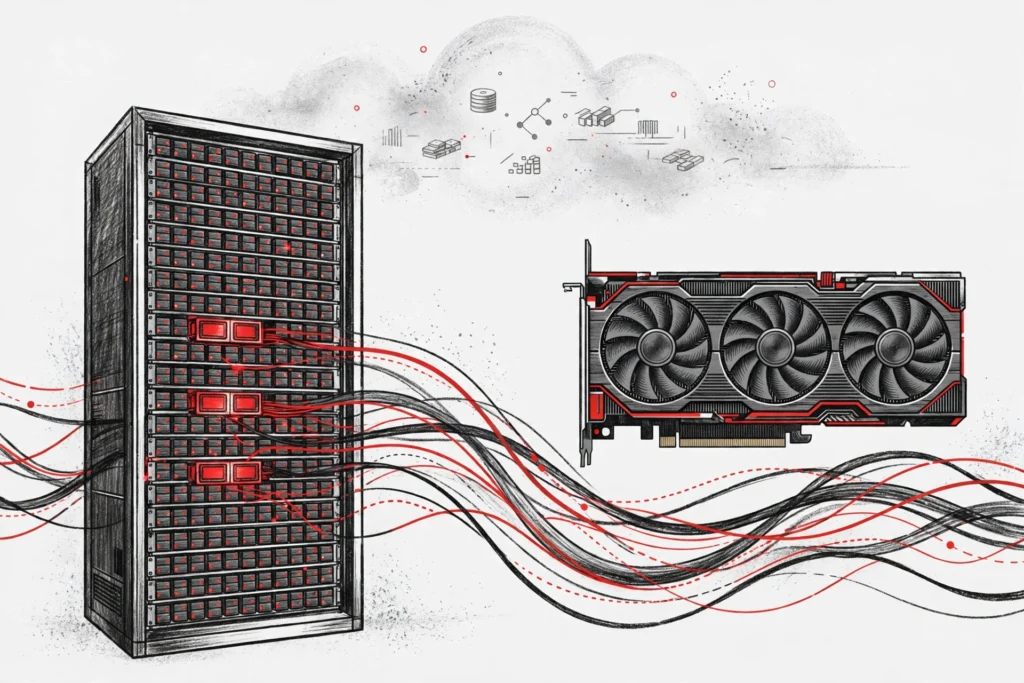
Picture an AI researcher staring at a database too large to fit inside the most powerful graphics card on the planet. The data is there, the model is ready, but the memory is not. That wall is one of the biggest bottlenecks in artificial intelligence, and SSD GPU memory may be the way through it.
This week, Kioxia and Nvidia showed a way around it. Their answer is SSD GPU memory: flash storage wired up so a GPU can treat it as an extension of its own high-bandwidth memory.
Kioxia announced the collaboration on November 26, according to Business Wire. The two companies built a proof of concept that pushes effective GPU memory past one petabyte.
What Kioxia and Nvidia Actually Built
The test system starts with Nvidia’s GB200 NVL72 rack, a liquid-cooled machine that packs 36 Grace CPUs and 72 Blackwell GPUs into a single rack-scale unit. It is the kind of hardware that already powers some of the largest AI training runs in the world.
Then Kioxia added storage. Eighteen server nodes were each fitted with eight Kioxia XD8 Series SSDs, for a total of 144 drives. Each drive holds 7.68 terabytes, which adds up to roughly 1.1 petabytes of raw flash capacity.
Every node gained nearly 60 terabytes of flash-based extended memory. The software that makes it work is Nvidia SCADA, short for Scaled Accelerated Data Access. It lets the GPUs reach into NVMe storage in chunks as small as 512 bytes.
That fine-grained access is the whole point. A GPU does not need to swallow an entire dataset at once. It can pull exactly the small pieces it needs, when it needs them, from a pool far larger than its onboard memory.
Kioxia says the architecture could support a database of two trillion 512-byte vectors. That is the scale of data behind the search and recommendation systems that modern AI depends on.
Why GPUs Keep Running Out of Memory
Graphics cards train AI models with high-bandwidth memory, or HBM. It is blisteringly fast, but it is also expensive, scarce, and limited in capacity. A flagship GPU might carry a few hundred gigabytes of it.
Meanwhile, the datasets AI needs keep growing. Vector databases power the retrieval systems behind chatbots and search tools. Graph neural networks map relationships across billions of connections. Both can easily outgrow the memory on any single GPU.
Until now, the usual answer was to buy more GPUs or more HBM. Both options are costly, and HBM supply has become a strategic bottleneck for the whole industry. Chipmakers have raced to stack more of it onto every new accelerator.
AMD’s MI450X, for example, ships with 288 gigabytes of HBM4 per GPU, and its Helios rack is built around the same idea of more memory per system. Kioxia and Nvidia are asking a different question: what if the memory does not have to sit on the GPU at all?
How SCADA Turns SSDs Into GPU Memory
SCADA is a software library, not a new chip. It sits between the GPU and the NVMe drives, translating the GPU’s memory requests into storage reads at very small block sizes.
That matters because AI workloads rarely read data in neat, large blocks. A vector search might need thousands of tiny, scattered records. Traditional storage handles that badly, which is why SSDs were never treated as memory before.
By supporting 512-byte accesses, SCADA lets the GPU fetch small pieces efficiently. The approach is part of Nvidia’s Storage-Next initiative, which aims to make storage a first-class part of the AI computing stack rather than a slow afterthought.
The XD8 drives used in the test are not exotic prototypes. They are current data-centre SSDs in the E1.S form factor, using the PCIe 5.0 interface. They come in 1.92, 3.84 and 7.68 terabyte capacities, rated for 2.5 million hours of mean time to failure.
The GP2 Series: Kioxia’s Next Move
Kioxia did not stop at the proof of concept. On the same day, November 26, it announced the GP2 Series, a second generation of SSDs built specifically for direct GPU access.
The GP2 drives use Kioxia’s third-generation XL-FLASH memory and target the PCIe 6.0 and NVMe 2.3 specifications. Kioxia reports more than 18 million random read operations per second at a 512-byte block size, nearly double the previous GP1 Series.
Sequential read throughput is expected to reach up to 28 gigabytes per second. For physical integration, Kioxia is evaluating E1.S and E3.S form factors with support for direct liquid cooling, and endurance of up to 50 drive writes per day.
That endurance figure matters. Storage used as memory gets written far more often than storage used as an archive. A drive that wears out in months would be useless in this role, no matter how fast it is.
What This Means for AI Data Centres
If the approach works at scale, it changes the economics of AI infrastructure. Flash memory costs far less per terabyte than HBM, and it is available in vastly larger quantities. A petabyte of extended memory becomes thinkable without a petabyte-sized budget.
The immediate winners would be workloads built on huge vector databases. Retrieval-augmented generation, the technique that lets chatbots consult external knowledge, depends on searching enormous collections of embeddings quickly. Graph neural networks, which model connections between people, products or proteins, face the same memory pressure.
There is a strategic angle too. Google’s TPU chips and AMD’s Instinct accelerators are already challenging Nvidia’s dominance in AI hardware. A cheaper memory tier could help every vendor, but it helps Nvidia’s installed base first, since SCADA runs on its systems.
The memory industry is watching closely. TSMC’s billion-dollar bets on AI customers show how much money is flowing into the AI supply chain. Storage companies now want a share of that spending, and Kioxia invented flash memory itself, back when it was part of Toshiba.
The Catch: It Is Still a Proof of Concept
For all the big numbers, this is a demonstration, not a product. Kioxia and Nvidia describe the system as a proof of concept, and both companies say they are still evaluating the technical feasibility and performance of SCADA.
There is no price, no ship date, and no promise that the exact configuration tested will ever be sold. The 1.1 petabyte figure is raw capacity, and real-world performance will depend on how the software handles the gap in speed between flash and HBM.
Flash is fast for storage, but it is still far slower than high-bandwidth memory. The trick only works if the software is smart about what stays in HBM and what can live on the SSDs. That is exactly what the two companies are testing now.
What Happens Next
The next step is more testing. Kioxia and Nvidia will keep measuring how SCADA performs on real AI workloads, and whether the petabyte-scale memory pool holds up under the punishing read patterns of vector search and graph processing.
Watch the GP2 Series as well. If those drives reach customers, they will be the first storage hardware designed from the start to sit beside a GPU as working memory rather than distant archive space.
For now, the message is simple. The memory wall in AI is real, but it may not need a more expensive brick to climb. Sometimes the answer is to stop stacking memory on the chip and start treating the storage you already have as part of the machine.


