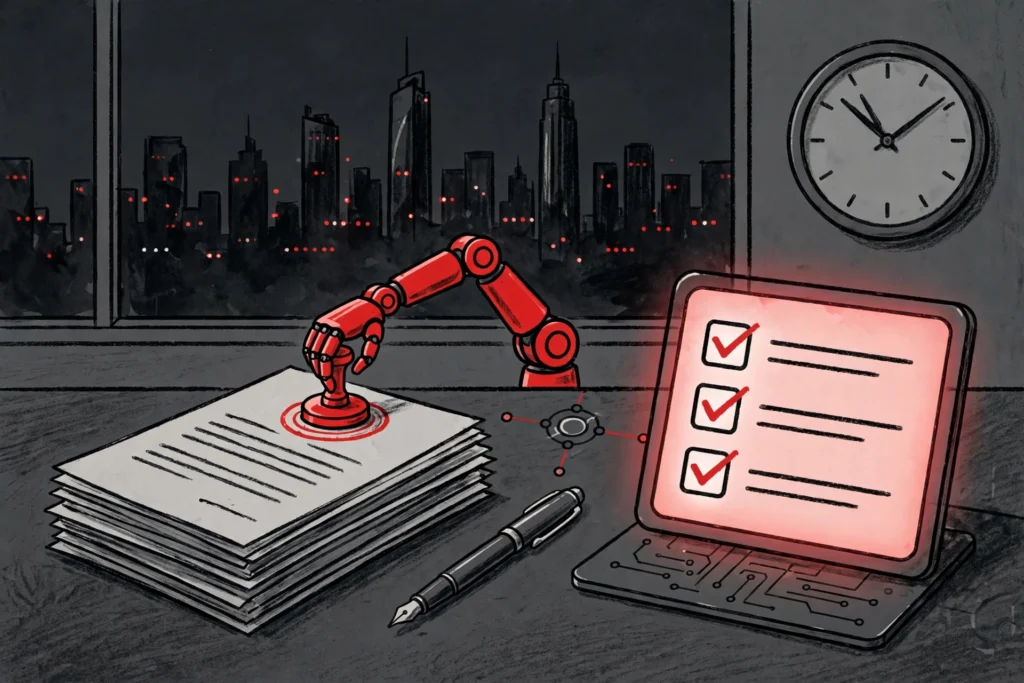
It is 2 a.m. in a San Francisco law office, and a junior associate is still awake. On her screen sit forty-seven documents for a single venture financing: a term sheet, a stack of ancillary agreements, a disclosure schedule that keeps changing, and a closing checklist with more red marks than ticks.
Every number in those documents has to agree with every other number. One wrong figure in a share count can delay a closing by days. One missed signature can kill it outright.
Now imagine the same deal handled by a system that never sleeps, never mistypes a figure, and knows exactly how this firm has closed its last fifty financings. That is the promise of Walton, a legal AI startup that has just released a platform it calls an autonomous transaction system.
What Is the Walton Autonomous Transaction System?
Walton announced the general release of its platform on November 17, 2026, according to PR Newswire. The company describes it as a system that executes complex legal transactions end to end, from the first term sheet to the final signature.
The deals it targets are the hardest ones in corporate law. Venture financings, mergers and acquisitions, fund formations and debt financings all involve dozens of documents, moving deadlines and two sides negotiating against each other.
Most legal AI tools stop at drafting a single document. Walton’s bet is that the real work is everything around the document: keeping the terms consistent, answering the other side, and tracking a hundred small tasks until the deal closes.
How Walton’s Autonomous Transaction System Works
Walton does not sell one generic product. It custom-builds each transaction system around a single law firm’s own forms, precedents and processes for a specific type of deal.
The starting point is the firm’s history. Walton’s legal engineers sit down with the firm’s attorneys and study how they have handled similar transactions in the past. The goal is to capture the firm’s judgment, not just its templates.
Every deal is then modelled as structured data. Walton maps every term, task and relationship in the transaction, so the system always knows the current state of the deal and what still needs to happen.
From that map, the system generates the full set of deal documents. When a term changes, the documents regenerate to match. Nothing drifts out of sync, because the documents are treated as outputs of the same underlying data.
Four Layers Behind Every Walton Deal
Co-founder Jake Sendar describes the system as four layers stacked on top of each other. At the top sit the firm’s precedent, positions and judgment, captured by Walton’s team working directly with its attorneys.
Beneath that, a terms map holds the state of the deal. It is the single source of truth for every number, date and obligation in the transaction.
The third layer is an execution graph, which sequences the work. It decides what happens next, in what order, and who needs to act.
At the bottom, a transaction engine generates the outputs: documents, schedules, models and checklists. Sendar’s summary is blunt. At the level of complexity involved in corporate transactions, he says, getting most of the way there is not enough.
What the System Does on a Live Deal
On a live transaction, Walton’s infrastructure handles the operational grind. It tracks terms, generates documents, and processes markups from opposing counsel, proposing responses drawn from the firm’s own knowledge.
It builds economic models for the deal and prepares disclosure schedules from a connected data room. It maintains the closing checklist and handles signatures when the deal is ready to close.
Importantly, the system does not work in secret. Attorneys review and approve its outputs, and they can work alongside it on live matters while it learns their preferences. Walton says its systems are tested on real cases until the firm’s attorneys grant their approval.
That supervision matters. A venture financing is not a form letter. Every deal has terms that are negotiated, positions that shift, and judgment calls that no template can make.
Who Built Walton and Who Is Using It
Walton was co-founded by Jake Sendar and Michael Dansey, and both men come from inside the world they are trying to automate. Sendar is a former software engineer who practised as a corporate attorney at Pillsbury Winthrop Shaw Pittman.
Dansey practised at Paul Hastings and Gunderson Dettmer, two of the firms most associated with venture capital work. He previously co-founded Talo, a translation startup that was acquired by Palabra.ai in 2025.
The company is backed by Afore Capital, though the size of the investment has not been disclosed. Its first public customer is Elego Law LLP, an early-access partner that uses Walton’s systems across its venture financing practice.
That choice of first customer is telling. Venture financings are high-volume, repeatable deals with similar structures, which makes them the easiest kind of complex transaction to systematise. If Walton can prove itself there, bigger and messier deals follow.
Why Walton Matters for the Legal Industry
The launch arrives as the business of law is already shifting. AI-native law firms and flat-fee pricing models are challenging the old way of billing by the hour, and clients are asking why routine deal work should cost what it used to.
Walton’s answer is that firms can productise their expertise. A system that encodes how a firm closes deals becomes an asset the firm can scale, serving more clients faster without hiring an army of juniors for the overnight shifts.
There is a parallel here with the wider AI agent wave. DeepMind’s AI agents now run experiments for the next Gemini model, and OpenAI has built a control room to supervise its own autonomous systems. The pattern is the same: agents do the work, humans set the guardrails.
Walton is applying that pattern to a profession that has resisted automation longer than almost any other. Law is built on precedent, caution and personal liability, which is why the company’s insistence on attorney approval is not a footnote. It is the product. The same shift is reaching every corner of enterprise AI, where agents are moving from answering questions to doing the work itself.
The Line Walton Will Not Cross
Walton is careful about what it claims. The company says its systems are designed to assist attorneys, not replace them. The operational side of a transaction — drafting documents, keeping terms consistent, keeping deliverables in sync — is what gets automated.
The judgment stays human. No system signs off on a deal by itself, and no client should want it to. A lawyer’s signature on a closing document is a statement of professional responsibility, and no software company can take that on.
That boundary also protects Walton. The legal industry has seen AI tools hallucinate case law and invent citations, and the backlash has been swift. A system that drafts from a firm’s own precedents, with a human reviewing every output, is a much safer proposition.
Still, the questions are real. If a system drafts the documents, negotiates the markups and runs the checklist, what exactly is the junior lawyer for? The honest answer is that the job changes: less copying, more deciding.
What Happens Next for Walton
Walton’s general release is only the beginning. The company says it is building evaluation suites specific to each transaction type, covering standard and nonstandard deal structures.
Those evaluations will matter, because the launch so far rests on the company’s own claims. No independent error rate has been published, and no outside party has tested the system on live deals.
Watch for two things. First, whether more firms beyond Elego Law adopt the platform, and whether they trust it with mergers and acquisitions, which are far less standardised than venture financings.
Second, whether the flat-fee firms and AI-native practices that Walton’s launch is aimed at start advertising faster, cheaper closings as a competitive edge. If they do, traditional firms will feel the pressure to follow.
The junior associate working at 2 a.m. is not going away tomorrow. But the night she spends checking forty-seven documents against each other may soon belong to a system that does it in seconds, while she decides the things only a lawyer can decide.


