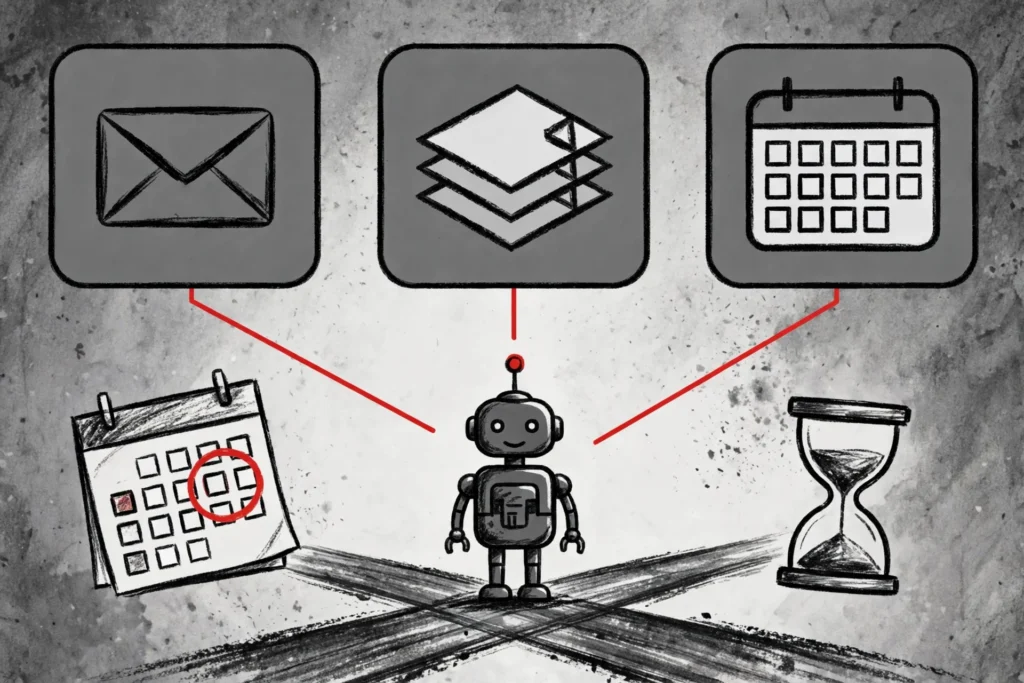
Picture the scene: a small startup’s AI assistant wakes up on a Monday morning, checks the founder’s inbox, pulls the latest sales figures from a spreadsheet, and drafts a reply to a customer before anyone has finished their coffee.
It has done this every day for months. Then, on February 1, 2027, it tries the same trick — and hits a wall.
Nothing about the assistant changed. Google did. On November 24, 2026, Google made its Workspace MCP servers generally available, and with them came a new rulebook for every AI agent that touches Gmail, Drive and Calendar. According to Google’s Workspace Updates blog, agents will soon have to reach Workspace data through those servers — or accept strict limits.
The change also comes with a price list. For the first time, heavy agent traffic on Google Workspace will be billed per request, starting April 1, 2027. Most developers will never pay a cent. The ones who do will want to understand how the meter runs.
What Google Workspace MCP Actually Changes
MCP stands for Model Context Protocol, the open standard for connecting AI models to outside tools and data. Instead of each agent writing its own fragile integration with Gmail or Drive, it talks to a standard server that Google itself hosts.
Google now runs those servers for eight Workspace apps: Gmail, Drive, Docs, Sheets, Slides, Calendar, Chat and Tasks. Google Keep is promised next. A command-line client, called gwscli, launched alongside them.
Until now, most agents reached Workspace the old-fashioned way: by calling Google’s REST APIs directly. That door is not slamming shut overnight. But from February 1, 2027, Google will begin technical enforcement of a new requirement — agents must go through the MCP servers instead.
The enforcement is not a hard block, at least at first. Agents that keep calling the REST APIs directly will be held to the free Standard tier’s quotas, whatever paid tier their project has chosen. A busy agent that ignores the deadline will find itself throttled.
The same date brings a new Workspace AI Tools Addendum into effect, plus fresh admin controls in the Workspace Admin console for managing third-party agents. The rollout reaches Rapid Release and Scheduled Release domains within about two weeks of the announcement.
Google Workspace MCP Standard vs Scaled: The Two Tiers
Alongside the servers, Google introduced two usage tiers that apply to a whole Google Cloud project, not to individual APIs. The tiers start with Gmail, Drive and Calendar, and their MCP servers.
The Standard tier is free and needs no billing account. Every project gets the published REST rate limits, plus 5,000 requests per day, per product, on each generally available MCP server. Go over that cap and requests are throttled until the window resets. You cannot buy more headroom on Standard.
Google says more than 99 percent of active developers currently sit inside those limits at no added cost. For a small team running one assistant, that is probably the whole story. The free tier is the default for every new and existing project.
The Scaled tier is the pay-as-you-go option. You link a billing account, and Google prices every operation in one of four buckets. It applies to the entire Cloud project at once — there is no way to put one API on Scaled and keep the rest free.
One detail catches many people out: signing up for Scaled does not raise your quota by itself. You still have to file a quota increase request if you need higher limits.
The February 1, 2027 Deadline for AI Agents
Two dates matter, and they are easy to confuse. February 1, 2027 is the enforcement date. April 1, 2027 is the billing date.
From February 1, the AI Tools Addendum takes effect and MCP enforcement begins. Any agent calling Workspace REST APIs directly is limited to Standard tier quotas, regardless of the tier selected. That gives teams roughly ten weeks from the announcement to find every agent touching Workspace, register its OAuth client as an agent, and move it onto MCP.
There is a second wrinkle for projects with raised quotas. If your project currently enjoys higher limits than the new tiers allow, you need to act before April 1, 2027 to choose a tier. Without action, it moves to Standard limits at no cost — which for a heavy user could mean a sudden squeeze.
The quiet agents are the dangerous ones. The assistant somebody wired up six months ago, the script that syncs a calendar in the background, the support bot that reads tickets from Gmail — these are the integrations most likely to be forgotten until they break.
What Google Workspace MCP Will Cost Heavy Users
The Scaled tier sorts every billable operation into four price buckets: Light at $0.10, Medium at $0.20, Plus at $0.25 and Premium at $0.50 per 1,000 requests.
Light covers simple lookups such as fetching file metadata or listing labels. Medium covers actions like creating a draft or copying a file. Plus covers searches and listing recent files — and every Calendar call. Premium covers the expensive reads: searching threads, reading a thread, or downloading file content.
Here is where the arithmetic gets interesting. On Scaled, REST traffic keeps large daily free allowances — 70 million Gmail Light requests a day, for example, or 10 million Medium ones. MCP traffic gets no free allowance at all. From April 1, 2027, every successful MCP request is billed from the first one.
Worse, a search is not one request. On the Gmail server, search_threads and list_drafts each count as 10 requests. That means the free Standard tier’s 5,000 daily requests buy at most 500 searches. A failed tool call can also count on the Scaled bill, because it returns an HTTP 200 response with an error inside it.
Composite tools add another multiplier: one tool invocation can trigger several underlying API calls, and each counts. A typical internal agent might cost a few dollars a day on Scaled — modest, but only if it is designed to search sparingly and read in bulk.
The Gmail Catch: No Send Button — Yet
There is one gap that surprises people who try the Gmail server first: it cannot send email. Google’s public tool list for the Gmail MCP server has no send tool, and the quota page marks send_message, reply and forward as requiring partner access rather than being generally available.
That means an agent can read your inbox, search threads and draft replies — creating a draft is a Medium operation at $0.20 per 1,000 — but the final send still needs another route. For teams building support or sales agents, that is a real limitation to plan around.
Why Google Workspace MCP Matters Beyond Google
This is not just a Google story. MCP has become the shared language of the agent era. Anthropic, which created the protocol, recently marked two years of MCP with 700 million downloads, and agent frameworks across the industry have converged on it.
Google’s move is the clearest sign yet that the protocol is shifting from an open experiment into managed infrastructure — with pricing, quotas, terms and admin controls attached. Anthropic’s MCP milestone showed the demand; Google is now showing what the economics look like.
The same pattern is playing out across the industry. Databricks turned Genie into an always-on AI coworker that works unsupervised, and Anthropic’s Claude office suite pushed AI agents directly into workplace documents. As agents move from demos into daily operations, the platforms they run on are starting to charge for the privilege — and to set the rules.
What to Do Before the Deadlines
For most readers, the honest answer is: probably nothing expensive. If your agents are light users, the free Standard tier covers you, and the main job is the migration itself — moving calls from REST to MCP before February 1, 2027.
Start by inventorying every agent, script and integration that touches Gmail, Drive or Calendar. Check whether each one already uses MCP or still calls the REST APIs directly. Register the OAuth clients that act as agents, and test the migration on a quiet project first.
If you run a heavy agent, model the cost. Count searches separately from reads, remember that searches cost ten units each, and design the agent to fetch in bulk rather than chat its way through a mailbox one thread at a time.
Google has given the industry ten weeks to move and four months before the first bill arrives. The agents that keep working on February 2 will be the ones whose owners read the announcement in November.
Source: Google’s Workspace Updates announcement, as reported by Datastudios.


