What Is the Hadrian $15 Billion Loan?
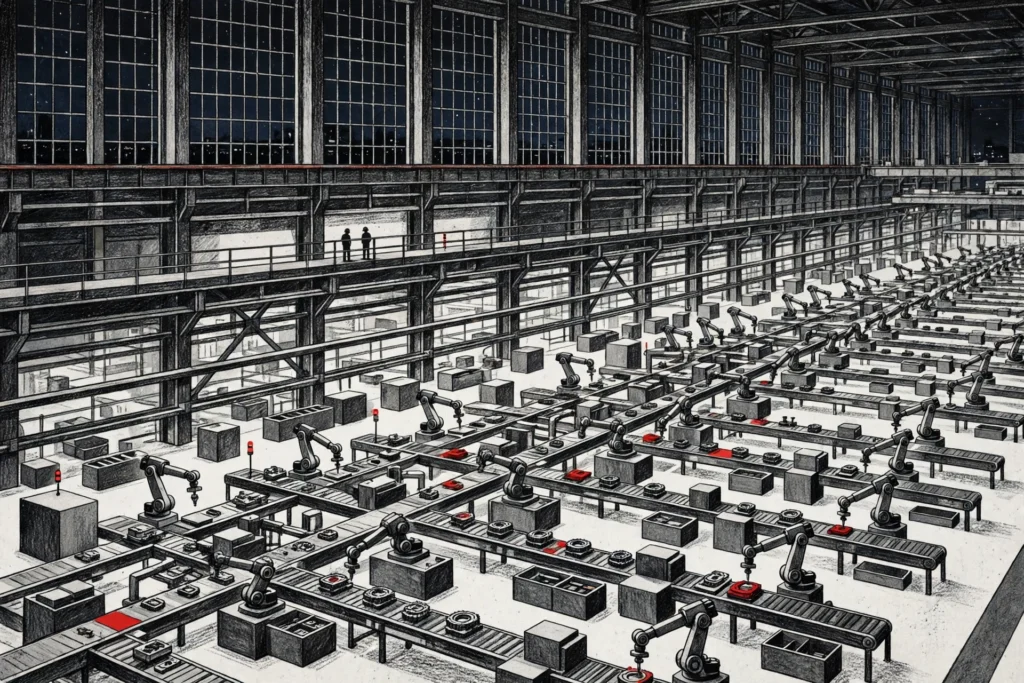
Picture a factory floor at midnight. No workers, no lunch breaks, no shift changes. Robot arms move in perfect rhythm, cutting metal for missile parts while the building hums in the dark. That is the future Hadrian Automation is selling. And now, according to ProPublica, the Pentagon may be about to bankroll it on a scale Washington has never attempted before.
The US Department of Defense is weighing a loan of $15 billion to the California startup, ProPublica reported on November 24, citing interviews and government documents. If it goes ahead, it would rank among the largest government loans in American history. It would also go to a company whose investors include a venture firm tied to Donald Trump Jr.
The money would come through the Pentagon’s Office of Strategic Capital, known as the OSC. The office was created under the Biden administration to mobilise private capital for technologies critical to national security. Its job is to fill gaps in the industrial base and reduce America’s reliance on adversarial supply chains.
Hadrian builds automated factories. Its plants use artificial intelligence and robots to produce precision components for defence, aerospace and other industries. The company says its approach can make parts faster and cheaper than traditional factories. The Pentagon documents reviewed by ProPublica say the loan would pay for a dozen new automated factories.
A Dozen Robot Factories for Munitions and Drones
The plan is not a single factory. It is a network. The dozen facilities would be built in partnership with other defence companies and possibly commercial manufacturers. Their output would include munitions, drones, submarine components and other equipment.
That list matters. Munitions production has become one of the most urgent problems in American defence planning. Stocks have run low after years of shipments to allies, and factories take years to build. A dozen automated plants could, in theory, close that gap far faster than the old way of doing things.
Hadrian’s pitch is speed through automation. Its factories are designed to run with far fewer people than a traditional plant. Software plans the work, robots do the cutting and assembly, and the whole line can switch between different parts without a long retooling process. For the Pentagon, that flexibility is the attraction.
The scale of the ambition is what makes the reported loan so striking. The OSC’s largest deal so far was a $1.5 billion conditional loan to semiconductor component maker Wolfspeed. A $15 billion loan to Hadrian would be ten times bigger. It would also be nearly twice the value of Hadrian itself.
Why the $15 Billion Figure Raises Eyebrows
Hadrian raised $1.37 billion in August 2026 at a valuation of $7.87 billion, according to ProPublica. The round included what the company described as major participation by 1789 Capital. A loan of $15 billion would therefore be almost double the entire worth of the company, as judged by its own investors only months ago.
That comparison is at the heart of the criticism. Former defence officials told ProPublica that the size and structure of the deal could create a dangerous interdependence between the company and the federal government. The government would use taxpayer money to vastly expand a young contractor, and then presumably award it contracts, effectively paying the company money it could use to repay the loan.
Pentagon staff have also raised practical concerns, the documents show. One is whether Hadrian can expand and hire fast enough to deliver a dozen factories. Building one automated plant is hard. Building twelve at once, while recruiting the engineers and technicians to run them, is a different order of challenge.
The figures also invite comparison with the wider AI investment boom. Money is pouring into artificial intelligence at a historic pace, and the biggest deals keep getting bigger. As we reported in our coverage of TSMC’s $1 billion investment in Anthropic and OpenAI, even the chipmakers are now buying stakes in their own customers. The Hadrian loan would take that logic into the defence world.
The Trump Jr. Connection
The political angle is impossible to ignore. 1789 Capital is the venture firm where Donald Trump Jr. became a partner after his father’s election in November 2024. The firm first invested in Hadrian in July 2025, in a $260 million round co-led by Founders Fund. A spokesperson for 1789 Capital said it holds a minority stake in Hadrian, though the total size of its share has not been disclosed.
The loan is under consideration weeks before Democrats take control of both chambers of Congress. Their leaders have vowed to scrutinise Trump-administration actions that benefited the Trump family. The timing alone guarantees the deal will be examined closely, whatever its merits.
Rep. Jamie Raskin, the Maryland Democrat who is the likely incoming chairman of the House Judiciary Committee, has launched his own probe into companies tied to 1789 Capital. House Democrats are separately examining the reported loan. The political fight around the deal has already begun, even though no loan has been approved.
Approval would fall to David Lorch, the political appointee who heads the Office of Strategic Capital. Lorch once worked at the investment firm started by Deputy Defense Secretary Steve Feinberg. That chain of command will draw attention from critics who question whether the process is being run at arm’s length.
The Pentagon Pushes Back
Both the Pentagon and Hadrian have pushed back hard on the report. A Pentagon spokesperson told ProPublica that the talks are in their early stages and disputed the $15 billion figure. The spokesperson said multibillion-dollar deals with other companies had been agreed but not yet announced, and characterised the Hadrian loan under discussion as not extraordinary.
The department also issued a firm denial of any favouritism. “Outside affiliations, investors, or political connections play absolutely no role in the Department’s funding decisions,” the Pentagon said in a statement. It did not say what the actual figure under discussion might be.
Hadrian disputed the account as well. “ProPublica’s story mischaracterises the status of these preliminary discussions. This was never about one company,” a company spokesperson said. According to Hadrian, the proposed loan contemplated a consortium of manufacturers across the American industrial base, including major defence prime contractors, component suppliers, small businesses and commercial manufacturers, to solve America’s critical munitions shortage.
That distinction matters. A loan to a consortium of established manufacturers would look very different from a loan to a single startup. But ProPublica says the documents it reviewed show specific loan terms under consideration and a discussion of the deal’s merits and risks. The two versions of the story have not yet been reconciled.
Audits and Investigations Are Already Underway
The controversy is growing beyond the loan itself. The department’s Inspector General launched an audit on Friday into contracts and loans to defence startups. The objective, according to the announcement, is to determine whether the department’s processes for issuing awards complied with applicable laws and regulations, specifically controls for preventing improper influence and safeguarding nonpublic information.
The audit is not aimed at Hadrian alone. It covers the wider pattern of awards to defence startups. But its timing, days before the ProPublica report, means the Hadrian talks will almost certainly fall within its scope. Auditors will be able to examine how the deal was put together from the inside.
There is also a legal question hanging over the whole arrangement. When Congress created the OSC, it barred the office from lending to projects with only military applications. A loan to build munitions factories would need to show a broader industrial purpose to stay inside that rule. How the Hadrian proposal clears that bar is one of the questions investigators are likely to ask.
The scrutiny reflects a broader anxiety about how fast AI money is moving through Washington. The Federal Reserve has already warned that the AI boom could end in a painful correction, as we covered in our report on the Fed’s warning about an AI stock market correction. When public money joins the rush, the stakes get higher still.
What Happens Next
For now, the loan is a discussion, not a decision. The Pentagon says the talks are early. Hadrian says the proposal is about a consortium, not one company. No approval has been announced, and the OSC’s decision is the next milestone to watch.
Several things will shape what happens next. The Inspector General’s audit will test whether the process followed the rules. The House investigations will test the politics. And the new Democratic majorities in Congress, once seated, will have subpoena power over the documents behind the deal.
The defence world will be watching too. If a $15 billion loan goes ahead, it would reset the scale of government support for AI manufacturing. It would signal that Washington is willing to bet enormous sums on automated factories as the answer to its industrial problems. If it collapses under scrutiny, it will become a cautionary tale about how not to do it.
Either way, the episode shows how far artificial intelligence has moved from the laboratory into the centre of American industrial policy. The same technology that powers chatbots is now being asked to rebuild the factories that make weapons. The question is not whether that will happen, but who pays for it, and who benefits. For more on the reporting behind this story, see The Outpost’s summary of the ProPublica investigation.
Hadrian’s robot factories may one day run through the night with no one on the floor. Whether the Pentagon writes a $15 billion cheque to build them is a decision that will now be made in public, under audit, and under investigation. That, as much as the factories themselves, is the real story here.


