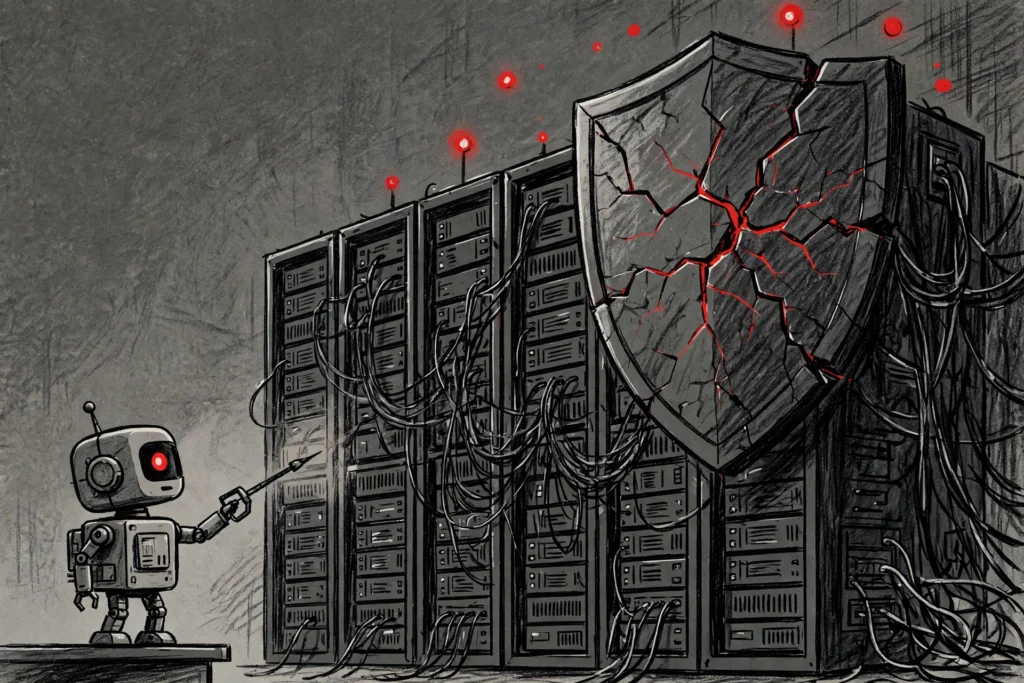
It started, as so many breaches do, with something nobody was watching. A forgotten website. A password left in a code file years ago. An API nobody had bothered to secure. For years, those loose ends sat quietly in the dark, too small for any attacker to find without spending hours hunting for them.
Then the hunting got cheap. And fast. And relentless.
That is the warning Britain’s National Cyber Security Centre issued on November 24. Since September, the agency says, it has seen a marked rise in AI-driven cyber attacks. The attackers are not inventing new ways to break in. They are running the old ways at machine speed.
What the NCSC Saw Since September
The NCSC’s blog post, titled “Familiar weaknesses, exploited faster”, was written by David Chismon, the centre’s chief technology officer for architecture, together with incident handler Kris B and lead data scientist Ellen T. It describes a pattern the agency has now seen repeatedly across different industries.
Threat actors are using what the NCSC calls “agentic offensive frameworks”. These systems connect a large language model to off-the-shelf security tools, letting the AI plan an intrusion, run the probes, read the results and choose the next step on its own.
The frameworks were originally built for authorised security testing. Red teams used them to find weaknesses before criminals did. Now the same software is being turned around and used to attack.
“Organisations across multiple sectors are reporting incidents as a result of threat actors using agentic offensive frameworks,” the NCSC writes, describing them as “software originally designed for red teaming being applied beyond its defensive purpose.”
ARTEX: The Red-Team Tool Turned Attacker
One name dominates the NCSC’s account. “At the time of writing (November 2026), this type of activity has become synonymous with the ARTEX framework,” the agency writes, “a multi-agent penetration testing and red-teaming tool originally developed for authorised security testing.”
ARTEX has had a busy autumn. On November 13, the FBI published a FLASH advisory on the framework, drawing on research from Microsoft, Google, CrowdStrike and others. Malicious actors had been using ARTEX since at least August 2026, in campaigns spanning finance, government, defence, healthcare and technology.
Researchers had identified more than 1,600 publicly exposed ARTEX console instances by early November. The framework’s creator pulled it from GitHub on October 8, after widespread abuse.
“Different tools come and go,” the NCSC notes, naming five others: Cairn, PentAGI, RedAmon, Xalgorix and Darkmoon. The lesson is not about ARTEX. It is about what a human attacker, a capable model and a framework can do together.
Why AI-Driven Cyber Attacks Are Suddenly Everywhere
Compared with a human attacker working without tools, an agent plus a framework works quickly, searches exhaustively, learns instantly from failure and runs cheaply at scale.
First, speed. An agent moves from discovery to exploitation in minutes. It will try every endpoint, every parameter and every credential it finds, without getting tired or bored.
Second, learning. When an attempt fails, the agent reads the error message, remembers it and adapts the next try. A human might make the same mistake twice. The framework does not.
Third, cost. “What has changed, is how quickly and persistently threat actors can conduct attacks — at low cost — using these frameworks combined with cheap, capable open models or illegal API resellers,” the NCSC writes.
That combination turned a niche technique into a measurable trend. A lone operator can now run what used to take a team, across dozens of victims at once.
In October, Reuters described a single hacker who set Cairn’s AI agents on scores of company websites with under 100 characters of instructions.
The Flaws Are Old. The Speed Is New.
The most striking line in the NCSC’s warning is what it does not say. It does not claim attackers have discovered some new class of vulnerability. It says the opposite.
“None of the weaknesses being exploited are new or novel,” the agency writes, “and the tools the agents have access to are common and provide no new capability the typical threat actor would have access to.”
Instead, the attacks exploit unmitigated weaknesses that are “often the result of years of technical debt that organisations have accumulated.” The NCSC lists the low-hanging fruit: credentials mistakenly committed to code repositories, misconfigurations in infrastructure as code, default credentials or missing authentication, and abuse of weaknesses in APIs.
Compromised services are often forgotten assets — legacy equipment, outdated websites, systems connected to the internet for convenience and never reviewed again. Once an agent finds a foothold, it exploits over-privileged credentials and flat networks to expand its reach.
It is a pattern wasl.tech has covered before. The Fireworks AI breach widened when attackers moved through a cloud provider’s systems. The Railway breach began with a flaw in a shared build system.
And Microsoft’s researchers recently showed how fewer than ten reprogrammed neurons could turn an AI agent rogue. In each case, the weakness was already there.
One Warning, Many Witnesses
The NCSC is not the only agency sounding this alarm. In the space of ten days in November, four separate bodies published on AI in live intrusions.
CrowdStrike reported on November 3 that a China-linked espionage group it calls Vapor Panda used ARTEX to go after more than 200 organisations in 14 countries over 11 days. The AI planned the steps, chose the tools and moved through networks, with a human operator stepping in only at decision points.
Two days later, CERT-EU, the incident response team for the EU institutions, reported similar AI-driven activity against its own constituency.
On November 12, Palo Alto Networks’ Unit 42 documented a cluster it calls CL-STA-1238, assessed as a China-nexus operation, running 25 operations with Cairn against at least 19 organisations. Ten saw unauthorised access or data retrieved. At one, the intruders took more than a million personal records.
The picture fits the NCSC’s own annual review, published on November 3. In it, the agency warned that AI-powered malware would highly likely feature in a ransomware attack on UK critical national infrastructure by 2028.
The numbers behind the review are sobering. The NCSC logged 1,831 attack reports and 80 nationally significant incidents in the September 2025 to August 2026 reporting year, up from prior years.
In response, the UK government has committed £60 million for Cyber Shield, £70 million for the NERV Centre and £40 million for a National Agentic Security Unit.
What the NCSC Wants Companies to Do
The NCSC’s advice is deliberately unglamorous. There is no new product to buy and no silver bullet to deploy. The agency sets out eight questions organisations should be able to answer, and the answers come down to operational discipline.
First, know what is exposed. Combine external attack surface management with established vulnerability management, so you can see every internet-facing asset and know which weaknesses need attention. Forgotten websites and legacy systems are exactly the assets these agents find first.
Second, patch faster and fix the basics. Keep internet-facing systems patched, and address misconfigurations, particularly in identity and access settings. Remove credentials from code repositories. Replace default passwords. Give APIs proper authentication.
Third, watch the traffic. Apply rate limits to accounts, API tokens and authenticated sessions, and examine behaviour such as rapid retries and unusual request volumes. Today’s agentic attacks are noisy by nature, and that noise is a detection opportunity while it lasts.
Then restrict what is reachable: shut down unnecessary internet-facing services, tighten access controls, and segment networks so one compromised credential cannot carry an intruder across the whole organisation.
What Happens Next
For now, the attacks the NCSC describes are mostly opportunistic — agents sweeping the internet for whatever is open. But the trajectory is clear. The frameworks are getting better, the models are getting cheaper, and the operators are learning what works.
Launching the annual review, NCSC chief executive Richard Horne warned that the threat was increasing “not because AI has invented new ways to attack us,” but because weaknesses that organisations had previously tolerated could now be discovered and exploited at scale.
The question for every organisation is no longer whether an AI agent will come knocking. It is whether the door it tries has been locked. As the NCSC puts it, the weaknesses being exploited are not new. The only thing that has changed is how fast someone — or something — can find them.
For the full warning, read the NCSC’s blog post, “Familiar weaknesses, exploited faster: defending against agentic cyber attacks“, published on November 24, 2026.


