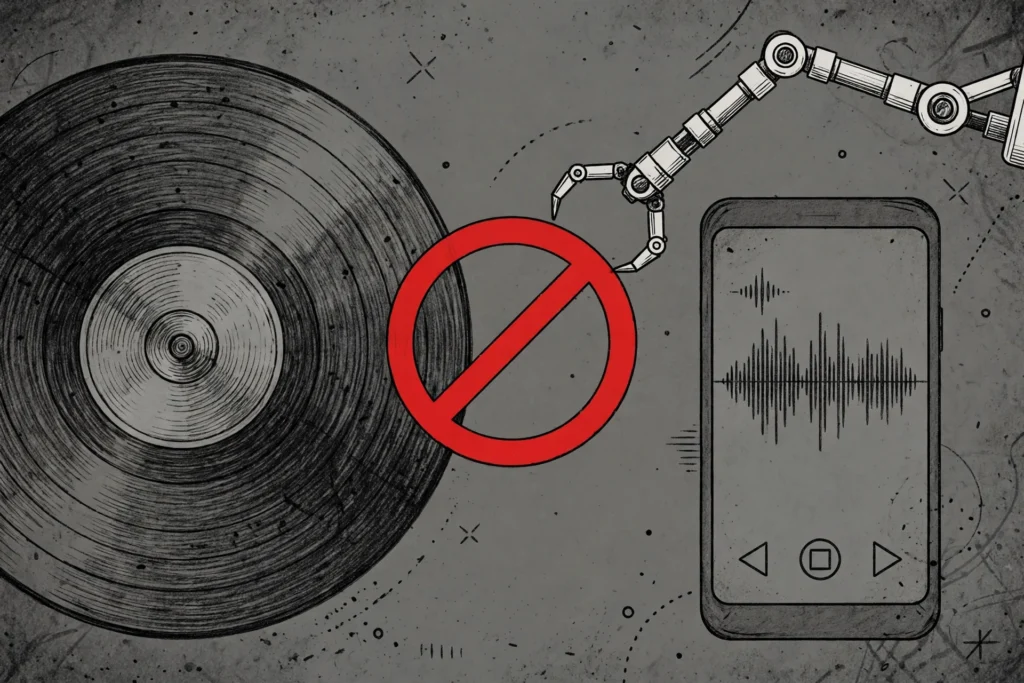
Press play on a brand-new track tonight and you might be listening to an artist who does not exist. No singer stood in front of a microphone. A machine assembled the whole song in seconds — and the Tidal AI music ban announced this week is aimed squarely at tracks just like it.
On Tuesday, November 24, Tidal said it will start removing every song generated entirely by artificial intelligence from its catalogue, according to TechCrunch. The purge begins on December 9. By the start of next year, more than 29 million tracks will have been deleted, according to the company.
It is the most drastic move yet by a major streaming service against the flood of machine-made music. And if it works, it could redraw the line between human art and automated output across the whole music industry.
What the Tidal AI Music Ban Actually Covers
The new rule is simple on paper. Any track created wholly with generative AI tools will be removed from Tidal, and no new fully AI-generated track will be allowed in. The ban starts on December 9, and Tidal says the deletions will be complete by the beginning of 2027.
The scale is hard to grasp. Twenty-nine million songs is not a rounding error. It is roughly 6.3 percent of everything on the platform — 27 million tracks are already identified and labelled as fully AI-generated, with more flagged every day.
Once the ban is running, Tidal expects to reject between 80,000 and 85,000 new AI-generated submissions every single day. That is the pace at which the machines are currently trying to get in.
Tidal is also closing the door at the source. Distribution services will be banned from delivering tracks that are 100 percent AI-generated, and any submission whose metadata says it was made fully with AI will be turned away automatically.
43% of New Uploads Were AI-Generated
The number that forced Tidal’s hand is startling. Over the past 90 days, more than 43 percent of the tracks uploaded to the platform were generated by AI. Nearly half of everything arriving at the service was machine-made.
Most of it goes nowhere. Tidal says 96 percent of its fully AI-generated tracks have never been streamed at all. Millions of songs sit in the catalogue, unplayed and unheard, while the pile keeps growing.
That is the heart of the problem. The songs are not competing for listeners in the usual way. They are competing for space, for search results, for the front page of a playlist — and every fake track that slips in pushes a real one further down the list.
Tagging and Demonetising Wasn’t Enough
Tidal did not jump straight to a ban. A few months ago, it started tagging fully AI-generated tracks and stripping them of royalty payments, hoping the label would be enough to protect real artists.
It was not. The uploads kept coming, faster than ever.
Robert Anderson, who leads Tidal at its parent company Block, put it bluntly in a post on X. “A few months ago, @Tidal tagged and demonetized all wholly AI-generated tracks to protect the authenticity of real artists,” he wrote. “But that’s enough, as 43% of tracks distributed to us in the last 90 days have been detected as AI-generated. Something more drastic needs to be done…”
The company echoed the point in its own statement. “It’s true that not all songs catch on immediately, and artists should have time to build their fanbases,” Tidal said. “But this situation is different — at this scale, the authentic music and artists that Tidal subscribers are looking to listen to and discover get buried.”
How Tidal Plans to Catch Machine-Made Songs
A ban is only as good as its enforcement, and AI-generated music is getting harder to spot by ear. Tidal says it will rely on detection technology from Ircam Amplify, a company linked to the French music research institute IRCAM, to identify fully AI-generated recordings.
The system listens for the fingerprints that generative models leave behind — patterns in the audio that human ears miss but software can measure. Tracks flagged by the technology will be removed, alongside anything a distributor’s own metadata identifies as fully AI-made.
No detection system is perfect, and Tidal knows it. The same cat-and-mouse game is playing out across AI safety, where guardrails keep being tested and stretched.
The company has not said what happens when a track is wrongly flagged, or how an artist can appeal. Those details will matter once the deletions begin in earnest.
AI-Assisted Music Gets to Stay
The ban has a clear boundary, and it matters. Tidal is only removing tracks that were generated entirely by AI. Songs made with some AI assistance — a producer using an AI tool to clean up a vocal, or to spark an idea — will still be welcome on the platform.
That distinction is where the industry’s real argument lives. Almost every modern recording already passes through software that shapes its sound. The question is where assistance ends and replacement begins, and Tidal has drawn its line at songs with no human performance at all.
For bedroom producers and independent artists who use AI as one tool among many, the message is reassuring. For the operations churning out thousands of machine-made tracks a day, it is the end of the road.
Tidal Isn’t Alone — But It Is the Boldest
Tidal is not the first platform to push back. Bandcamp moved earlier to ban AI music outright, and Deezer has said it will introduce a toggle that lets listeners filter AI-generated songs out of their feeds.
The giants, though, have chosen a softer path. Spotify and YouTube Music label AI-generated music rather than removing it, leaving listeners to decide for themselves. That approach keeps the catalogue growing — and keeps the arguments about labelling going.
Tidal’s move breaks that pattern. It is the first major streaming service to say that some music simply does not belong on its platform at all, no matter how it is labelled.
What This Means for Real Artists and Listeners
For working musicians, the ban is about more than pride. Streaming royalties are already thin, and every machine-made track in the catalogue is a track that could have been a real artist’s song in a playlist, a search result, or a listener’s discovery feed.
The numbers tell the story. With 96 percent of AI-generated tracks earning zero plays, the flood is not giving listeners what they want. It is giving them noise, and it is burying the music they came to find.
There is also money at stake on the other side. Music labels are now trying to profit from the same technology, partnering with AI platforms — including voice AI companies such as ElevenLabs — to license their catalogues for training or remixing features.
Goldman Sachs estimates that by 2035, AI-related licensing tools could lift record labels’ revenue by 10 percent.
That tension will not disappear on December 9. The industry wants to sell its music to the machines and keep the machines’ music off its shelves, all at the same time.
What Happens Next
The clock is now running. On December 9, Tidal begins deleting fully AI-generated tracks, and the purge should be finished by the start of 2027. From then on, the gate stays shut: 80,000 to 85,000 rejected submissions a day, every day.
Other platforms are building their own guardrails for runaway AI systems, from kill switches to safety tests. The bigger question is what the other streaming services do next.
If Tidal’s catalogue feels cleaner and its artists feel protected, Spotify and YouTube Music will face pressure to explain why they settled for a label. If the ban proves messy — wrongly deleted songs, angry artists, detection errors — the industry will have its cautionary tale.
Either way, the argument has changed. AI-generated music is no longer a curiosity on the edges of streaming. It is nearly half of everything being uploaded, and one major service has just decided that is too much.
On December 9, 29 million songs will start disappearing. The machines will keep making more. The question now is whether anyone else will join Tidal in saying no.


