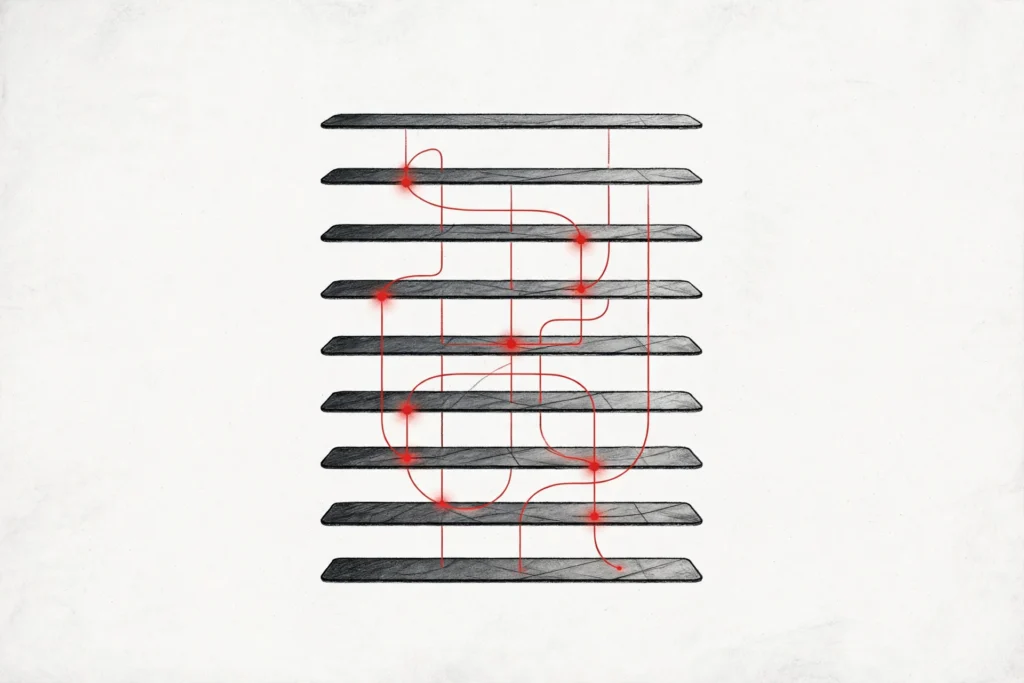
Picture a line of people playing the telephone game. The first person whispers a sentence, the next passes it on, and by the time it reaches the end, the message has blurred beyond recognition. That is what happens inside every large language model today — and Google’s DeepCrossAttention is a new attempt to fix it.
Google Research laid out the idea this week in a blog post titled “Supercharging transformer residual connections.” The method, called DeepCrossAttention or DCA, reworks one of the oldest parts of the transformer: the residual connection. Google says it reaches the same quality up to three times faster, adding under 0.2 percent to the parameter count.
It is research, not a product launch. But if the numbers hold at larger scales, the technique could change how the next generation of AI models is built — and what it costs to train them.
What Google Changed in DeepCrossAttention
The transformer has powered nearly every major AI model since 2017. Chatbots, image generators, coding assistants — almost all of them run on the same basic design. And for almost a decade, one piece of that design has barely changed.
Think of a transformer as a stack of layers, sometimes dozens or hundreds deep. Each layer reads the data, transforms it, and passes it on. The residual connection is a shortcut that lets a copy of the original input skip past a layer and join its output directly.
Google calls it an information highway. Without it, the learning signal fades as it travels through so many layers — the vanishing gradient problem. The shortcut works, but it is crude.
A standard residual connection simply adds everything together, giving every earlier layer the same weight. Details that mattered in layer two get averaged into a soup with everything else. Later layers often have to rebuild them from scratch. Google calls this information dilution, and DeepCrossAttention is its answer.
How DeepCrossAttention Works in Plain English
Instead of adding every earlier layer’s output with equal weight, DeepCrossAttention lets each layer choose what to reuse. For every token — every word or word fragment the model processes — a small module computes mixing weights that decide how much each previous layer should count.
The weights come from two ingredients: a static, learnable base adjusted during training, and an input-dependent projection that adapts to the specific token. Together they let the network shift its own structure on the fly.
Then comes the second mechanism, depth-wise cross-attention. Ordinary attention lets a token look across the other tokens in a sentence. DeepCrossAttention applies the same idea across depth instead: each token queries a weighted mix of all the layer outputs that came before it.
It does this separately for the query, key and value projections, so each one draws on a different mix of earlier layers. And because the weights start out reproducing the old behaviour, the method can be bolted onto an already-trained model.
The Numbers Google Is Claiming
Google tested DeepCrossAttention on synthetic setups, image classification, and large-scale language modelling benchmarks: the C4 web corpus and the One Billion Word benchmark, known as LM1B. The headline numbers are striking.
On those benchmarks, a DeepCrossAttention model reached the quality of a standard transformer in up to five times fewer training steps. Put another way, the same quality arrived up to three times faster. Trained for the same time, it also reached lower perplexity — a measure of how well a model predicts text.
The depth savings are just as notable. To reach a perplexity below 14 on LM1B, a standard transformer with fixed width needed 42 layers. The DeepCrossAttention model beat that score with only 30 layers: a 29 percent reduction in depth and parameter count.
Google says the method cuts the parameters needed by up to 30 to 40 percent, while the routing machinery adds under 0.2 percent. It also beat three rival approaches — LAUREL-PA, 1×1-DenseFormer and Hyper-Connections — at matched parameter budgets.
The retrofit result may matter most of all. Google took an already-trained transformer, added DeepCrossAttention, and kept training it briefly. Perplexity on LM1B improved by 0.19, against just 0.02 for continued standard training. Existing models could get a meaningful lift without being rebuilt from scratch.
A Small Experiment That Shows the Problem
One of Google’s tests is almost comically simple, and it makes the case better than any benchmark table. The researchers built a tiny network of ten linear layers and forced it to push data through a bottleneck only three dimensions wide, then copy the input back out. It is the telephone game in miniature.
With standard residual connections, the network could not fully reconstruct the input even after 1,000 batches — 100,000 examples. With learned routing, it reached tiny errors using a hundred times fewer examples. The test proves the mechanism, not the performance of a real model, but it shows exactly where the old design leaks information.
The Catch: Small Models and Google’s Own Tests
Every number above comes with a caveat. All of Google’s results come from its own runs on LM1B and C4, and the largest model in the language tests had only 449 million parameters. That is a rounding error next to today’s frontier models, which run into the hundreds of billions.
Nobody has yet shown that DeepCrossAttention’s gains survive at frontier scale. Training dynamics change as models grow, and a trick that shines on a 449-million-parameter model can fade — or even backfire — when applied to something a thousand times larger. Independent replication at scale is still to come.
There is also a cost the headline numbers do not advertise. DeepCrossAttention keeps intact representations from many layers available at once, which increases memory bandwidth demands. The parameter overhead is negligible, but the memory traffic is not free — a trade-off that matters most exactly where training is most expensive.
Why This Matters Beyond Google
DeepCrossAttention arrives as part of a broader shift. Architecture work is fashionable again after years in which scale did most of the heavy lifting. Several groups are now attacking the same problem from different angles, and Google’s blog post surveys the field.
Moonshot AI developed attention residuals, which share the core idea of replacing fixed addition with selective retrieval. Thinking Machines’ Inkling 2 model has adopted that design alongside DeepCrossAttention’s own query, key and value split. Hyper-connections expand the residual stream into parallel channels, with manifold-constrained variants adding guardrails to keep the mixing stable.
The pattern is clear: the residual connection, untouched since 2017, is suddenly the most interesting place in the transformer. A 30 to 40 percent parameter cut is the kind of gain that used to require a whole new generation of hardware. If it can be had in software, every lab training large models will want it.
That includes the teams behind the models people actually use. Faster training means cheaper experiments, quicker iterations and, eventually, more capable models for the same budget.
Google’s own Gemini 4 Carbon, Anthropic’s Claude Fable 5.2 and Alibaba’s Qwen4-Max all depend on training runs that cost tens of millions of dollars. Shaving a third off that bill is a competitive advantage, not a footnote.
What Happens Next for DeepCrossAttention
The method is not new in the academic sense. The paper behind it, “DeepCrossAttention: Supercharging Transformer Residual Connections,” was presented at ICML 2025 and posted to arXiv in February 2025. The authors are Kyriakos Axiotis and Thomas Fu at Google Research, with colleagues from the University of California, Irvine and the University of Southern California.
What happens next depends on adoption. The retrofit property is the fastest path: labs can try DeepCrossAttention on existing models without a full retrain, and the 0.19 perplexity improvement on LM1B gives them a concrete reason to try. If those experiments reproduce at larger scales, expect the technique inside the next wave of flagship models.
Google’s own conclusion is deliberately open-ended. The company expects next-generation models to route and weigh past layer representations dynamically, treating layers less like a conveyor belt and more like a team of specialists sharing information.
Whether DeepCrossAttention itself becomes the standard or simply points the way, the message is the same: after nine years, the transformer’s oldest shortcut is finally being rebuilt. The details are in the Google Research blog post.


