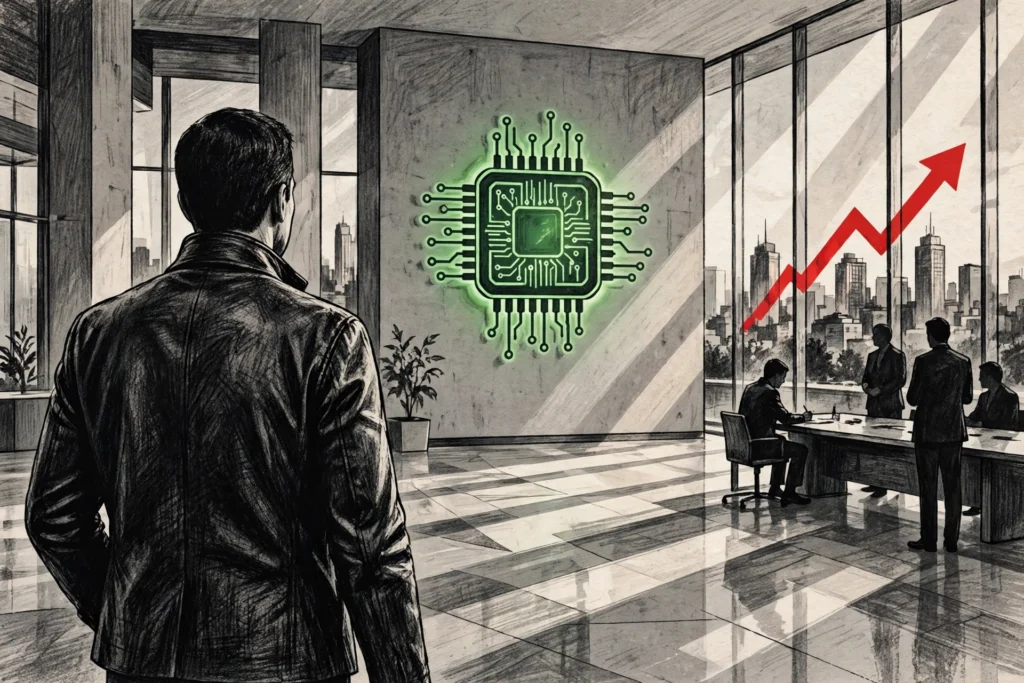
Eleven Days Out, One Morning Back
Eleven days ago, Jensen Huang walked out of Nvidia in disgrace. On Monday morning, he walked back in as chief executive — and the stock market handed him a welcome-home gift worth nearly a trillion dollars.
Nvidia announced before the opening bell that Jensen Huang has been reinstated as president and chief executive, effective immediately. The board voted unanimously to bring back the man who co-founded the company in 1993 and built it into the most valuable chipmaker on the planet.
It is one of the fastest corporate comebacks in modern business history. Huang resigned on November 12 after revelations of two extramarital affairs, including one with a woman US officials suspected of working for Chinese intelligence. Eleven days later, he is back in the chair he never really left behind.
The reversal stunned even seasoned Wall Street watchers. Just days earlier, on Nvidia’s earnings call, the board had said it did not intend to bring Huang back. Then, over the weekend, the directors changed their minds.
Why Jensen Huang Was Reinstated After 11 Days
The board’s statement, released on Monday, was short and strikingly confident. After a series of discussions and meetings with Huang, the directors said they were satisfied with his candour and his ability to lead the company.
Crucially, the board said it had received input from senior levels of the United States government. Based on that input, it said, it was confident that Huang’s reinstatement posed no national security risk.
“The Board believes Jensen is the right person to lead NVIDIA, and that his reinstatement is in the best interests of our stockholders, employees, partners and customers,” said Harvey Jones, the board chair who took over after Huang’s removal.
According to Semafor, the board met on Sunday night to take the vote. Several directors had been pushing for Huang’s return for days, arguing that the company could not afford a prolonged leadership vacuum at the centre of the AI boom.
The formal vote took place on November 22, according to a regulatory filing, and the decision was announced publicly on Monday morning, November 23.
Trump’s Role in the Comeback
The reinstatement came under direct pressure from the White House. Reuters reported that President Donald Trump had pressed for Huang’s return, and Trump celebrated the decision publicly within hours of the announcement.
“The NVIDIA Board of Directors has made the correct and proper decision to return Jensen Huang to the position of CEO,” Trump wrote on Truth Social on Monday.
The president’s involvement adds a political dimension to an already extraordinary saga. Nvidia sits at the heart of America’s AI strategy, and its chips power everything from data centres to military research. A leadership crisis at the company had become a national concern, not just a corporate one.
The Market’s Verdict: A 30 Percent Surge
Investors did not need much persuading. Nvidia shares leapt by roughly a third in early trading on Monday, clawing back much of the value destroyed during two brutal weeks.
The rally was so powerful that it lifted the entire market. The Nasdaq jumped 6 percent and the S&P 500 rose 4 percent, recovering from Friday’s sharp sell-off. Nvidia alone added roughly $960 billion in market value in premarket trading, according to NotebookCheck.
The surge tells its own story. In the two weeks since Huang resigned, Nvidia shares had lost about a third of their value. Investors had dumped AI-exposed stocks, worried about export-control violations, a messy CEO transition and the loss of the industry’s most recognisable leader.
Even so, the shares remain in the red for 2026. The comeback has repaired the damage of the past fortnight, but not the losses of the full year.
The Spy Allegations That Forced Him Out
To understand the comeback, you have to remember the fall. The crisis began on October 29, when the New York Times reported that US officials believed Alice Huang, a Chinese executive at the Singaporean firm Megaspeed, had been recruited by China’s Ministry of State Security.
Alice Huang, who is not related to Jensen Huang, had been in a romantic relationship with the Nvidia chief. Megaspeed was an important Nvidia customer, and US authorities had been investigating it since 2024 over suspicions that it smuggled advanced Nvidia chips to China.
On November 8, Jensen Huang admitted infidelity in a staff memo. Three days later, the Times reported a second affair, with Kimberly Powell, a Nvidia vice-president who reported directly to him. The board met, hired the law firm Wachtell Lipton to investigate, and accepted Huang’s resignation the following day.
A shareholder class action followed within minutes of the market close on November 9. House committees sought a closed-door briefing. The company’s Q3 results, due November 17, were delivered by interim chief executive Colette Kress instead.
What the New York Times’ Latest Report Reveals
Just as Huang was returning, the story took another twist. On Sunday, the New York Times reported new details about Alice Huang’s alleged contacts with Chinese intelligence, citing people with knowledge of US intelligence reports.
According to the report, Alice Huang was in touch with an officer of China’s Ministry of State Security from the spring of 2025 until the autumn of this year. That period overlaps with at least part of her relationship with Jensen Huang.
US intelligence agencies have also gathered evidence that her business partner Kang Wei, who was often introduced as her husband, worked with the same spy agency. The extent and timing of their contacts had not previously been reported.
But the picture is far from settled. Attorney General Todd Blanche said on November 12 that the Justice Department had reached no conclusion about whether Alice Huang was a spy. CNN reported that the intelligence collected on her so far did not prove she had acted as one.
Singapore’s Ministry of Home Affairs, meanwhile, said there was insufficient evidence that she had committed the suspected offences relating to false declarations in server purchases. She was barred from re-entering Singapore after police assessed that she had knowingly given them inaccurate information about her role at Megaspeed.
The Investigation Isn’t Over
Huang’s return does not close the book on the affair. Nvidia said on Monday that its investigation into reporting that Huang “has been the target of a foreign intelligence effort” would continue.
That matters because the central question — whether Huang was the target of a Chinese intelligence operation — remains unanswered. The board’s statement addresses his leadership and his candour, not the underlying intelligence questions.
US officials are still working to determine the full extent of Alice Huang and Kang Wei’s alleged work with Chinese intelligence, and whether their network supplied chips or computing power to Chinese military projects. Corporate records reviewed by the Times also point to links between Alice Huang’s family and associates, Nvidia partners and data centres.
For now, though, the board has decided that those questions can be investigated while Huang runs the company, rather than from outside it.
What Happens Next for Nvidia
Colette Kress, who served as interim chief executive and delivered the third-quarter earnings report, will remain as chief financial officer. The leadership team that steadied the company through the crisis stays in place around the returning founder.
The immediate test is whether the rally holds. Nvidia’s chips remain the backbone of the global AI buildout, and demand has not slowed. What the market needed was certainty about who is in charge — and on Monday, it got it.
The longer test is governance. A board that pushed out its founder in 24 hours and reinstated him 11 days later will face hard questions about its process. Shareholders, regulators and Congress will all want to know how the same facts produced two opposite decisions in less than two weeks.
For now, though, the leather jacket is back. Eleven days after the most powerful man in AI lost his job, he has it back — with the president’s blessing, a unanimous board vote, and nearly a trillion dollars of market value restored in a single morning.
Sources: Reuters, The Wall Street Journal, Investopedia, Engadget, Barron’s, The New York Times.


