What Is Howie?
It is 9:04 on a Monday morning, and the owner of a small design studio is already losing her week to her inbox. Three clients want a call, two suggested the same Tuesday slot, and a fourth replied to an old thread. It is the exact mess Google buys Howie to clean up.
She does what Howie users have been doing for the past year. She adds one more name to the email thread, an assistant who never sleeps, never double-books, and never forgets a time zone. Within minutes, the meeting is set and the thread goes quiet.
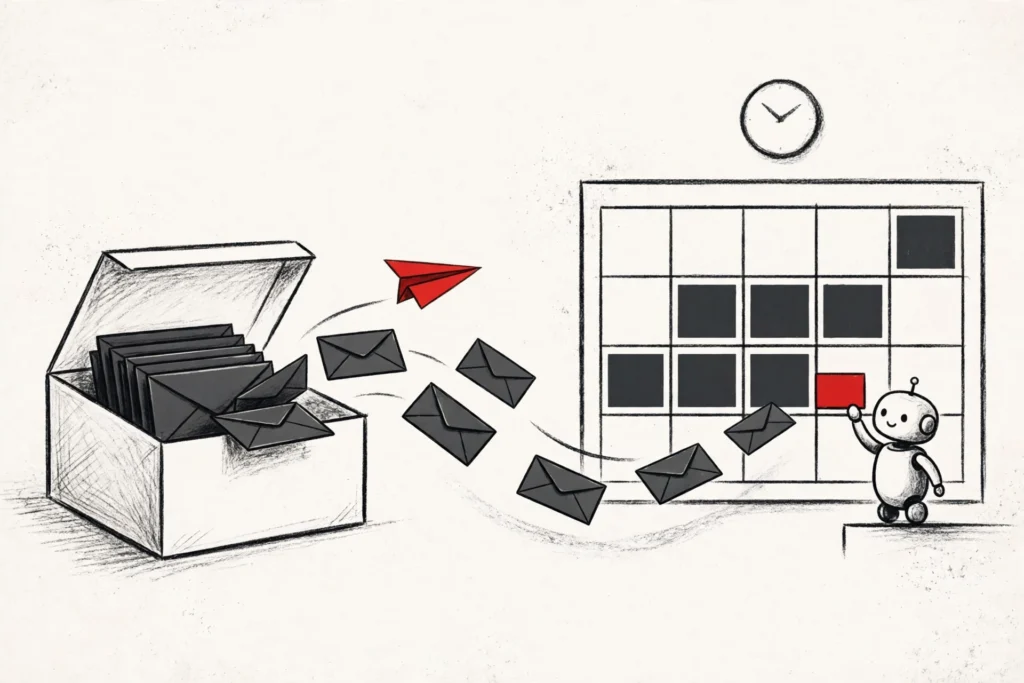
That assistant is Howie, a Seattle startup built around a simple idea. You do not open a new app to schedule a meeting. You loop an AI into the email conversation, the way you would loop in a human secretary, and it handles the rest.
Google has now bought the company behind it. The deal was announced on Monday, November 16, 2026, and the small scheduling assistant is joining Google Labs, the company’s experimental arm. The financial terms were not disclosed.
Why Google Buys Howie Now
The announcement came quietly, in matching posts on X from Google Labs and Howie, rather than with a press release. Google Labs said it “can’t wait to learn from them as we build the next generation of intuitive AI tools together for small businesses.”
Bloomberg first reported the transaction, and the deal fits a pattern that has defined Google’s year. The search giant is buying small, focused AI agents and folding them into its own products, instead of building every capability from scratch.
Howie is a neat fit for that strategy. It already lives inside the two products Google owns outright: Gmail and Google Calendar. It does not ask users to change how they work. It meets them in the inbox, where the scheduling problem starts.
The price Google paid has not been made public. PitchBook data cited by Bloomberg valued Howie at $14 million in 2024, a modest figure by the standards of this year’s AI deals. Google is not buying revenue here. It is buying a team, a working product, and a way of thinking about agents.
How the Assistant Actually Works
Howie was founded around 2023 by Austin Petersmith, its chief executive, and Dave Newman, its chief technology officer. The company raised a $6 million seed round led by True Ventures in September 2025, when it also launched publicly out of private beta.
The product’s pitch is deliberately boring, and that is why it works. A user copies Howie into an email thread, and the assistant reads the conversation, proposes times, checks everyone’s calendars, and books the meeting. There is no scheduling link to send and no back-and-forth about availability.
For a freelancer or a small business, that removes one of the most tedious parts of the working week. Scheduling a single meeting can take five or six emails. Multiply that across a team of ten, and the lost hours add up fast.
The company focused on small businesses from the start. Its site lists a Team plan at $25 a month, aimed at shared workspaces rather than giant enterprises. That focus matters, because Google’s own productivity tools have often been built for large organisations first.
Google Howie and the Race to Build AI Agents
The acquisition lands in the middle of an industry-wide race to turn AI chatbots into AI agents: software that does not just answer questions, but takes action on your behalf. Scheduling is one of the most obvious places for that idea to work.
Google has been moving quickly on this front. In May 2026, it released Gemini Spark, an agent that proactively completes tasks such as scanning an inbox, organising files, or building a spreadsheet. Gemini Tasks later brought much of that capability to free users, letting the assistant call businesses and book appointments.
Howie adds something those products do not quite have. It is a specialist, not a generalist. It does one job, scheduling, and it does it inside the email thread where the conversation is already happening. That is a different design philosophy from a do-everything assistant.
The competition is not standing still either. Anthropic has been pushing its Claude office suite deeper into workplace software, while OpenAI has spent the year turning ChatGPT into a platform for business tools.
Our report on Claude office suite and OpenAI’s response shows how fast the workplace AI race is moving, and ChatGPT Enterprise on AWS Marketplace shows how aggressively these tools are being sold.
What Happens to Howie Customers?
For now, the honest answer is that nobody outside Google and Howie knows. Neither side has published a product roadmap, a pricing change, or a timeline for folding Howie into Gmail or Calendar. The only commitment on record is Howie’s own line that it will keep serving its existing customers.
That silence is normal for a Google Labs acquisition. The division is Google’s experimental workshop, where small teams are given room to keep building before their work is folded into a flagship product. Howie’s homepage now reads “Howie, now part of Google Labs.”
Existing customers have reason to be cautiously optimistic. Google bought a product that already runs on its own mail and calendar systems, so there is no awkward migration to plan. The risk, as with any small acquisition, is that the standalone product slowly fades as its features are absorbed into a bigger one.
Petersmith said his team will “continue building” the tool at Google. That wording matters. It suggests the team was not bought to be shut down, but to keep doing what it was doing, with far more resources behind it.
Why This Small Deal Matters
On the surface, buying a startup valued at $14 million is barely a footnote for a company of Google’s size. It would not make headlines in a year when AI deals are measured in billions. But small acquisitions like this one often say more about a company’s direction than the big ones do.
Google is signalling that it believes the future of productivity software is agentic, and that the agents people actually use will be the ones that fit into existing habits. Nobody wants to learn a new scheduling app. Everybody already lives in their inbox.
There is also a defensive logic to the deal. If AI scheduling becomes a standard feature of every email client, Google cannot afford to let a rival buy the team that does it best. Bringing Howie in-house keeps the capability inside Google’s walls.
The deal also shows how the AI talent market has changed. Two years ago, the most valuable startups trained giant models. Today, some of the most sought-after teams build narrow, practical tools on top of those models. Howie never trained a frontier model. It built a useful product, and Google came calling anyway.
What Comes Next for Google Howie
The most likely next step is a quiet one. Watch for Howie’s scheduling smarts to appear inside Gmail and Google Calendar, perhaps first as a Labs experiment and later as a standard feature. Google has a long habit of testing new ideas in Labs before rolling them out widely.
A second possibility is that Howie becomes part of a broader small-business push. Google Labs explicitly mentioned small businesses in its announcement, and that audience has often been underserved by AI tools built for enterprises. A scheduling assistant that works from the inbox could be the first of several Labs tools aimed at that market.
For users, the practical advice is simple. If you already use Howie, nothing changes today. If you have been waiting for AI scheduling to arrive in Gmail, this deal makes it more likely, and probably sooner than you think. The meeting that used to take six emails may soon take none at all.
Google’s purchase of Howie will not reshape AI overnight. But it is a clear bet on a specific vision: AI assistants that live in the tools you already open every morning, not in a separate app. According to GeekWire, the deal was announced on November 16, and the team is now part of Google Labs.
Source: GeekWire


