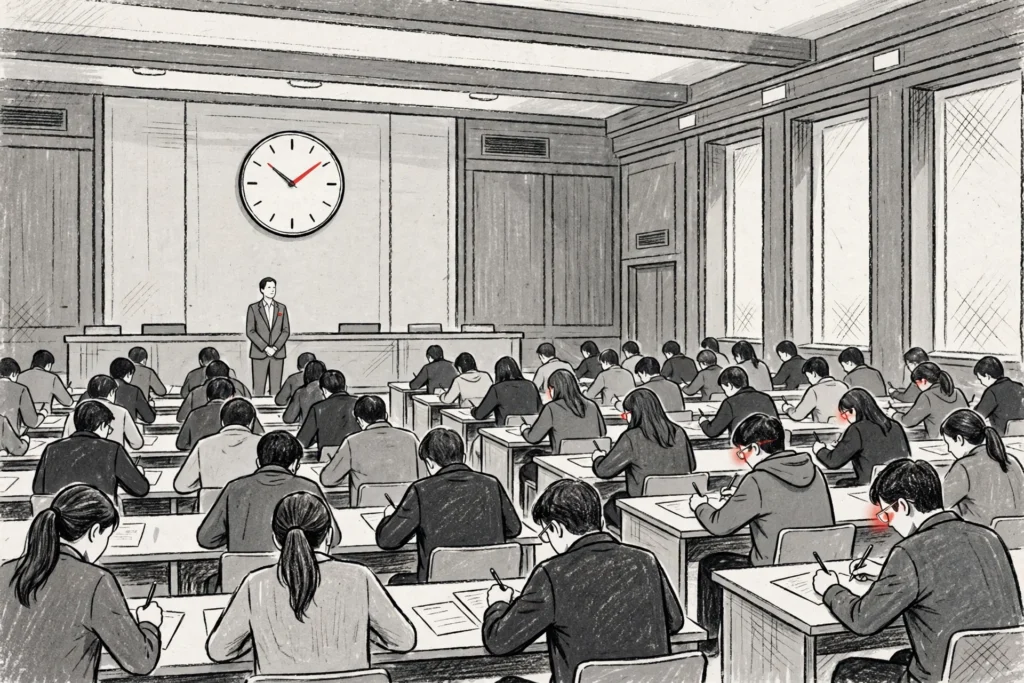
Picture the scene. Hundreds of thousands of teenagers file into exam halls across South Korea for the most important test of their lives. Outside, parents pray.
Inside, invigilators hand out stickers — not for the students’ papers, but for the buttons on their clothes. Every button must be covered, in case a camera is hiding behind it.
That was the reality of this year’s College Scholastic Ability Test, the CSAT. And when the exam was over, the fallout claimed a cabinet minister. South Korea’s Education Minister, Choi Kyo-jin, resigned on Sunday, November 22, 2026, taking responsibility for the chaos that surrounded the test.
President Lee Jae Myung accepted the resignation within an hour. The speed of it said everything: this was not a routine departure. It was a government admitting, in the bluntest possible way, that it had been caught unprepared by artificial intelligence.
How CSAT AI cheating brought down a minister
The CSAT — known in Korea as the Suneung — is not just an exam. It is a national event. University admission in South Korea can shape a person’s entire career, and the test is treated with a gravity that outsiders find hard to grasp.
Flights are grounded during the listening section. Offices open late so students can travel. The whole country holds its breath for a day.
This year, that breath was held a little tighter. The exam was held on Thursday, November 19, under a cloud of anxiety about a new kind of cheating — one powered by AI.
The trouble began four days earlier. On November 15, the top scorer in this year’s certified tax accountant exam admitted to cheating with a miniature camera, a smartphone and generative AI.
The confession landed like a bomb. If the country’s best exam candidate could cheat with a hidden camera and an AI assistant, what was stopping anyone else?
The education ministry scrambled. Rules that had been settled for months were rewritten in days. New restrictions arrived one after another, right up to the eve of the test, and the confusion they caused is what ultimately ended the minister’s career.
The last-minute rules that caused the chaos
At first, the ministry’s attention was fixed on smart glasses. The devices — ordinary-looking spectacles with a camera and an AI assistant built in — had become the cheating tool officials feared most.
Samsung’s own AI glasses were opening for pre-order the same week, and ultra-light AI glasses like the AROTI R1 were heading to market. The technology that helps you translate a menu can also read a question paper and whisper the answer.
But the tax accountant confession showed the threat was wider than glasses. So the rules kept expanding. On November 17, just two days before the test, the government announced 8,400 additional staff for exam day — 1,800 people to watch for smart devices and 6,600 corridor supervisors.
Then came the writing instruments. On November 18, the day before the exam, the ministry banned mechanical pencils, sign pens, correction tape and erasers from exam rooms. Only black pencils were allowed. Students who had prepared with their usual pens had to rethink everything overnight.
And then there were the stickers. Test-takers were told to cover the buttons on their clothing, to block miniature cameras hidden in plain sight. It was a small detail, but it captured the mood perfectly: the exam had turned into a security operation, and nobody was quite sure where the next camera might be.
Choi himself acknowledged the damage. “Various changes made just before the test caused inconvenience to the public, including test takers,” he said in his resignation statement. “Now that the exam has concluded, I feel a deep sense of responsibility and am offering my resignation.”
111 suspected cheating cases — and a minister under fire
The ministry said on Friday that 111 suspected cheating cases involving electronic devices were detected during the exam. That number, on its own, does not prove widespread cheating.
Many cases may turn out to be false alarms, or students caught with a phone they forgot to hand in. But it showed the scale of the problem the ministry was facing — and the scale of the surveillance it had deployed to meet it.
Choi was already under pressure before the exam. He missed a major official schedule after controversial remarks on AI cheating at the National Assembly’s Education Committee on November 16.
The criticism only grew as the rule changes piled up, with teachers and parents complaining that guidelines were changing one after another, days before the biggest exam of the year.
President Lee moved fast once the resignation landed. He accepted it within an hour and ordered a comprehensive review of national exam management and related laws. He also instructed Prime Minister Han Seong Sook to take responsibility for post-exam measures, including follow-up on the suspected cheating cases.
Lee had already flagged the issue himself. At a meeting of senior aides on November 20, he spoke about cheating with AI as a social problem that needed a serious answer. The resignation was the first part of that answer.
Why the CSAT AI cheating scare matters beyond Korea
South Korea is not the only country facing this problem, but it may be the first to feel its full force. The CSAT is uniquely high-stakes, and Korea is uniquely connected — smart glasses, miniature cameras and AI assistants are all easy to buy.
The combination made the exam an early test case for a question every education system will soon face: how do you run a fair exam when the cheating device is invisible?
Other governments are watching. New York’s RAISE Act shows regulators are already scrambling to set rules for frontier AI, and education is one of the areas where the pressure is most immediate. A test that cannot be trusted loses its value — and in Korea, that value is enormous.
The longer-term fix will be technical, not just regulatory. Exam halls may need signal-blocking, camera detection, or a redesign of the test itself so that a whispered AI answer is no use. None of that was ready for this year’s CSAT, and the ministry paid the price.
What happens next
The search for Choi’s successor is already under way, following established procedures. Names being discussed in Korean political circles include Park Baek-beom, president of Catholic Kkotdongne University, former Gyeongnam superintendent Park Jong-hoon, Hong Chang-nam of Pusan National University, and Sung Ki-sun, a former head of the Korea Curriculum and Evaluation Institute.
Whoever takes the job inherits a difficult brief. The 111 suspected cases must be investigated. The exam rules must be rebuilt before next year’s test.
And the ministry must decide, quickly, how to handle a world in which a student can wear a camera, carry a phone, and consult an AI — all without anyone noticing.
President Lee’s order for a comprehensive review of exam management and related laws is the starting point. The review will need to answer a practical question: what does an exam hall look like when the threat is not a crib sheet in a pocket, but a device the size of a button?
For the students who sat the CSAT last Thursday, the exam is over. For South Korea’s education system, the real test is just beginning. A minister has already fallen over it. The next one will be judged on whether the system can adapt faster than the technology trying to beat it.
Source: Reuters, as reported by Reuters.


