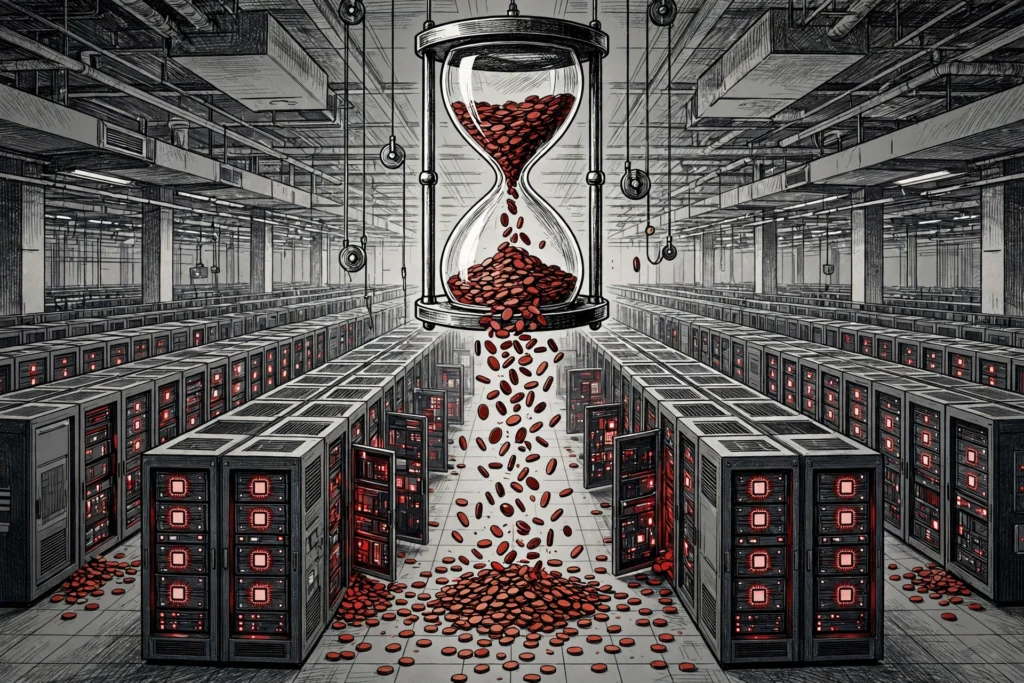
The Saturday Warning That Shook the AI Boom
Picture a warehouse the size of a small town, somewhere in the desert outside Phoenix or on the plains of Texas. Row after row of gleaming graphics processors hum inside, each one worth more than a family car. The power is on. The cooling systems are running. The bills are being paid every single day — and almost no customers are paying for any of it yet.
That gap — between the money going out and the money coming in — is the heart of Elon Musk’s latest warning about the artificial intelligence industry. On Saturday, November 21, 2026, the Tesla and xAI chief took to X and told the world that the AI boom is heading for a cash crunch in 2027. His words were blunt, even by his standards. “It’s going to be nuts,” he wrote.
Musk was not warning about a collapse in demand. He was warning about something far more ordinary, and far harder to fix: time. The AI industry, he argued, is paying for its future months before that future starts paying it back. When the sums run into the hundreds of billions, a delay of a few months can become a financial emergency.
What Musk Actually Said on X
The warning came in a public exchange with François Chollet, the AI researcher behind the Keras deep-learning framework. Chollet had argued that demand for computing capacity remains strong, pointing to rising spot prices for graphics processing units and memory chips effectively sold out through 2029.
Musk did not disagree. Instead, he shifted the conversation to the part nobody likes to talk about: the plumbing. “Getting this amount of compute turned on, cooled and working reliably is incredibly hard,” he wrote, according to the Financial Express. Then came the line that travelled around the world within hours.
“The cash shortage is also going to be nuts next year. Even cumulative industry delays of a few months between paying for compute and getting it reliable enough to generate revenue will mean hundreds of billions of incremental dollars just for working capital. Where will that come from?”
Working capital is the cash a business needs to keep the lights on between paying its suppliers and collecting from its customers. For the AI industry in 2027, Musk is saying, it could be a bill worth hundreds of billions of dollars — and nobody has explained where that money will come from.
Why the AI Cash Crunch Is a Timing Problem, Not a Demand Problem
To understand Musk’s argument, forget the models for a moment and think about the sequence of events. A company that wants to sell AI computing must first buy the chips. Then it must build or lease a data centre, secure power, install cooling systems, wire everything together, and test it until it works reliably.
Only then can it start charging customers. Every one of those steps takes months, and every one of them can slip. A grid connection can be delayed. A cooling system can underperform. A shipment of chips can arrive late. And while the project waits, the interest on the borrowed money keeps ticking.
Musk’s point is that the industry is not short of customers. It is short of finished, revenue-generating capacity. The demand is real — Chollet’s point about sold-out memory production proves that much. But demand does not pay the electricity bill. Only working, reliable, customer-facing compute does, and there is a long, expensive road between ordering a GPU and earning money from it.
A Trillion-Dollar Buildout on Borrowed Money
The scale of the spending behind Musk’s warning is hard to overstate. Research firm IDC said global AI infrastructure spending reached $121.4 billion in the second quarter of 2026 alone, up 53 percent from a year earlier. It raised its full-year forecast for 2026 to $521 billion.
The International Energy Agency, in its April 2026 report on energy and AI, said capital expenditure by five major technology companies exceeded $400 billion in 2025 and was expected to rise by another 75 percent in 2026. Morgan Stanley estimates hyperscaler capital spending at roughly $800 billion to $900 billion in 2026, rising above $1 trillion in 2027.
Much of that spending is being funded with debt. Goldman Sachs data cited in recent reporting puts global AI-related debt issuance at nearly $600 billion so far in 2026, with AI capital expenditure nearing $1 trillion for the year. Goldman also expects more than $400 billion of hyperscaler debt issuance in 2027, alongside about $300 billion of global AI project financing.
Barclays calculated that the big five hyperscalers spent about 40 percent of their operating cash flow on capital expenditure in 2023. By 2027, the bank projects that figure will reach roughly 90 percent, leaving far less cash for dividends, buybacks, debt service and mistakes.
Musk himself is one of the biggest borrowers in the sector. In October 2026, SpaceX disclosed that it had closed roughly $40 billion in debt financing, mostly earmarked for GPU purchases expected to be deployed in early 2027. On November 20, Apollo Global Management and Goldman Sachs priced about $44 billion of notes to buy Nvidia’s Vera Rubin chips for SpaceX.
Power, Cooling and the Months Nobody Budgets For
If the money is the first problem, power is the second. The International Energy Agency estimated that global data-centre electricity consumption would rise from 485 terawatt-hours in 2025 to around 950 terawatt-hours by 2030. S&P Global Market Intelligence has highlighted grid connection delays, power shortages and local opposition as obstacles, and it expects annual net additions to US and Canadian data-centre IT power capacity to reach around 20 gigawatts in 2027, against approximately 8 gigawatts in 2026.
Cooling is the quieter constraint. Modern AI chips run hot, and the cooling systems that keep them alive are complex, expensive and slow to install. Musk’s phrase — “turned on, cooled and working reliably” — is doing a lot of work in his warning. Each condition is a project in itself, and each can add weeks or months to a schedule that was already optimistic.
Who Gets Hurt First — and Who Doesn’t
Not everyone in the AI industry faces the same risk. The largest cloud companies have enormous cash reserves, diversified revenues and direct access to capital markets. They can absorb delays that would sink a smaller rival.
The danger, Musk has argued before, concentrates among the smaller players. In October 2026, responding to venture capitalist Chamath Palihapitiya on X, he predicted that “200+ neoclouds are going to see guppy-level death and consolidation” — the many small companies renting out AI compute on borrowed money will be swallowed or wiped out when financing tightens.
That is the scenario Musk’s warning describes: companies that borrowed heavily to buy GPUs, then discovered that the data centres to house them were not ready, the power was not connected, or the cooling did not work. The chips sit idle. The debt payments do not stop. And the revenue that was supposed to cover both never arrives.
There is an irony here that Musk himself acknowledged. Once AI compute is actually running, it can be very profitable. He noted that inference — running trained models for customers — delivers margins of 70 to 85 percent. The business works. The problem is surviving the gap between paying for it and getting paid for it.
What Happens Next
Musk’s warning is a prediction, not a fact. No part of the 2027 cash crunch he describes has happened yet, and it is worth remembering that he has a direct interest in the debate: SpaceX is one of the sector’s heaviest borrowers, and xAI is one of its biggest spenders on compute.
Still, the warning lands at a moment when scepticism about AI spending is already growing. Earlier this month, Goldman Sachs warned about AI stocks, and reports on this site have tracked AI shares falling after the bank’s caution and AI server prices jumping 45 percent after contracts were signed. Meanwhile, the neocloud model that Musk says is most at risk has been producing eye-catching results — CoreWeave’s revenue jumped 168 percent in the third quarter — even as its losses widened and its debt pile grew.
If the delays stay small and the financing keeps flowing, the warning will look like a false alarm from a man who profits from attention. If they do not, the industry will discover that the hardest problem in AI was never building a smarter model. It was paying for the machines that run it — and surviving long enough for the customers to arrive. As Musk put it, the question is simple: “Where will that come from?” The industry has about a year to find an answer.


